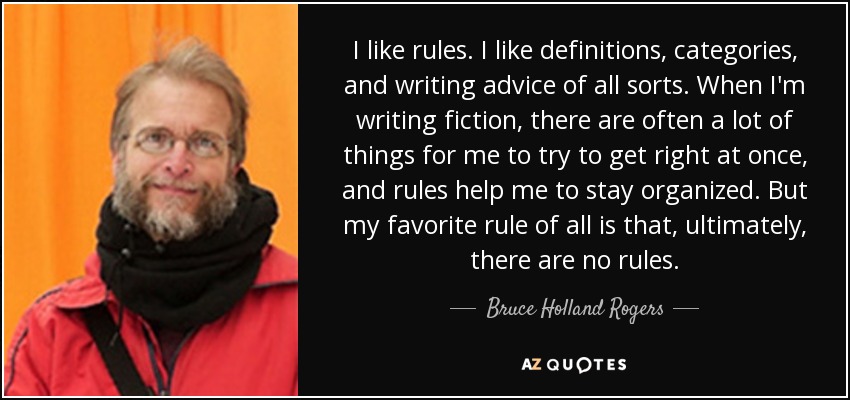
I like rules. I like definitions, categories, and writing advice of all sorts. When I'm writing fiction, there are often a lot of things for me to try to get right at once, and rules help me to stay organized. But my favorite rule of all is that, ultimately, there are no rules.
The most difficult part of writing a book is not devising a plot which will captivate the reader. It's not developing characters the reader will have strong feelings for or against. It is not finding a setting which will take the reader to a place he or she as never been. It is not the research, whether in fiction or non-fiction. The most difficult task facing a writer is to find the voice in which to tell the story.
Funny how the world always praises its opera-singers so much and pays 'em so well and then starves its shoemakers, and yet it needs good shoes so much more than it needs opera--or war or fiction.
The symmetry of form attainable in pure fiction can not so readily be achieved in a narration essentially having less to do with fable than with fact. Truth uncompromisingly told will always have its ragged edges.
Fiction writers, at least in their braver moments, do desire the truth: to know it, speak it, serve it. But they go about it in a peculiar and devious way, which consists in inventing persons, places, and events which never did and never will exist or occur, and telling about these fictions in detail and at length and with a great deal of emotion, and then when they are done writing down this pack of lies, they say, There! That's the truth!
In a sense, all fiction is experimental. Every new book is an adventure into unknown territory. As Hemingway told us, you (the writer) have to go out beyond where you have gone before.
My feeling about fiction, regardless of the genre, is that it is meant to be a representation of life. I want my books to give a whole spectrum of experiences to my readers. Not just fear or terror or revulsion, but excitement, laughter, pain, sorrow, desire, etc.
Corporations are not legal "persons" with constitutional rights and freedoms of their own, but legal fictions that we created and must therefore control.
Physics has entered a remarkable era. Ideas that were once the realm of science fiction are now entering our theoretical and maybe even experimental grasp. Brand-new theoretical discoveries about extra dimensions have irreversibly changed how particle physicists, astrophysicists, and cosmologists now think about the world. The sheer number and pace of discoveries tells us that we've most likely only scratched the surface of the wondrous possibilities that lie in store. Ideas have taken on a life of their own.
Topiary has always seemed like a good occupation, comparable in some ways to writing short fiction.
I often use detective elements in my books. I love detective novels. But I also think science fiction and detective stories are very close and friendly genres, which shows in the books by Isaac Asimov, John Brunner, and Glen Cook. However, whilst even a tiny drop of science fiction may harm a detective story, a little detective element benefits science fiction. Such a strange puzzle.
Expectation is a statistical fiction, like having 2.5 children.
Isherwood did not so much find himself in Berlin as reinvent himself; Isherwood became a fiction, a work of art.
When a story has gone the grand circuit, and travels back to us uncontradicted, we may reasonably begin to relax in our belief of it. If nobody questions it, it is manifestly a fiction; if it passes current, it is almost sure to be a counterfeit. The course of truth never yet ran smooth.
As success converts treason into legitimacy, so belief converts fiction into fact, and "nothing is but what is not.
Blade Runner is a rare science fiction movie so full of material that pages can be written about it without scratching the surface. A review like this can provide little more than an overview. A detailed exploration of the movie, its style, and its mysteries requires dedication that only someone immersed in Blade Runner lore can provide.
Although The Terminator is arguably the more visionary of the first two films, [Terminator 2] is the more visually and viscerally satisfying. It's an exhausting experience and, even 18 years after its release (as I write this review), few films have matched it within the science fiction genre for sheer white-knuckle exhilaration.
Fictions of law must be consistent with justice.
C.S. Lewis says that fiction is able to sneak past the watchful dragons of religion. It becomes more powerful to speak in poetry. The song goes straight to the heart while the numbers and the math of it will never be able to reach that.
Science fiction is hard to define because it is the literature of change and it changes while you are trying to define it.
Everything I had read in the fields of fiction and science led me to a single, dark conclusion. Humans are screwed, and so is our planet.
Yeah, I know what your English Professor tried to tell you. But if your English Professor could make a living writing fiction, they would have been doing it.
In high school I was drawn to the study of literature, poetry Shakespeare, contemporary fiction, drama, you name it - I read it.
I took the liberty in Snowboarding to Nirvana to do a type of parody of what I suppose you would call "New Age fiction."
I enjoy the writings of all of these authors and they have been very inspirational for me. But I think that it is important as writers of metaphysical, New Age, occult fiction and nonfiction to not take ourselves too seriously.
Follow AzQuotes on Facebook, Twitter and Google+. Every day we present the best quotes! Improve yourself, find your inspiration, share with friends
or simply: