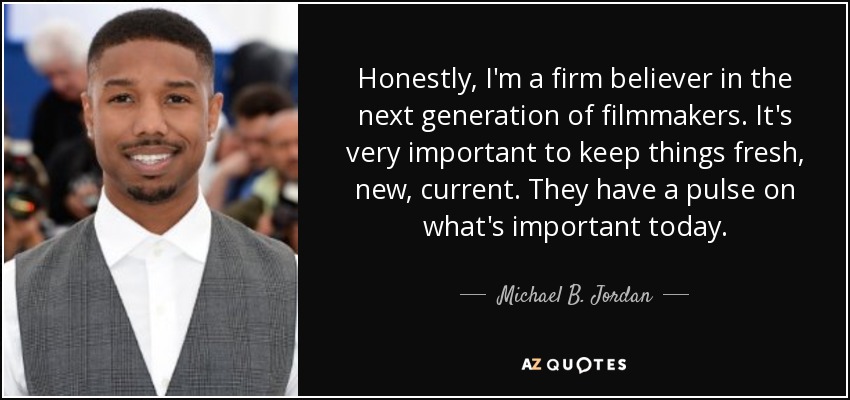
Honestly, I'm a firm believer in the next generation of filmmakers. It's very important to keep things fresh, new, current. They have a pulse on what's important today.
I feel like God has intrusted a lot into me and I don't want to sit on it and be selfish. I want to think long term on how we can help this next generation of Christian filmmakers to make a big impact for God.
For a lot of filmmakers, their first goal is to be successful and make some money. But once people start doing that, the real goal is then to win an Academy Award. Because when they do, they know that their obit is going to start out, "Academy Award winner so-and-so."
My background is in like short form digital media, I call myself more of a digital filmmaker than anything else.
I think every filmmaker in Europe would be lying if they didn't say one day they just wanted to make a movie here in Hollywood or at least try it. It's very different from European filmmaking, because here it's like a real industry. It's very much about money and making money, which I think is fine, because it's very expensive to make movies.
When you are a filmmaker, you need to be rooted, because committing yourself to producing or directing a film is a good three-year process.
I have wondered if I might be placed on a watch list of some sort by the government, though. I know that the documentary filmmaker Laura Poitras, who is a friend and who has made documentaries about controversial Middle Eastern terrorists has had trouble at customs when she travels internationally - but nothing like that has happened to me.
I think [ Lars Von Trier] is a fantastic filmmaker. No question. You've got to be ready for him. He's sharp and he's got a sharp tongue and I love that. He doesn't mind it back.
I want to see more young filmmakers, and specifically filmmakers who have a unique voice. I wouldn't mind seeing less of the attempt to force-feed people what others think they want, if that makes sense - whatever the formula is that some people seem to operate under, like needing a certain star, or needing a certain thing in order to get a piece made.
The filmmaker Amos Poe was a huge inspiration for me by making guerrilla-style punk films on the streets of New York and - well, it's just a lot of painters and artists and filmmakers all within that scene, and it's very, very important to me.
One thing we haven't mentioned is something everyone should understand very clearly. Look at the budget that was invested in 'Avatar': who in China has that kind of money to spend on making a movie? So we as Chinese filmmakers should work together to make Chinese movies that can compete as best we can for Chinese audiences, not make lousy movies, but make the best we can for that audience. Concentrate the money, the talent we have on making good movies [for China].
A good filmmaker is someone who can look at a piece and go, "This camera's really going to be a character. I want people to feel like they're being punched."
Long, long before I became a filmmaker I was talking to killers. Filmmaking was an after thought.
For me, as a documentary filmmaker, I'm interested in telling stories of real people whose experiences tell us something about ourselves or our history, or who we are and our potential.
One of my beliefs as a filmmaker is that if you can make somebody laugh, you can make them listen. With laughter, you can get somebody's guard down, you can open them up to listening to you. They don't feel like they're being preached to or talked down to. I think it helps, it makes really hard to understand information a little more accessible and palatable. And at the end of the day, it makes a movie a little more fun. It doesn't feel so heavy handed.
I do not think that my films or films by any other filmmaker represent "THE TRUTH." I do not feel the need to categorize my films or anyone else's.
What you hope, what you're trusting the filmmaker to do, is to capture the emotional truth of the situation.
[Sundance is] giving people a chance - many first-time filmmakers. It carries that weight - if you bring something here, people connect with it and it can launch a career.
I talked with [ Blair Macon] a lot. I always like to come up with it - sometimes the filmmaker is not into it at all.
When you do these things, you sort of take the journey. The journey is all about how I can interweave the Oscar Wilde story, the story of Salome, the play itself and what it is, what it contains, and my journey as an actor, as a director, as a filmmaker, as a person struggling with whatever I'm struggling with - my own celebrity, my own life. This is semi-autobiographical in terms of my commitment to this kind of thing.
If you want the film [La La Land ] to represent all things jazz, it does not. You'll be disappointed by that. But, if you just see it as one guy's point of view, one filmmaker's point of view, and one story among many stories that can be told about jazz, then it's not as much of an issue.
When I first saw a White Dutch person dressed up as Black Pete, I was both sickened and shocked. It's hard to stand next to someone who views your skin color and hair as a costume. As a filmmaker, whenever I get that feeling, I want to explore what motivates people to engage in such offensive behavior and enlighten folks about its origins.
Over the course of my career, I've had the great fortune of working with some incredible filmmakers who have protected me and inspired me and taught me what an honor it is to work in film.
Maybe today I would call Fred Leuchter and there would be two or three other documentary filmmakers interested in his story simply because of the exposure.
The filmmaker is not telling you what to think.
Follow AzQuotes on Facebook, Twitter and Google+. Every day we present the best quotes! Improve yourself, find your inspiration, share with friends
or simply: