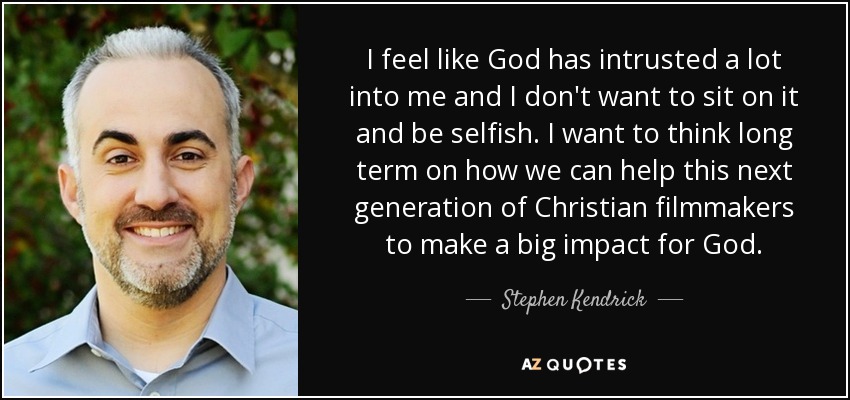
I feel like God has intrusted a lot into me and I don't want to sit on it and be selfish. I want to think long term on how we can help this next generation of Christian filmmakers to make a big impact for God.
I think there's been a gigantic shift in the way we talk to each other, and the way that we communicate with each other. So as a filmmaker, the stuff's always been really interesting to me, and I sort of considered a lot of my films horror films, the ones that were relationship dramas, because I feel like it was very easy to look at modern communication and the Internet and cell phones and all that stuff as horror movies, basically.
I was never a critic. I was a journalist and wrote about filmmakers, but I didn't review movies per se. I make that distinction only because I came to it strictly as someone who was just a lover of storytellers and cinematic storytellers. And I still am. I'm still a great movie fan, and I ,that love of movies is very much alive in me. I approach the movies I make as a movie-lover as much as a movie-maker.
I still consider myself to be an amateur filmmaker. And I say that because in the Latin origin of the word amateur is the word love, and it's love of a form, whereas professional implies something you do for money or for work.
I would not describe myself as a left-wing filmmaker. I don't think this is the first thing that would pop into my mind when talking about my work.
I think every filmmaker in Europe would be lying if they didn't say one day they just wanted to make a movie here in Hollywood or at least try it. It's very different from European filmmaking, because here it's like a real industry. It's very much about money and making money, which I think is fine, because it's very expensive to make movies.
What you hope, what you're trusting the filmmaker to do, is to capture the emotional truth of the situation.
The filmmaker Amos Poe was a huge inspiration for me by making guerrilla-style punk films on the streets of New York and - well, it's just a lot of painters and artists and filmmakers all within that scene, and it's very, very important to me.
I have wondered if I might be placed on a watch list of some sort by the government, though. I know that the documentary filmmaker Laura Poitras, who is a friend and who has made documentaries about controversial Middle Eastern terrorists has had trouble at customs when she travels internationally - but nothing like that has happened to me.
I talked with [ Blair Macon] a lot. I always like to come up with it - sometimes the filmmaker is not into it at all.
Long, long before I became a filmmaker I was talking to killers. Filmmaking was an after thought.
Along the way, a lot of filmmakers get rid of things that are messy or don't fit in some ways. To me, I want to work with serendipity and things we happened upon. That's our job, that's what the form demands.
I do not think that my films or films by any other filmmaker represent "THE TRUTH." I do not feel the need to categorize my films or anyone else's.
I've come to really believe that I have something to offer as a filmmaker, that goes beyond what I had to offer as an actress and maybe this is what I'm meant to do.
I love reading scripts and offering notes and opinions. I'd like to be an advocate for the emerging filmmakers whom I'm working with.
Honestly, I'm a firm believer in the next generation of filmmakers. It's very important to keep things fresh, new, current. They have a pulse on what's important today.
For me, as a documentary filmmaker, I'm interested in telling stories of real people whose experiences tell us something about ourselves or our history, or who we are and our potential.
A good filmmaker is someone who can look at a piece and go, "This camera's really going to be a character. I want people to feel like they're being punched."
When I first saw a White Dutch person dressed up as Black Pete, I was both sickened and shocked. It's hard to stand next to someone who views your skin color and hair as a costume. As a filmmaker, whenever I get that feeling, I want to explore what motivates people to engage in such offensive behavior and enlighten folks about its origins.
There are some filmmakers like the Coen brothers that are very precise. They make shooting boards, they do it shot by shot, and they follow every single line in their own script. They make amazing movies, and I admire them so much, but I can't do that. I have no idea how the movie will exactly be. While shooting, I just try to create an accident that I don't control very well - grabbing things from different sources and ideas, and then having a sensation somewhere that it will make sense.
Maybe today I would call Fred Leuchter and there would be two or three other documentary filmmakers interested in his story simply because of the exposure.
Sometimes I go to the cinema and I see a movie where the directors or the filmmakers are telling me what to think, what to feel. They are giving me all the answers, and I'm like, "What am I doing here?" I try to have an active audience that are thinking and feeling for themselves.
As a woman filmmaker it's pretty important that you have some basis of confidence that you're coming from, because, as I got closer to LA, there's less and less women. There's less and less mirrors for who you are.
Every time I get criticism from people, I learn from it and what to do the next time so there are fewer misconceptions. I'm continuing to be socialized as a woman, but also as a filmmaker.
I'm a visual filmmaker so the camera is a big part of my storytelling tool and it's something that I really rely on to tell a scene or create the suspense that I need and create the emotion of a scene or a sequence.
Follow AzQuotes on Facebook, Twitter and Google+. Every day we present the best quotes! Improve yourself, find your inspiration, share with friends
or simply: