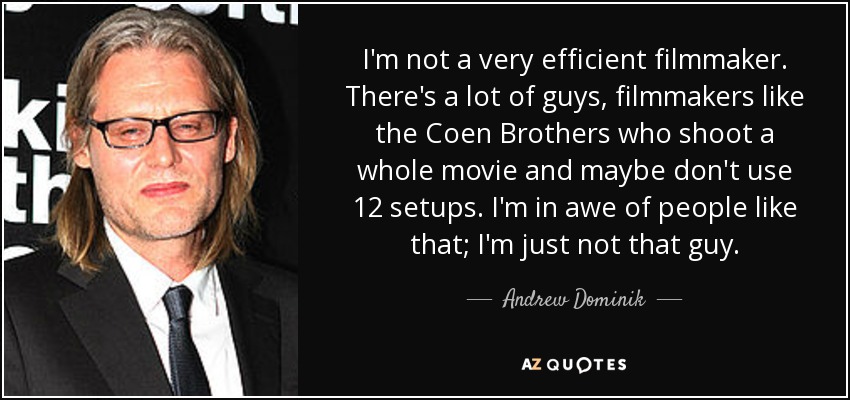
I'm not a very efficient filmmaker. There's a lot of guys, filmmakers like the Coen Brothers who shoot a whole movie and maybe don't use 12 setups. I'm in awe of people like that; I'm just not that guy.
Look at the people who are coming to television Ridley Scott, Ang Lee or Guillermo del Toro - all these great filmmakers - actively put themselves back into TV. That's because the environment is very encouraging for bold storytelling, storytelling that you've never seen before.
What is my intention being a filmmaker? To make as much money as possible, or get as much attention as possible? It's not really either of those things. Now I can tell the stories that I want to tell.
[Steven Spielberg's films] are comforting, they always give you answers and I don't think they're very clever answers. The success of most Hollywood films these days is down to fact that they're comforting. They tie things up in nice little bows and give you answers, even if the answers are stupid, you go home and you don't have to think about it. The great filmmakers make you go home and think about it.
Despite his reputation as one of America's foremost "serious" filmmakers, Oliver Stone's name under the "director" caption does not guarantee a good movie. I learned that lesson while enduring the seemingly-endless tedium of The Doors, and was reminded of it during some of the long, drawn-out portions of JFK. However, nothing that Stone has directed or misdirected prepared me for the grotesque mess that is Natural Born Killers.
For any filmmaker who has just released a film and who is experiencing some measure of success, the temptation can be great to respond to every screening request that comes in.
The ABCs of Death offers us a chance to work closely with a large number of visionary filmmakers to create a film with more jaw-dropping moments than a whole summer of blockbusters.
I have always admired him (Bergman), and I wish I could be an equally good filmmaker as he is, but it will never happen. His love for the cinema almost gives me a guilty conscience
I come from a documentary background and my natural tendency, as a filmmaker, is to make a movie, if I have something to talk about. If it's not about anything that matters, I don't feel like doing it. I'm not against people who make movies just for fun, but I'm not one of those guys. I just want to provoke thinking and debating about certain issues.
There's no such thing as "an auteurist filmmaker." Every film directors is an auteur. We only make films that we do because we cannot put on clothes that don't fit us.
It's exciting to try to do something in a totally different way - to bring out something totally different in me as a filmmaker. It's time to try something totally different.
If you have to become a filmmaker, find a story that takes you away, and tell that story. Don't think about whether it's going to sell, or whether it's going to make money, or whether it's going to appeal to distributors. Do something from the heart that really matters, and then you'll do something good.
I encourage first time filmmakers to be ambitious and take chances and risks, because you never know where your career is going to go.
Both as a filmmaker and as a fan I love the behind-the-scenes stuff, I like it even more than deleted scenes frankly. Especially when you're happy with the movie and you're proud of it, those deleted scenes give you also a sense of the making of the film and the process through which you end up with the final product.
I love making films. I'm happiest when I'm doing it. For me, the fear is not being able to make the next thing and not being able, as a woman filmmaker and as a filmmaker of color, to put together the resources to make another thing.
As an artist, I like working with filmmakers that have the balls to kind of imagine the unimaginable. Those are kind of the radicals that I identify with.
As a filmmaker you have to keep asking yourself the question are we really going to impress them [audience] either by the wow factor, the intelligence factor, the I didn't see that coming factor?
I think filmmakers all secretly wanna be musicians and all musicians secretly wanna be filmmakers.
As people, [my parents were] very colorful, very talkative, passionate, they really loved each other. But that also meant heated, it meant there was a lot of drama in the house. Which is good for a filmmaker, I think.
You should always make it like it's your last film. That's my personal belief. Every filmmaker is going to have another belief... That's the only way I know to try to make a film that might be good. You got to take it real seriously like it's your last thing.
I think the purpose of test screenings is different for the studio and for the filmmaker. For the studio, I think they want to know whether the film works or not.
Im free - but Im also not free because there are millions of young people living in Iran. A filmmaker can only do a little.
I'm very fortunate to have the privilege of working with directors like Bill Condon and Paul Thomas Anderson, who I think is one of the greatest filmmakers of our time.
I just want to work with good filmmakers and do good projects that mean something to me and play interesting characters. That's really it.
Making African American films are hard in Hollywood. We need to rely on a support network and bring more cohesion to different filmmakers, actors, producers etc. It's a very difficult business. There aren't a lot of Africans Americans or people of color in high positions in Hollywood that we can green-light films.
Follow AzQuotes on Facebook, Twitter and Google+. Every day we present the best quotes! Improve yourself, find your inspiration, share with friends
or simply: