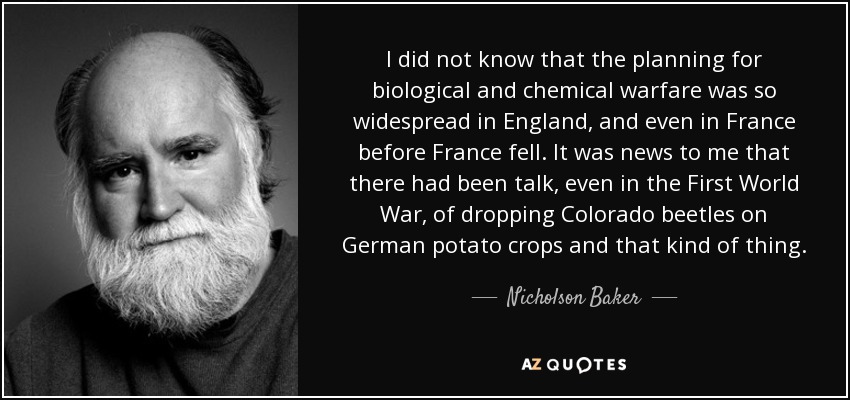
I did not know that the planning for biological and chemical warfare was so widespread in England, and even in France before France fell. It was news to me that there had been talk, even in the First World War, of dropping Colorado beetles on German potato crops and that kind of thing.
All the people of all the nations which had fought in the First World War were silent during the eleventh minute of the eleventh hour of Armistice Day, which was the eleventh day of the eleventh month. It was during that minute in nineteen hundred and eighteen, that millions upon millions of human beings stopped butchering one another. I have talked to old men who were on battlefields during that minute. They have told me in one way or another that the sudden silence was the Voice of God. So we still have among us some men who can remember when God spoke clearly to mankind.
If you look at the First World War, the Kaiser was actually, actively buying a lot of the armaments from Britain! in the years, in the run-up to the First World War. And I mean, there was a connection there. He was, indeed, Queen Victoria's grandson. You know, they were all related, all these royal families.
The First World War began because one man was shot. The Second World War began because of a mad German dictator. Who knows how a third could start. There are also people who think that the war has been going for a long time.
England Their England by AG Macdonell which was written in the thirties and is about a young Scotsman who's got shell shocked during the First World War I love it.
... there was the first Balkan war and the second Balkan war and then there was the first world war. It is extraordinary how having done a thing once you have to do it again, there is the pleasure of coincidence and there is the pleasure of repetition, and so there is the second world war, and in between there was the Abyssinian war and the Spanish civil war.
The period after the First World War was an extremely different time, so that Sherlock Holmes would have been a different person following 1918 than he was during the Victorian era.
During the first World War women in the United States had a chance to try their capacities in wider fields of executive leadershipin industry. Must we always wait for war to give us opportunity? And must the pendulum always swing back in the busy world of work and workers during times of peace?
My entire life has really revolved around music that was written about the time that I was born, 1908, to just before the First World War and shortly after it. This music I've always known, and it is that music that's most important to me.
What is the great fear of the United States? That an Eastern power will build a navy to challenge us. How do you keep them from doing that? Keep them at each other's throats so they don't have any money to do this. This is why we fought the First World War, the Second World War, and the Cold War.
The idea that Christianity is basically a religion of moral improvement... has its roots in the liberal Protestantism of the late nineteenth century and early twentieth century... It is this stereotype which continues to have influence today... But then came the First World War... What had gone wrong was that the idea of sin had been abandoned by liberal Christianity as some kind of unnecessary hangover from an earlier and less enlightened period in Christian history.
Fox hunting, there's big fox hunting thing, there's arguments in Britain about fox hunting. And they go around. They obviously hunt foxes because the foxes, they attack chickens. And posh people have an alliance with chickens just like in the First World War.
After the First World War, Germany was trying to build a democracy. Then when the Reichstag, the legislature, was burned down in 1933, this was seen as such an emergency that human rights had to be suspended. The attack on the World Trade Towers has allowed Bush and his gang to do anything. What are we to do now? I say when there's a code red, we should all run around like chickens with our heads cut off. I don't feel that we are in any great danger.
Not only in America but in Germany, in France since the war, in Germany after the First World War, the Germany of Adenauer, these are the creative relationships of Catholicism to a free society that the average American doesn't fully appreciate.
Today people can see and protest all the different interests that want war to happen, the people it financially benefits. The First World War wasn't fought for that reason. The Second World War wasn't fought for that reason. Your entire country and way of life could be overtaken.
Up until the First World War, when people turned anti-German, Germany had been described by American political scientists as the model of democracy.
Arthur Scargill is the Labour movements nearest equivalent to a First World War General.
There is a difference between Iraq, where you have Sunni, Shia, and Kurds put together after the First World War by the Western powers. It doesn't work. It needs to break up into three parts.
Perhaps this is an area where every generation starts from scratch. Although the crisis of the First World War inaugurated an especially strong period of disillusion with regard to the optimism of the previous age, the pattern has repeated itself in many ways in more recent times, e.g., the loss of faith in politics as a means of advancing human well-being. And perhaps this also has to do with basic elements in growing up.
After the First World War, it was, like, let's form the League of Nations, we have to learn to work together. It's the only way we're going to survive. And now it's like we're undoing these very fragile institutions that were built after the First and Second World Wars that were about nations working on a kind of global diplomacy for our mutual benefit. And we're undoing them at such rapid-fire pace.
Speaking of [Philip] Larkin, in his poem about the First World War he wrote something like, "Never such innocence, before or since, that turned itself to past without a word".
The first World War in so many ways shaped the 20th century and really remade our world for the worse.
Ten thousand officers and men named Smith died in the First World War. One thousand four hundred Campbells died, six thousand Joneses, and one thousand Murphys. Smith, Campbell, Jones and Murphy: the names of the United Kingdom, whose presence in regiments from all four countries speaks of the ebb and flow of peoples within these islands, of a common sacrifice, and a shared agony that burned in so many million hearts down the decades.
In the first World War British propaganda had to invent the stories of German soldiers bayoneting Belgian babies, because there were too few real atrocities to feed the hatred against the enemy.
What can I say about the First World War, a war in which I served as an infantryman, a war I hated at the start and to which I never warmed as it proceeded?
Follow AzQuotes on Facebook, Twitter and Google+. Every day we present the best quotes! Improve yourself, find your inspiration, share with friends
or simply: