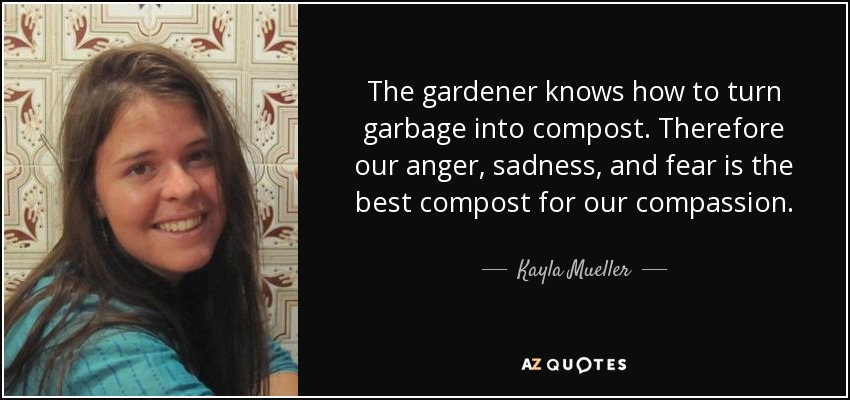
The gardener knows how to turn garbage into compost. Therefore our anger, sadness, and fear is the best compost for our compassion.
My kind of composing is more like the work of a gardener. The gardener takes his seeds and scatters them, knowing what he is planting but not quite what will grow where and when - and he won't necessarily be able to reproduce it again afterwards either.
Gardeners are good at nurturing, and they have a great quality of patience, they're tender. They have to be persistent.
They say that gardens look better when they are created by loving gardeners rather than by landscapers, because the garden is more tended to and cared for. The same thing goes for cooking. I only cook for people I love.
The job market of the future will consist of those jobs that robots cannot perform. Our blue-collar work is pattern recognition, making sense of what you see. Gardeners will still have jobs because every garden is different. The same goes for construction workers. The losers are white-collar workers, low-level accountants, brokers, and agents.
I grow as many of our vegetables as I can, because my granddad was a professional gardener, and it's in the blood.
We're like a gardener with a hose and our attention is water - we can water flowers or we can water weeds.
As for money - when I have it, it's great. When I don't, I go get some. I've been a dishwasher, a gardener, a cleaner.
Wild roses are fairest, and nature a better gardener than art.
I do think it's smart to see a marriage as "a garden and a gardener who constantly swap roles." You really have to switch from one to another. Being the gardener would be the more active role in the situation. Being a garden would be more passive. You've got to be both the one who gets help and the one that's helping. That's the circulation in a couple. You should switch from one position to another. I think it's good to be always aware that love can fade. There's something I really like about that sentence. It's as if love should be seen as work...because it is.
The great French Marshall Lyautey once asked his gardener to plant a tree. The gardner objected that the tree was slow growing and wouldn't reach maturity for 100 years. The Marshall replied, "In that case, there is no time to lose; plant it this afternoon!
The gardener had a dread of small women; he'd always imagined them to have an anger disproportionate to their size.
Tis in ourselves that we are thus or thus. Our bodies are our gardens to the which our wills are gardeners.
It is only to the gardener that time is a friend, giving each year more than he steals.
When you're cooking with food as alive as this -- these gorgeous and semigorgeous fruits and leaves and flesh -- you're in no danger of mistaking it for a commodity, or a fuel, or a collection of chemical nutrients. No, in the eye of the cook or the gardener ... this food reveals itself for what it is: no mere thing but a web of relationships among a great many living beings, some of them human, some not, but each of them dependent on each other, and all of them ultimately rooted in soil and nourished by sunlight.
The good gardener knows with absolute certainty that if he does his part, if he gives the labour, the love, and every aid that his knowledge of his craft, experience of the conditions of his place, and exercise of his personal wit can work together to suggest, that so surely will God give the increase. Then with the honestly-earned success comes the consciousness of encouragement to renewed effort, and, as it were, an echo of the gracious words, 'Well done my good and faithful servant'.
A gardener's work is never at an end; it begins with the year and continues to the next.
Then there are those who plant. they endure storms and all the many vicissitudes of the seasons, and they rarely rest. But, unlike a building, a garden never stops growing. And while it requires the gardener's constant attention, it also allows life for the gardener to be a great adventure.
Gardening is like everything else in life, you get out of it as much as you put in. No one can make a garden by buying a few packets of seeds or doing an afternoon's weeding. You must love it, and then your love will be repaid a thousandfold, as every gardener knows.
I find that a real gardener is not a man who cultivates flowers; he is a man who cultivates the soil. He is a creature who digs himself into the earth and leaves the sight of what is on it to us gaping good-for-nothings. He lives buried in the ground. He builds his monument in a heap of compost. If he came into the Garden of Eden, he would sniff excitedly and say: "Good Lord, what humus!"
Find the most delicate qualities within; then treat these qualities as tiny little seeds that you would plant in your heart, with you being the gardener.
The principal value of a garden is not understood. It is not to give the possessors vegetables and fruit (that can be better and cheaper done by the market-gardeners), but to teach him patience and philosophy, and the higher virtues - hope deferred, and expectations blighted, leading directly to resignation, and sometimes to alienation.
There are several ways to lay out a little garden; the best way is to get a gardener.
What would become of the garden if the gardener treated all the weeds and slugs and birds and trespassers as he would like to be treated, if he were in their place?
By the time one is eighty, it is said, there is no longer a tug of war in the garden with the May flowers hauling like mad against the claims of the other months. All is at last in balance and all is serene. The gardener is usually dead, of course.
Follow AzQuotes on Facebook, Twitter and Google+. Every day we present the best quotes! Improve yourself, find your inspiration, share with friends
or simply: