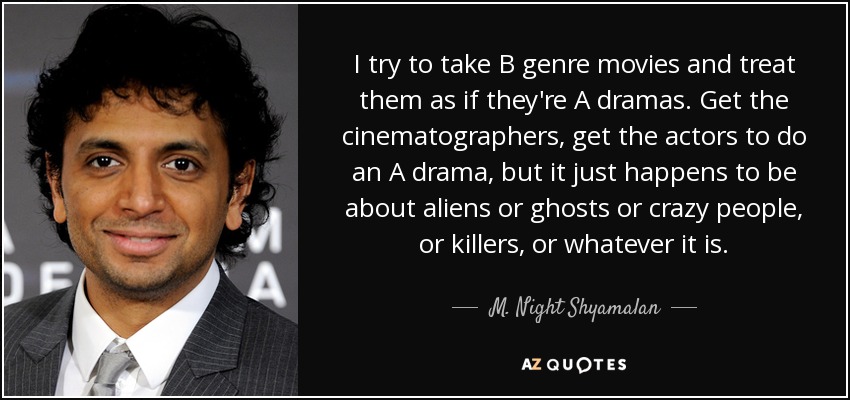
I try to take B genre movies and treat them as if they're A dramas. Get the cinematographers, get the actors to do an A drama, but it just happens to be about aliens or ghosts or crazy people, or killers, or whatever it is.
There are certain tenets set in place for all different types on genres. For thrillers, women usually die first.
I owe a lot to my parents, because they kept no genre off limits. Music was always playing in the house. They never told me to be quiet, turn the music down or anything like that. So I felt pretty free and experimental as a kid to kind of figure out my own voice.
As players of instruments, it is our duty to reach out and give light to those in the dark in whatever way that we can. All my actions are a fulfilment of all the African music genres - I'm only trying to maintain the culture and the tradition. I am a musician.
Blogging has helped create an expanded awareness of the creative nonfiction genre, generally. But I suspect many bloggers continue to be unaware that they are (or have the potential to be) "literary" or "artful."
And there are two types of stories. One type is one's own story. The other type is telling the stories of others. Thanks to this genre, writers of nonfiction can now use the tools of the reporter, the points of view and ear for dialog of a novelist, and the passion and wordplay of the poet.
When I began to cover songs for YouTube, they all tended to be in the super pop-genre.. as in, smash-hit songs. My writing process was heavily influenced by this - I went from a more heavy punk rock style to straight up sugary-sweet pop.
'Get Out' takes on the task of exploring race in America, something that hasn't really been done within the genre since 'Night of the Living Dead' 47 years ago.
The movement for women's liberation was about an emotional transformation, an explosion, a feeling all over the country that things must be different, and ideas about how they should be. I think fiction can capture that kind of thing better than other genres because in fiction you can explore the feelings of your characters - the before and the after.
I like being able to do anything. I think that's healthy, doing anything and everything, rather than just getting completely obsessed with one particular genre or particular kind of work.
To think of writing poetry as a "career" is not only ridiculous, it's dangerous. To the imagination. To the way one thinks of art. The reason poetry as a genre is so special is because it cannot be made a commodity.
I think that people like getting their money's worth, so it's cool to have a load of bands in a similar genre.
I certainly realize that not only do I like the horror genre, but I'm getting really good at it and I'm having a good time making them.
The main trend with the theme episodes is that anywhere there is a misconception about the way the physical world works, we're finding fertile material. Whether it's in a phrase like "going over like a lead balloon" or "a needle in a haystack," or tackling movie myths or even a genre, like MacGyver or James Bond, we're finding that all these things can lead to people believing the world works in a certain way. It might not be correct, but we can test out if it's true.
I want people to get out of that nasty habit of needing a label. Every genre for each song is different.
I want everything, no matter what concept or genre, to feel real, because it is real. I want to keep making real music, I hope people remember me for that, that's a good thing to be remembered for.
There's always music that moves me. It doesn't necessarily mean that it's within the parenthesis of rock or blues, or whatever. It's usually far more reaching than that. It can be in many different genres.
I'm just looking for material that excites me more than any specific genre. It just needs to be good.
That's exactly what I'm driving at. 'Basterds' was interesting because it was, in a way, unfamiliar. I thought well, OK. Let's leave the comfort zone and just risk it. Why not? Because, exactly as you said, in a way, by taking that risk, I make up a little bit for my ignorance in the subject, or rather, the genre.
I saw what luck and success I had as an opportunity to twist it up and do something different, so I've always sought out different genres and different kinds of characters.
When the publisher here in America wanted to put the word "memoir" on the title page [of 'Winter Journal'] and on the cover, I said, "No, no, no, no, no, no." No genre whatsoever. It's an independent work not really connected to those things at all.
What scares me is what scares you. We’re all afraid of the same things. That’s why horror is such a powerful genre. All you have to do is ask yourself what frightens you and you’ll know what frightens me.
There's something about the sci-fi genre that gets an audience interested in it, so maybe you can take some risks that you couldn't, if you were just doing a drama. It lets you maybe reach a little further and surprise people a little bit more because there's still that little safety base of working on that genre that everybody loves.
The goal [of mine] was always to work in as many different genres as I possibly could.
There's no denying that the way horror has been packaged in the past has done it no favours. Lurid black covers adorned with skulls, corpses crawling with insects and scantily clad maidens being chewed into by vampires -- all good clean fun, but it doesn't do much to give the genre an air of respectability or seriousness to the casual browser.
Follow AzQuotes on Facebook, Twitter and Google+. Every day we present the best quotes! Improve yourself, find your inspiration, share with friends
or simply: