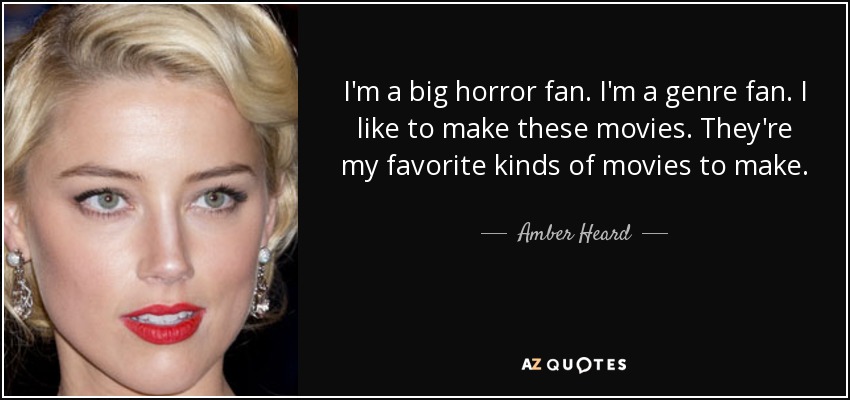
I'm a big horror fan. I'm a genre fan. I like to make these movies. They're my favorite kinds of movies to make.
Performance capture is a genre of acting which is not going to go away, it's going to proliferate more and more. I'm passionate about it, and I love it. It's the most liberating tool an actor has, because you are not limited by your own physicality, look, or color of your eyes.
You've got to be a good reader. So whatever genre that you're interested in, read a lot of books about it and it's better than any kind of writing class you'll ever take. You will absorb techniques and then in a lot of cases you can just start writing using the style of the book or the author that you admire and then your own style will emerge out of that. Be a diligent reader and then try to write seriously, professionally and approach everything in writing in a professional way.
There is a real problem with the lack of diversity, specifically in genre films and the superheroes our kids grow up watching and emulating, they can't really identify with. When you see the same thing, over and over again, and it seems not to speak of you and your heritage and your culture, it leaves you out of this world, a little bit. It gives a certain social distance with your world.
I had an idea for a medical conspiracy thriller. Since it was non-horror, I didn't want the publishers and editors bringing a lot of baggage - my history as a genre writer in the SF and horror fields, for instance - to the novel when they read it. I wanted them to consider the book solely on its own merits. So I called myself Colin Andrews. I was tired of seeing my books at floor level. Not that Herman Wouk and Phyllis Whitney and William Wharton are bad company, but I wanted to be up at eye level for a change, where people with bad backs could get a chance to see my books.
I've always thought that "punk" wasn't really a genre. My band started in Olympia where K Records was and K Records put out music that didn't sound super loud and aggressive. And yet they were punk because they were creating culture in their own community instead of taking their cue from MTV about what was real music and what was cool. It wasn't about a certain fashion. It was about your ideology, it was about creating a community and doing it on your own and not having to rely on, kinda, "The Man" to brand you and say that you were okay.
That's how it always is with me: the thing that sets me down to start writing is usually not what I end up doing. Because, as much as I love genre, and I try to deliver the goods, I go off from it. I go do my own thing.
If you look at the horror genre, that work is all about making people uncomfortable by stimulating our fear of death.
I never had a problem with genre because a genre actually is like a uniform - you put yourself into a certain uniform. But if you dress up in a police officer's uniform, it doesn't mean that you are an officer; it can mean something else. But this is the starting point, and the best way is to not to fit into this uniform but to make this uniform a part of yourself.
I do think that once a horror genre is commonly parodied in other movies it sort kills that genre or that specific take on that genre. Once it sort of becomes a joke in and of itself, so you have to push and find something new.
I'm not limited by genre and it doesn't really matter what the genre is as long as the film is going to be new and have some real artistic integrity.
My advice is to write about what you are interested in. If you read science fiction and fantasy, then write in that genre. If you read romance novels, then try writing one.
I think that with the Internet, it has given a lot of people the opportunity to get themselves out there to the masses. But it's easy to group everyone that's on the Internet together. I try to cross and jump around between genres and different styles, kind of find my own niche.
I wrote, I think, half a dozen films that were completely out of genre. Comedies, love stories, even one serious film about Vietnam, and we couldn't get backing for any of it. And we both sort of drifted from making, at that time, serious money on Last House to going through it all in the course of almost three years and only getting offers to do something scary again.
I realized that I really, almost by accident, had fallen into a labyrinthine, very powerful paradigm for dealing with these things through genre films. And once I realized that and realized the power of it, and the fact that because horror films aren't, in general, studio products - studios back them sometimes, but they don't try to meddle too much, because they kind of don't want to sully their skirts - you have a lot of freedom.
I think my sound differentiates me from everyone else. I'm able to dip and dabble in other genres, without feeling out of place. Im not confined to one sound.
I'm open to doing any kind of role and any kind of genre as long as it's interesting and as long as I feel it could be a great character to play. I never take into my own personal opinions or my own public image into account when I chose movie roles.
In some ways it's hard to see electronic music as a genre because the word "electronic" just refers to how it's made. Hip-hop is electronic music. Most reggae is electronic. Pop is electronic. House music, techno, all these sorts of ostensibly disparate genres are sort of being created with the same equipment.
Every time you read something about Rolling Stones it always mentions their age and how long can they go on? I think there are certain genres of music where people are allowed to go on, but there is something about rock and roll, I guess because it originally started out to be a teenage rebellion.
I am completely open to doing a romantic comedy, but I will never do something just for the sake of doing a specific genre or because it's the time or place to do a different type of movie. I think that would be a huge mistake.
There are shows, a lot of small cable shows like Breaking Bad, where in the general population nobody watches them really, but everybody in Los Angeles in the industry watches them, and to get a small role on a show like that actually, in some respects, advances your career more than having a huge hit role on a genre show because they are somehow dismissed as a secondary market in this industry
Write what you want to read. So many people think they need to write a particular kind of book, or imitate a successful style, in order to be published. I've known people who felt they had to model their book on existing blockbusters, or write in a genre that's supposed to be "hot right now" in order to get agents and publishers interested. But if you're writing in a genre you don't like, or modeling yourself on a book you don't respect, it'll show through. You're your first, most important reader, so write the book that reader really wants to read.
If we're talking about the science fiction or action genres, I've always tried when I could to do them in a way that's not just cookie-cutter - that they bring something fresh or original to it, have some kind of ideas to it. I've been fortunate, in some sense, to do those kinds of movies that are unique.
I just like movies, not one particular kind or genre. In fact, movies that are harder to classify I like more.
My favorite kinds of stories are the ones that have these big crazy genre hijinks and then a real honest, meaty, emotional story where we're watching a character grapple with some real things.
Follow AzQuotes on Facebook, Twitter and Google+. Every day we present the best quotes! Improve yourself, find your inspiration, share with friends
or simply: