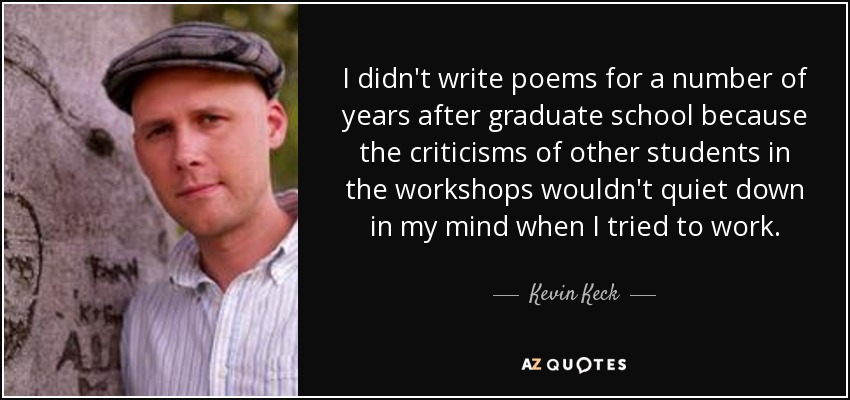
I didn't write poems for a number of years after graduate school because the criticisms of other students in the workshops wouldn't quiet down in my mind when I tried to work.
I felt a lot of ambivalence about going back to graduate school for a second MFA. The impulse was really the opposite from what it had been more than a decade before: I wanted to interrupt a career.
I didn't graduate high school, so I never got a teacher's education, I'm mostly self-read, self-taught. I always loved music, so I would probably either be in a band with another group of people, or an arranger, a producer, a musicologist, a music history guy, something to do with music. Either that, or I would probably be in jail. Or dead.
The important thing is to learn from mistakes - something graduates are adept at. Our graduate engineers are working on new technology - from uncharted applications for our digital motor, to a new take on the hand dryer. With an unhindered mind, nothing is off limits.
I went back to graduate school because I wanted to avoid being a professional, to try to piece together a life that would let me avoid the tenure race and full-time teaching.
I tried to talk to the graduates who haven't figured what they're going to do next. The kids who are heading in medical school or law school, they've got pretty much figured where they're headed in life. But there are so many kids out there, that are just going, they're still kids. They've always been promoted from grade to grade.
One particular spark was when I went back to my favorite spot in the mountains where my father always used to take us before my graduate studies in Canada and finding that the stream I had gone swimming in wasnt there. The forest had been converted into an apple orchard with World Bank financing. The entire place, literally, had changed.
When I was contemplating medical school after graduating from Knox, several people suggested that nursing was a more suitable profession for women. My own mother discouraged me from becoming a doctor. But this is not why I became a nurse instead!
I didn't drop out of school, I placed out of it. I took correspondence courses and ended up graduating early. I did everything I could to get the hell out of there.
Graduating at the age of 21 was a wonderful age to hopefully start a career.
I never expected my graduate degrees to give me all the practical how-to's that can perhaps only be learned through the school of hard knocks.
Andrew Hacker argues that algebra and trigonometry and calculus are subjects that almost nobody used after they graduate, and so why should we continue to compel students to try to pass them?
I know that it's very dispiriting for people in their twenties, who expected to graduate from college, get their own apartments, get a job, and move forward with their lives, and in fact are still now living with Mom and Dad, which is challenging for all involved.
When I was in graduate school, my thesis included both poetry and essays. Influenced by the personal essays of James Baldwin and Norman Mailer, I loved the form, but pretty much stopped.
Students are suffering under incredibly high tuitions and high student loan interest rates. They graduate from school, and they're having a very difficult time finding a job. They don't feel as though there are honest leaders who are listening to them, and who will be a part of the solution.
I had a Masters of Fine Arts, but so did thousands of other graduates every year, and we were all competing for the same jobs. I realistically didn't expect to become a teacher, and after two or three years, I accepted defeat.
Being a graduate student is no fun and is hard, but I'm sticking with it. I love making art.
It's difficult to get a job and people stay in school longer because they're employed as teaching assistants or instructors by their schools, by their schools where they're graduate students, and that does become exploitative eventually because they're very cheap labor and there's a way in which in it's not in the institution's interest to give them a degree if they can continue to employ them, I don't think anybody thinks that way, but effectively that's the way the system is starting to work.
Whole class of filmmakers, they're all graduating to a new level of filmmaking, which I think is awesome.
I was starting out in the business, there was only one path to playing professionally - graduate, or go four years. With the creation of the ABA [American Basketball Association] in the early 1970s, the sanctity of having to go to college was broken. The ABA took anyone, starting with Spencer Haywood.
The day you graduate from childhood to adulthood is the day you take full responsibility for your life.
When I get interested in a new topic I teach a class on it. There's a graduate seminar I teach in which the students and I try to expand the terminology we use to talk about poetry as well as expand our notion of what makes a poem - we read source texts on architecture, dance, photography, film and the graphic novel.
Normally, if someone goes bankrupt, you wipe out the debt and get a fresh start. But that's not permitted with student loans. So the effect is to impoverish many graduates with very high debts.
Animation wasn't my love, but drawing was. I loved drawing, and when it came time to graduate from high school, I looked around and it was like, "Wow, I don't really want to study math. I don't really want to study science. I don't really want to study literature. Is there a place where I can go and draw cartoons?"
The thing I wanted to focus on first was that I wanted to graduate, and (with me) coming back, I knew that I wanted another national championship. Another national championship is everyone's main goal, but we have to take it one game at a time. We can't get ahead of ourselves. We've got Washington first, then we'll see what happens.
Follow AzQuotes on Facebook, Twitter and Google+. Every day we present the best quotes! Improve yourself, find your inspiration, share with friends
or simply: