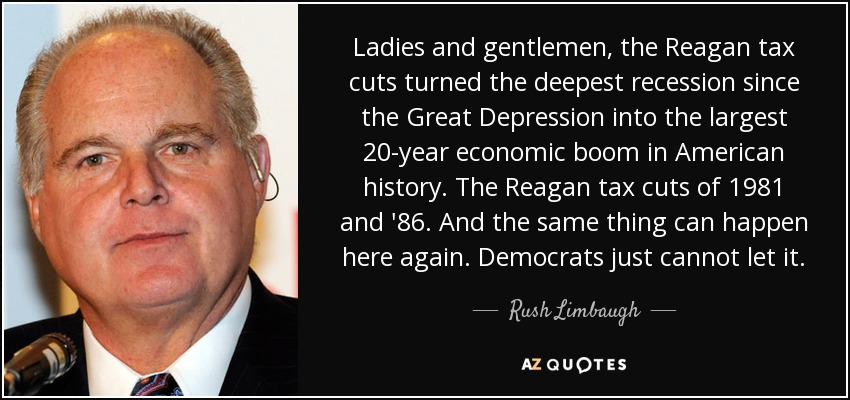
Ladies and gentlemen, the Reagan tax cuts turned the deepest recession since the Great Depression into the largest 20-year economic boom in American history. The Reagan tax cuts of 1981 and '86. And the same thing can happen here again. Democrats just cannot let it.
We're living through an era of higher income inequality than the country has experienced since before the Great Depression. Meanwhile, most people are running in place, and those in the bottom quintile of the economy are being swept backward year in and year out. A worker with a high school education today is likely to earn less in real terms than did their parents and grandparents in the early 1970s. Not coincidentally, while overall life expectancy is increasing in America, for those with low levels of education it's actually declining.
I know many of you are hurting and angry about the economy, and I don't blame you. It's the worst economy since the Great Depression. When consumers can't buy and businesses won't expand for lack of customers, the government has to be the purchaser and employer of last resort. We learned that in the Great Depression, but Republicans obviously didn't - and they've blocked every jobs program I've offered.
One of [ways being lucky] was to go to school during the Great Depression because teaching became a plum job.
The smartest people in Indianapolis became teachers [during the Great Depression]. And, for once, there was something for women to do because teaching was regarded as a woman's profession, like nursing. So the smartest women in town - Jesus, my women teachers were so exciting.
When my husband was president, we went from a $300 billion deficit to a $200 billion surplus and we were actually on the path to eliminating the national debt. When President Obama came into office, he inherited the worst economic disaster since the Great Depression. He has cut the deficit by two-thirds.
There is a myth that the New Deal programs on their own pulled the US out of the Great Depression and created the conditions for the economic boom after World War II. As an economist, I can tell you, that is not true. In reality, it was mainly World War II that launched the boom - the massive war mobilization, the horrifying destruction and death caused by it, and then the reconstruction in its aftermath. he US was the only advanced capitalist country that was not bombed during the war.
Even though the play [ The Best Man] was written a long time ago, the characters seem modern and their struggles to make ends meet and to "have a little fun along the way" have a very contemporary feel. The similarity between the The Great Depression and The Great Recession - as well as the gulf between the super-rich and the ordinary Joe - still rings a bell. One of the things this production accentuates is how beautifully Grandpa and his family accept all kinds of people - rich or poor, black or white - and the best thing that can happen to you is to be part of a loving family.
I was born January 6, 1937, eight years after Wall Street crashed and two years before John Steinbeck published The Grapes of Wrath, his Pulitzer Prize-winning novel about the plight of a family during the Great Depression.
This crisis of long-term unemployment is having a profoundly damaging impact on the lives of those bearing the brunt of it. We know this thanks to a series of careful studies of the problem conducted in the depths of the 1930s Great Depression.
We beat the Great Depression without lotteries and legalized gambling
We have the worst revival of an economy since the Great Depression. And believe me: We're in a bubble right now.
We call for a green New Deal, like the New Deal that got us out of the Great Depression, but in this case focusing on green jobs to create 100% clean renewable energy by 2030, which is exactly what the science calls for.
Don't ever let anyone tell you that history doesn't repeat. For 70 years, liberals have been spinning the yarn that FDR's New Deal, despite all the evidence that it exacerbated and prolonged the Great Depression, quickened our economic recovery. Indeed, I remember scratching my head when one of my college history professors in the 1970s tried to convince us of that theory and its corollary - an even better howler - that FDR was actually a conservative, because if he hadn't implemented his socialist programs, the republic would have died right there.
Jesse Owen was bigger than a black hero, he was an American hero. For me, I looked at it from that perspective. Through my research, I obviously learned a lot, much of which made me sad, upset, disappointed and even angry, regarding what Jesse had to go through. Not only was he a black man in America during an age of high racial tension and segregation, but he was also living in the middle of the Great Depression - it was very difficult times for him and his family.
The years of the Great Depression were a superb time for economists because people not knowing what could be done or what should be done would always assume that maybe an economist had the answer. If you were just a lawyer in Washington, you were nobody. But if you were an economist, you might have the answer.
Through much of its history, the US did not have high inequality as compared with Europe. Less so, in fact. That began to change in the industrial age, reaching a peak in 1928, after the forceful destruction of the labor movement and crushing of independent thought. Largely as a result of labor mobilization, inequality declined during the Great Depression, a tendency continuing through the great growth period of regulated capitalism in the early postwar decades.
Burlesque thrived during the Great Depression, and by extension, so, too, did Gypsy [Rose Lee]. Men could no longer afford to pay $5.50 to see a show on Broadway, but they could scrape together $1.00 for a matinee at a burlesque house.
I know that some poor immigrants from that era had unrealistic expectations and were disappointed, but I don't think my grandparents were disappointed at all, even though they experienced some very hard times during the Great Depression.
The public doesn't get to see everything. I worked with X a couple times since then. Me and X have a close relationship. We actually did a record they were going to put on the Training Day soundtrack but he ending up buying the record from me and putting it on Great Depression as a bonus track.
Importantly, in the 1930s, in the Great Depression, the Federal Reserve, despite its mandate, was quite passive and, as a result, financial crisis became very severe, lasted essentially from 1929 to 1933.
In his first term, President Barack Obama played a cautious manager navigating the worst economic disaster since the Great Depression and cleaning up the messes left by President George W. Bush in Iraq and Afghanistan.
There may be a recession in stock prices, but not anything in the nature of a crash.
For the immediate future, at least, the outlook (stocks) is bright.
I see nothing in the present situation that is either menacing or warrants pessimism.
Follow AzQuotes on Facebook, Twitter and Google+. Every day we present the best quotes! Improve yourself, find your inspiration, share with friends
or simply: