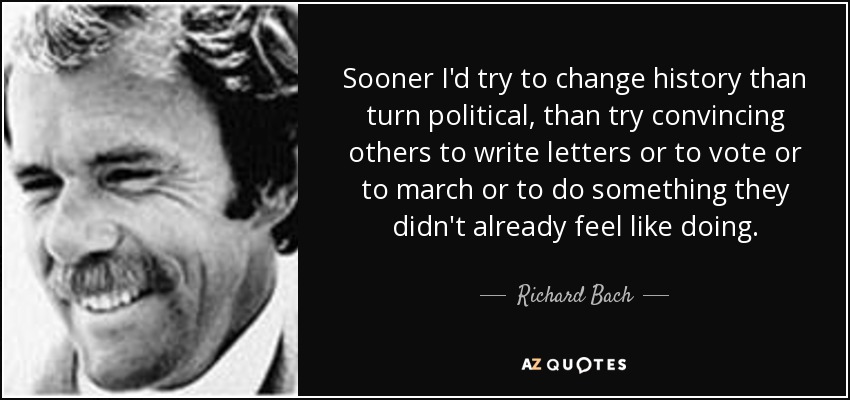
Sooner I'd try to change history than turn political, than try convincing others to write letters or to vote or to march or to do something they didn't already feel like doing.
It is long ere we discover how rich we are. Our history, we are sure, is quite tame: we have nothing to write, nothing to infer. But our wiser years still run back to the despised recollections of childhood. . . .
Careless of waste, wallowing in refuse, exterminating the enemies . . . despising age, denying human natural history, fabricating pseudotraditions, swamped in the repeated personal crises of the aging preadolescent; all are familiar images of American society. They are signs of private nightmares of incoherence and disorder in broken climaxes where technologies in pursuit of mastery create ever-worsening problems - private nightmares expanded to a social level.
It is one of the great ironies of human history that some mortals with incorrect understanding of God and life's purposes sometimes scold God because of the abundance of human misery and suffering-which, indeed, lies all about us. Such individuals almost dare God to demonstrate His existence by straightening things out-and at once! But He is a much different kind of Father than that. Surely it is requisite to eternal life that we come to know God and Jesus Christ whom He has sent (see John 17:3).
And always we had wars, and more wars, and still other wars - all over Europe, all over the world. "Sometimes in the private interest of royal families," Satan said, "sometimes to crush a weak nation; but never a war started by the aggressor for any clean purpose - there is no such war in the history of the race."
The scale of marital breakdowns in the West since 1960 has no historical precedent that I know of, and seems unique, . . . There has been nothing like it for the last 2,000 years, and probably longer.
Any movement in history which attempts to perpetuate itself, becomes reactionary.
There is not a truth to be gathered from history more certain, or more momentous, than this: that civil liberty cannot long be separated from religious liberty without danger, and ultimately without destruction to both. Wherever religious liberty exists, it will, first or last, bring in and establish political liberty.
Great steps in human progress are made by things that don't work the way philosophy thought they should. If things always worked the way they should, you could write the history of the world from now on. But they don't, and it is those deviations from the normal that make human progress.
On the eve of this great adventure I send my best wishes to every soldier in the Allied team. To us is given the honour of striking a blow for freedom which will live in history; and in the better days that lie ahead men will speak with pride of our doings.
If the history of England be ever written by one who has the knowledge and the courage,-and both qualities are equally requisite for the undertaking, - the world will be more astonished than when reading the Roman annals by Niebuhr.
In the index to the six hundred odd pages of Arnold Toynbee's A Study of History, abridged version, the names of Copernicus, Galileo, Descartes and Newton do not occur yet their cosmic quest destroyed the medieval vision of an immutable social order in a walled-in universe and transformed the European landscape, society, culture, habits and general outlook, as thoroughly as if a new species had arisen on this planet.
ZOOLOGY, n. The science and history of the animal kingdom, including its king, the House Fly ("Musca maledicta"). The father of Zoology was Aristotle, as is universally conceded, but the name of its mother has not come down to us.
In historical and constitutional terms, the recent political status vote in Puerto Rico was a necessary but obviously not decisive step on the road of self-determination leading to full self-government.
This generation, raised on "Eyewitness News," conditioned by the instant replay, and spared the illumination that comes from tedious historical study, tends to be even more ahistorical than most.
I think utopianism and eschatology are really two sides of the same coin. They both assume that some massively transformative event is going to happen that's going to completely change the nature of society. They only disagree on whether we get a happy ending or all die horribly. And so utopianism is on the wane right now because at the moment most of the plausible candidates for huge historical transformation look like they're going to kill us.
I like to create imaginary characters and events around a real historical situation. I want readers to feel: OK, this probably didn't happen, but it might have.
Marxism must abhor nothing so much as the possibility that it becomes congealed in its current form. It is at its best when butting heads in self-criticism, and in historical thunder and lightning, it retains its strength.
Due to the fact that I experienced personally the situation of a political prisoner, I have an historical commitment to all those that were or are prisoners just because they expressed their views, their public opinion, their own opinions.
I will give you my definition of a nation, and you can add the adjective 'Jewish.' A Nation is, in my mind, an historical group of men of a recognizable cohesion held together by a common enemy. Then, if you add to that the word 'Jewish' you have what I understand to be the Jewish nation.
The corniest movie ever made about the white man's need to lose his identity and assuage racial, political, sexual and historical guilt.
Beauty has never been absolute and immutable but has taken on different aspects depending on the historical period and the country
The idea of the paranoid style as a force in politics would have little contemporary relevance or historical value if it were applied only to men with profoundly disturbed minds. It is the use of paranoid modes of expression by more or less normal people that makes the phenomenon significant.
When the venture has been made of dealing with historical events and characters, it always seems fair towards the reader to avow what liberties have been taken, and how much of the sketch is founded on history.
Our historical bequest is sublime. I have inherited a fragmented but highly creative exile and, since 1948, a home. I don't know that I want to settle there. I prefer the creative spur of exile. () But wherever I am I shall be Jewish, and that sound will inform every syllable I write. I am blessed with a long ancestry of wisdom, prophecy, and promise, a line of overwhelming creative achievements, courage, humor, and, above all, a dogged and chronic permanence, the greatest legacy of all.
Follow AzQuotes on Facebook, Twitter and Google+. Every day we present the best quotes! Improve yourself, find your inspiration, share with friends
or simply: