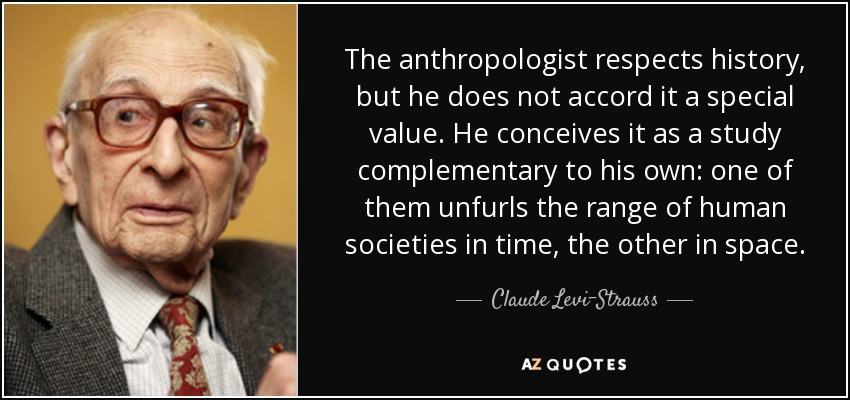
The anthropologist respects history, but he does not accord it a special value. He conceives it as a study complementary to his own: one of them unfurls the range of human societies in time, the other in space.
Country' and 'city' are very powerful words, and this is not surprising when we remember how much they seem to stand for in the experience of human communities. In English, 'country' is both a nation and a part of a 'land'; 'the country' can be the whole society or its rural area. In the long history of human settlements, this connection between the land from which directly or indirectly we all get our living and the achievements of human society has been deeply known.
You should know as much as you can about the human species if you have a hand in designing human society.
If any country were indeed filled with men, each thus diligently discharging the duties of his own station without breaking in upon the rights of others, but on the contrary endeavoring, so far as he might be able, to forward their views and promote their happiness, all would be active and harmonious in the goodly frame of human society.
Gossiping has become the main form of communication in human society. It has become the way we feel close to each other, because it makes us feel better to see someone else feel as badly as we do. There is an old expression that says, 'Misery likes company,' and people who are suffering in hell don't want to be all alone.
In spite of difference of soil and climate, of language and manners, of laws and customs-in spite of things silently gone out of mind, and things violently destroyed, the Poet binds together by passion and knowledge the vast empire of human society, as it is spread over the whole earth, and over all time.
I have never said that human society ought to be aristocratic, but a great deal more than that. What I have said, and still believe with ever-increasing conviction, is that human society is always, whether it will or no, aristocratic by its very essence, to the extreme that it is a society in the measure that it is aristocratic, and ceases to be such when it ceases to be aristocratic. Of course I am speaking now of society and not of the State.
I find the science behind major natural events almost more interesting than the way in which those same events wreak their effects on human society.
Women's liberation, if not the most extreme then certainly the most influential neo-Marxist movement in America, has done to the American home what communism did to the Russian economy, and most of the ruin is irreversible. By defining relations between men and women in terms of power and competition instead of reciprocity and cooperation, the movement tore apart the most basic and fragile contract in human society, the unit from which all other social institutions draw their strength.
We must start human society from scratch; as Francis Bacon said, we must recreate human understanding.
If you look at any religious description of hell, it is the same as human society, the way we dream. Hell is a place of suffering, a place of fear, a place of war and violence, a place of judgment and no justice, a place of punishment that never ends.
The sheep-like tendency of human society soon makes inroads on a child's unsophistications, and then popular education completes the dastardly work with its systematic formulas, and away goes the individual, hurtling through space into that hateful oblivion of mediocrity. We are pruned into stumps, one resembling another, without character or grace.
There's a popular concept of 'intelligence' as book smarts, like calculus or chess, as opposed to, say, social skills. So people say that 'it takes more than intelligence to succeed in human society.' But social skills reside in the brain, not the kidneys.
The walking delegates of a higher civilization, who have nothing to divide, look upon the notion of property as a purely artificial creation of human society. According to these advanced philosophers, the time will come when no man shall be allowed to call anything his. The beneficent law which takes away an author's rights in his own books just at the period when old age is creeping upon him seems to me a handsome stride toward the longed-for millennium.
I was hardly fit for human society. Thus destiny shaped me to be a science fiction writer.
In every human society of which we have any record, there are those who teach and those who learn, for learning a way of life is implicit in all human culture as we know it. But the separation of the teacher's role from the role of all adults who inducted the young into the habitual behavior of the group, was a comparatively late invention. Furthermore, when we do find explicit and defined teaching, in primitive societies we find it tied in with a sense of the rareness or the precariousness of some human tradition.
How fortunate for governments that people do not think. There is no thinking except in giving and executing commands. If it were otherwise human society could not exist.
No human society is too primitive to have some kind of literature. The only thing is that primitive literature hasn't yet become distinguished from other aspects of life: it's still embedded in religion, magic and social ceremonies.
The greatest and noblest pleasure we have in this world is to discover new truths, and the next is to shake off old prejudices... A man who seeks truth and loves it must be reckoned precious to any human society.
In every human society of which we know - prehistoric, ancient or modern, whether hunter-gatherer, pastoral, agricultural or industrial - at least some form of art is displayed, and not only displayed, but highly regarded and willingly engaged in.
There’s always been a need for horror fiction, though - ghost stories have been a staple of every human society since the beginning of recorded literature - and while commercially the field may have its ups and downs, it will never go away. Hell, look at the Bible: gods, devils, ghosts, witches, giants, resurrections. That’s one big horror story. And it’s the most popular book on the planet.
The drive to be useful is encoded in our genes. But when we gather in very large numbers, as in the modern nation-state, we seem capable of levels of folly and self-destruction to be found nowhere else in all of nature. But if we keep at it and keep alive, we are in for one surprise after another. We can build structures for human society never seen before, thoughts never heard before, music never heard before.
The more the Jew is a Jew, the more universalist will his views and aspirations be, the less aloof will he be from anything that is noble and good, true and upright, in art or science, in culture or education; the more joyfully will he applaud whenever he sees truth and justice and peace and the ennoblement of man prevail and become dominant in human society.
Human society is part of the general order, and the more our knowledge increases the less we are inclined to believe that the birth or death of princes, the rise or fall of millionaires, are matters that cause the sun to stand still or even produce the appearance of comets in the sky.
I am a stronger follower of Veganism by principle, not just because of moral and aesthetic reasons. I truly believe in a Vegetarian lifestyle and I have faith and hopes in change in human destiny, thanks to the physical effects and benefits of a healthier diet and its influence on the character of the people. It will bring about some benefit and improvement to human society.
Follow AzQuotes on Facebook, Twitter and Google+. Every day we present the best quotes! Improve yourself, find your inspiration, share with friends
or simply: