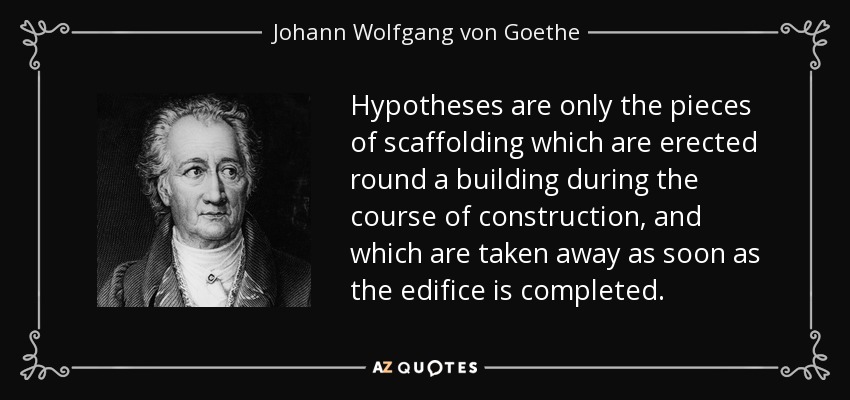
Hypotheses are only the pieces of scaffolding which are erected round a building during the course of construction, and which are taken away as soon as the edifice is completed.
Do not say hypothesis, and even less theory: say way of thinking.
An electron is no more (and no less) hypothetical than a star. Nowadays we count electrons one by one in a Geiger counter, as we count the stars one by one on a photographic plate.
For the Members of the Assembly having before their eyes so many fatal Instances of the errors and falshoods, in which the greatest part of mankind has so long wandred, because they rely'd upon the strength of humane Reason alone, have begun anew to correct all Hypotheses by sense, as Seamen do their dead Reckonings by Cœlestial Observations; and to this purpose it has been their principal indeavour to enlarge and strengthen the Senses by Medicine, and by such outward Instruments as are proper for their particular works.
Given any rule, however "fundamental" or "necessary" for science, there are always circumstances when it is advisable not only to ignore the rule, but to adopt its opposite. For example, there are circumstances when it is advisable to introduce, elaborate and defend ad hoc hypotheses, or hypotheses which contradict well-established and generally accepted experimental results, or hypotheses whose content is smaller than the content of the existing and empirically adequate alternative, or self-inconsistent hypotheses, and so on.
Hypotheses are the scaffolds which are erected in front of a building and removedd when the building is completed. They are indispensable to the worker; but the worker must not mistake the scaffolding for the building.
If we respect students abilities to define their own experiences, to generate their own hypotheses, and to discover new ways of categorizing the world, we might not be so quick to evaluate the adequacy of their answers. We might, instead, begin listening to their questions. Out of the questions of students come some of the most creative ideas and discoveries.
The results serve to disprove the tetranucleotide hypothesis. It is, however, noteworthy-whether this is more than accidental, cannot yet be said-that in all desoxypentose nucleic acids examined thus far the molar ratios of total purines to total pyrimidines, and also of adenine to thymine and of guanine to cytosine, were not far from 1.
Her professors were astonished by her leaps of thought, by the finesse and elegance of her insights. She arrived at hypotheses by sheer intuition and with what eventually one of her mentors described as an almost alarming speed; she was like a dancer, he said, out in the cosmos springing weightlessly from star to star. Drones, merely brilliant, crawled along behind with laborious proofs that supported her assertions.
Religion, after all, is nothing but an hypothesis framed to account for what is evidentially unaccounted for.
I think philosophers can do things akin to theoretical scientists, in that, having read about empirical data, they too can think of what hypotheses and theories might account for that data. So there's a continuity between philosophy and science in that way.
To Napoleon on why his works on celestial mechanics make no mention of God: Your Highness, I have no need of this hypothesis.
People who live in states have as a rule never experienced the state of nature and vice-versa, and have no practical possibility of moving from the one to the other ... On what grounds, then, do people form hypotheses about the relative merits of state and state of nature? ... My contention here is that preferences for political arrangements of society are to a large extent produced by these very arrangements, so that political institutions are either addictive like some drugs, or allergy-inducing like some others, or both, for they may be one thing for some people and the other for others.
I tell you what you’ll never really know: all the medical hypothesis that explained my brain will never be as true as these struck leaves letting go.
Or if the hypothesis were offered us of a world in which Messrs. Fourier's and Bellamy's and Morris's Utopias should all be outdone, and millions kept permanently happy on the one simple condition that a certain lost soul on the far-off edge of things should lead a life of lonely torment, what except a specifical and independent sort of emotion can it be which would make us immediately feel, even though an impulse arose within us to clutch at the happiness so offered, how hideous a thing would be its enjoyment when deliberately accepted as the fruit of such a bargain?
In fact, whenever energy is transmitted from one body to another in time, there must be a medium or substance in which the energy exists after it leaves one body and before it reaches the other ... and if we admit this medium as an hypothesis, I think it ought to occupy a prominent place in our investigations, and that we ought to endeavour to construct a mental representation of all the details of its action, and this has been my constant aim in this treatise.
A failed structure provides a counterexample to a hypothesis and shows us incontrovertibly what cannot be done, while a structure that stands without incident often conceals whatever lessons or caveats it might hold for the next generation of engineers.
That's what I'm trying to get over: the idea that anarchism offers a description of equitable relations that go way back rather than a hypothesis of what the future should look like.
The theory, hypothesis, framework, or background knowledge held by an investigator can strongly influence what is observed.
The art of discovering the causes of phenomena, or true hypotheses, is like the art of deciphering, in which an ingenious conjecture often greatly shortens the road.
Are not all Hypotheses erroneous, in which Light is supposed to consist in Pression or Motion, propagated through a fluid Medium? For in all these Hypotheses the Phaenomena of Light have been hitherto explain'd by supposing that they arise from new Modifications of the Rays; which is an erroneous Supposition.
It seems a miracle that young children easily learn the language of any environment into which they were born. The generative approach to grammar, pioneered by Chomsky, argues that this is only explicable if certain deep, universal features of this competence are innate characteristics of the human brain. Biologically speaking, this hypothesis of an inheritable capability to learn any language means that it must somehow be encoded in the DNA of our chromosomes. Should this hypothesis one day be verified, then lingusitics would become a branch of biology.
During the last two centuries and a half, physical knowledge has been gradually made to rest upon a basis which it had not before. It has become mathematical. The question now is, not whether this or that hypothesis is better or worse to the pure thought, but whether it accords with observed phenomena in those consequences which can be shown necessarily to follow from it, if it be true
History, human or geological, represents our hypothesis, couched in terms of past events, devised to explain our present-day observations.
Many 'hard' scientists regard the term 'social science' as an oxymoron. Science means hypotheses you can test, and prove or disprove. Social science is little more than observation putting on airs.
Follow AzQuotes on Facebook, Twitter and Google+. Every day we present the best quotes! Improve yourself, find your inspiration, share with friends
or simply: