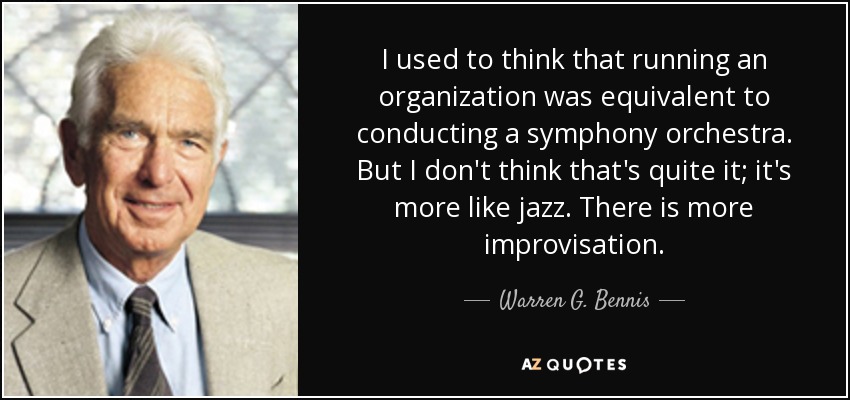
I used to think that running an organization was equivalent to conducting a symphony orchestra. But I don't think that's quite it; it's more like jazz. There is more improvisation.
Improvisation is about finding the best joke or the silliest way to get something across. Improvising conflict is always fun because you can just go for it.
When I think back now to the recording sessions, there is more improvisation than one hears. It's an ideal combination of arrangements and improvisation. Only a few people are able to listen and say what is composed and what is improvised. It's a unit.
As you know from reading many of these Negro writers, we don't deal too much with the discussion of democracy and what it means and how improvisation fits in all that.
Preparing to improvise is at a level commensurate with mastering the structure in a European classical piece. Another way to define improvisation is spontaneous melody. In order to improvise, a player first needs to have memorized and analyzed the harmonic structure of so many pieces.
Generally speaking I would say I enjoy the smaller films more because there's a less sense of pressure and often the material is more unusual. But in "Iron Man" it was kind of like both worlds colliding because there was a lot of improvisation, not that we improv-ed in the scenes but to discover the actual scenes themselves.
Improvisation is empowering because it welcomes the unknown. And since what's impossible is always unknown, it allows me to believe I can cheat the impossible.
All actors have to make the words fit in their mouths, and make the words the words fit to how you say it and how you make it life-like and make it look like what you're saying is just conversation that you're just thinking off the top of your head. That process is not quite improvisation.
Effortless [performance] and improvisation are two different things. Just because it's improvised doesn't mean it's effortless and just because it's effortless doesn't necessarily mean it's improvised.
Sometimes some of the best moments are contributed by the actors being creative, with their own improvisations.
During improvisations, I'll hear people bringing back up details from something I heard about at breakfast or something somebody was saying that they were thinking about, and it informs a rewriting of a scene.
I honestly would tell anyone young to start looking at stories and learning story, because I think that’s the next step after people go, ‘OK, I’ve had enough of that improvisation, I’ve had enough of those short comedy bits. Tell me a story, tell me a more complex story, something that lasts and maybe has a little more meaning to it.’ Don’t ever look at what’s happening now; look at what’s coming next.
I continued studying by myself in the field of jazz with my own technique of improvisation, walking bass lines, rhythms, all kinds of stuff, which I created for myself.
I started improvisation at age nine, and I loved it so much I stuck with it. As a by-product, acting was just something I was lucky enough to fall into.
Not with the Rochester Philharmonic, but I formed my own orchestra, made up of musicians from the Eastman School, where I'm on the faculty now, direct the Jazz Ensemble and teach improvisation classes.
As far as I'm concerned, the essentials of jazz are: melodic improvisation, melodic invention, swing, and instrumental personality.
Improvisation has never been my strong point.
A lot of improvisation ends up being about just thinking outside of the box in the scene. It's not improvisation as much as it is quickness or making it real.
I am not a fan of improvisation, because it bores me. Working off a tight scenario gives you the confidence and ability to - why don't we change this a little bit and bring it back to the script. You always discover things while shooting.
It may seem like improv because it flows quite naturally, and a little bit of leeway for improvisation is good, but you have to be judicious with it. So it's good, but sometimes people deify it. You can't improvise your way out of a paper hat.
I've never been a big fan of improvisation, because I think you appreciate the process and the cleverness of it more than the actual comedy in most cases.
Most of my comedy writing happens through improvisation on stage; doing it in the moment. Going up with an idea and fleshing it out over time on stage and in front of people until it becomes a full bit.
When I create I don't think in technical or mathematical terms until the idea is formulated Musical composition is formulated in improvisation. Once a pianist like myself sits down and begins to play and start thinking about what I am writing all of a sudden a little tune will emerge, a little spot light and I'll go, "That's interesting."
Improvisation is risky. I like that. Another practical reason for that is that you have to go out and play every day on a tour. I couldn't do it if I thought I was going to do the same songs every day in the same order, like a full-on robot.
Music to me is spontaneous, writing is spontaneous and it's all based on not trying to do it. From beginning to end, whether it's writing a song, or playing guitar, or a particular chord sequence, or blowing a horn, it's based on improvisation and spontaneity.
Follow AzQuotes on Facebook, Twitter and Google+. Every day we present the best quotes! Improve yourself, find your inspiration, share with friends
or simply: