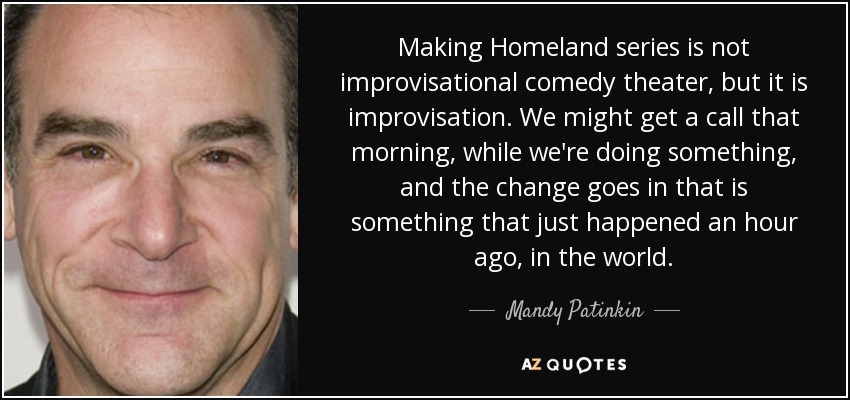
Making Homeland series is not improvisational comedy theater, but it is improvisation. We might get a call that morning, while we're doing something, and the change goes in that is something that just happened an hour ago, in the world.
Continual improvisation on a theme is a more useful way to think of how to bring the various parts of life together.
John [Cassavetes] loved actors. He gave them a lot of freedom. So if something came up that a certain actor just felt at the moment and said - that kind of improvisation he would accept. He gave very little direction.
I like the idea of the objecthood of music being destabilized by process and things like improvisation. That's what empowers us; that's how we make each day new as players, as people.
With Halloween, the director was this genius wonder boy who was the writer, director, producer, along with his girlfriend. They were this team, and they were making this small movie, and it was just completely different, but it was really inspiring and a lot of fun, and also allowed me to do a lot of improvisation, because they just depended on the girls to expand their parts to bring some real life, being girls ourselves, to the characters.
Remember that a book is many drafts - mine certainly are. It's improvisation. It's as much jazz and the way we talk and the way I heard people preach coming up as it is writing.
Anything I do, I learn about first. I am not in favour of improvisation; I believe in work and in learning
I don't think I differentiate between composition and improvisation. Improvisation could be a large part of a composition.
It was amazing how much their [Seth Rogen, Evan Goldberg, Shauna Robertson] process seemed familiar to me, translating that into the work that I had done and giving actors a lot of freedom and doing a lot of improvisation and a total respect and collaboration with all the department heads and all the crews, and just really making it an enjoyable industry rather than just clocking in and doing a job which a lot of movies are.
It's a very collaborative environment [making The Office]. We always do takes of how it's scripted, but then we also mix it up a lot too. And it's kind of a crapshoot, you never know which one... I mean a lot of time improvisation doesn't go anywhere and it's not good at all but, so what was written is often times better.
The idea of improvisation kind of freaked me out.
[Improvisation ] is been with me all my life. We all do it.
I have a variety of ways that I make music, but I'm working with the Thingamajigs in a particular way, which is: They are bringing to me their performance skills and their unusual instruments, which I'm relishing. They're really beautiful. The other thing is improvisation - these players improvise and they do it very beautifully, as a matter of fact.
I try to influence this improvisation in two ways. One is by centering on reflections, in both senses of the word: acoustic reflections as well as visual reflections from a mirror or surface, and then reflecting on the material in a contemplative way. The other influence is listening to the tails of the sounds that you make.
I always hankered to be a composer - I was mad about music, though I never studied seriously, and can't read a note. But I learned to play the piano and became pretty skillful at improvisation, especially after a drop or two.
That's what it is-it's jazz. It's just jazz. That's what the whole thing is about to me. It's about what's happening right now in this context. This conversation is jazz to a certain extent. It's improvisation. What appeals to me about music is the improvization. That's what I don't like about the media-they're not living it.
Bad improvisers block action, often with a high degree of skill. Good improvisers develop action.
I lived in San Francisco for about eight years and I did a lot of improvisation there. The improvisational world ruled the voice world in San Francisco, so I became a voice talent there and did a lot of commercials and worked all the time. But I never could break into animation.
There is really not that much improvisation in my films. There is an acceptance of a chance.
So much of the show [ Too Much Tuna] is improvisation, and I think that Nick [Kroll] and John [Mulaney] kind of catch each other at times, surprise each other. I think that really makes it a fun, sort of live, unique experience.
I loved the idea [of improvisation], but I'd never taken any classes or practiced it.
As a director and an actor, I encourage improvisation but in character and in the moment of what it is.
Having been an actor, I always want to leave room for the actors to find their comfort zone, so I don't like to be too rigid in how I plan my shots. It's different if you have weeks to rehearse and you can rehearse on your sets or in your locations and you can plan that out with your actors, but in modern independent filmmaking, you don't really have that time. You have to have a certain level of improvisation.
You have to study composition to understand that things can be done backwards and forwards and upside down, inverted, but it's mainly just an inner valid intuitive thing. Where do you want to go? Ok this is busy, or this needs some space, or this is too much space so now I want to put more notes in there or something. It's all about contrast. High, low. Fast, slow, thick or thin or what have you. And it's the same with improvisation.
Everyone asks me if piano had helped me in football. I guess improvisation and creativity helps on the field, but that's a reach. The two skills are just so different. And, by the way, I get more nervous playing piano.
Follow AzQuotes on Facebook, Twitter and Google+. Every day we present the best quotes! Improve yourself, find your inspiration, share with friends
or simply: