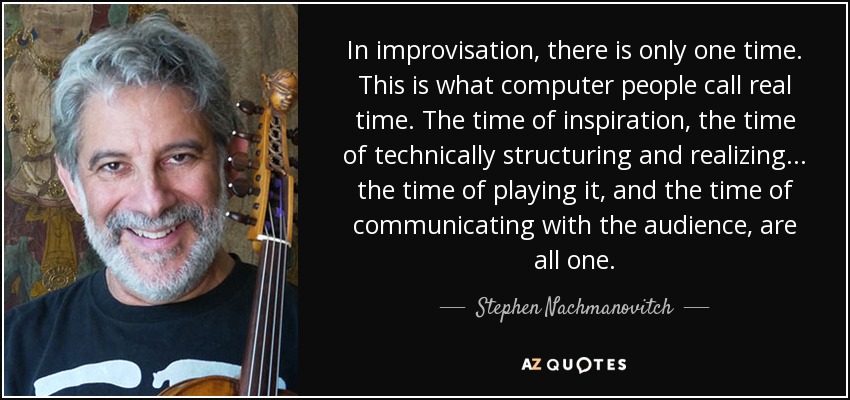
In improvisation, there is only one time. This is what computer people call real time. The time of inspiration, the time of technically structuring and realizing... the time of playing it, and the time of communicating with the audience, are all one.
Working within the limits of the medium forces us to change our own limits. Improvisation is not breaking with forms and limitations just to be 'free,' but using them as the very means of transcending ourselves.
In a one-woman show, there must be compelling material that you adore. In both of these there are conversations with you and another character. My Second City (improvisation) background comes in very handy for accent and body posture.
I believe that improvisation is really just a directorial tool. It's a writing tool.
Everyone can act. Everyone can improvise. Anyone who wishes to can play in the theatre.
Music making features real-time creation, real-time decisions and actions. It's basically improvisation, which is the stuff of everyday life. In the realm of discourse about music, improvisation is marginal, but in the realm of doing it, it's omnipresent. Strange distinction here: we're improvising all the time, but when we tend to talk about music, we tend to talk about objects that are fixed, like recordings, scores, pieces.
I think in theater it demands that you say the same words every night and make it feel fresh and new. Improv demands that you be operating at the highest level of your creativity intelligence. So these two skills are both very important but I've seen people who are very skilled at one area struggle with the other. Either improvisers feel constrained by having to say the same thing over and over again or people who are really good at doing scripted work feel intimidated and exposed doing improvisation.
John [Cassavetes] loved actors. He gave them a lot of freedom. So if something came up that a certain actor just felt at the moment and said - that kind of improvisation he would accept. He gave very little direction.
Most of my music is improvisation, and composition is improvisation. Even if I have a score, it is improvisation.
There is indeed a level of improvisation where we can distort and shuffle the music patterns, samples, and loops in each phase of the show within fixed cue points, but at the same time there is a constant result that we are trying to achieve each night while performing and operating our system - quite similar in spirit to a broadway show for example: If you go see a musical two nights in a row, the performances are different yet similar.
Making Homeland series is not improvisational comedy theater, but it is improvisation. We might get a call that morning, while we're doing something, and the change goes in that is something that just happened an hour ago, in the world.
I like messing up the song, doing some improvisation. And I like running around the room with the mic.
When I was in college my improvisation troupe and I did a road trip to Chicago, and went to The Second City to see the classic 'Paradigm Lost' revue - with Tina Fey, Rachel Dratch, Scott Adsit and Kevin Dorff. It blew my mind, and proved to me you can do sketch comedy like you're doing 'Long Day's Journey into Night.' We could treat it like theater.
The reality for me is simple. When music is written, it is usually categorized as classical. When it is improvised, it can still be called classical if it is an inspired improvisation. In either category, it is still music, and it can be good or bad or simply mediocre.
I like the idea of the objecthood of music being destabilized by process and things like improvisation. That's what empowers us; that's how we make each day new as players, as people.
Continual improvisation on a theme is a more useful way to think of how to bring the various parts of life together.
What people think improvisation is and non-improvisation is, it's nothing to do with what you like or dislike. It's all about how it happens with certain directors and certain scenes. That's the way it works. It's not something, in general, that you can decide.
What I want to happen is to be really creative, and to play something new in the improvisations, every time.
Even if you're improvising, the fact that beforehand you know certain things will work helps you make those improvisations successful. It really helps to have a certain amount of knowledge about musical structure.
I can't speak American dog very well. There was a lot of improvisation with Uggie - like when I put the dog on the table or sometimes I follow him, sometimes he follows me. I had a lot of treats in my pocket. We worked with Omar Von Muller, the dog trainer. It was very easy because it was a big movie.
I love improvisation.
The problem that I have is with the music business. For some reason it seems almost impossible to get anything, any music, released which includes improvisation or soloing.
I really enjoyed working on 'Dumb & Dumberer' with Cheri Oteri, maybe because we are both into improvisations. We were meant to act together.
I teach a graduate seminar called "Theorizing Improvisation" that is pretty interdisciplinary, but really makes students deal with black studies seriously. A lot of authors of color, a lot of women of color - those become central to the intellectual trajectory. It considers music, but it also considers areas of thought that might seem unrelated to music. That's partly because we're expanding the notion of what music is beyond objects, beyond scores, beyond things.
I think the films and the paintings erase each other. The paintings are extremely slow and constantly going on in the studio - they're constantly regenerating themselves in this slow, monotonous way that's a physical struggle and can be a pain in the ass. They're all based on very specific math and diagrams. And the films, when I'm making them, are very fast, very collaborative, with a lot of improvisation.
Follow AzQuotes on Facebook, Twitter and Google+. Every day we present the best quotes! Improve yourself, find your inspiration, share with friends
or simply: