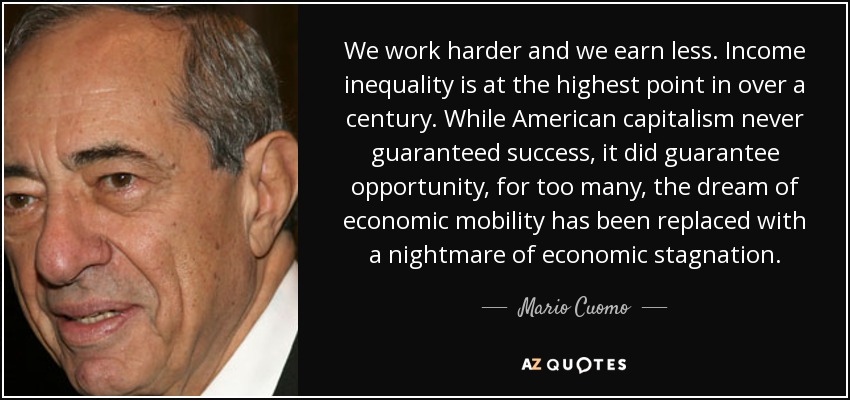
We work harder and we earn less. Income inequality is at the highest point in over a century. While American capitalism never guaranteed success, it did guarantee opportunity, for too many, the dream of economic mobility has been replaced with a nightmare of economic stagnation.
If you really want to end income inequality, I've got the way to fix it. People who don't work shouldn't get any income.
When the wilderness movement emerged, it emerged separate from the issue of social inequality and the economic problems of survival. It was a preservationist ecology movement created by an occupying culture. Clearly, a wilderness movement started by Native Americans would not have had the same roots.
Let there be no mistake, Sen Sanders, his campaign and the vigorous debate that we've had about how to raise incomes, how to reduce inequality, increase upward mobility, has been very good for the Democratic Party and for America.
We have the history of slavery or inequality to women, and now the civil rights movement of the 21st century is the struggle for equality for the gays, lesbians, bisexuals and transgender people. And I think it's important for Americans to know about the times that we failed.
We started out covering income inequality in the magazine [Mother Jones], but that ongoing body of work positioned - and sourced - us well to put both Occupy and the 47 percent in context.
All those people who went out [to Occupy Wall Street] missed work, didn't get paid. Those were individuals who were already feeling the effects of inequality, so they didn't have a lot to lose. And then the individuals who were louder, more disruptive and, in many ways, more effective at drawing attention to their concerns were immediately castigated by authorities. They were cordoned off, pepper-sprayed, thrown in jail.
I don't support everything Bernie Sanders supports, but I support most of it: universal health care, reining in Wall Street, fighting climate change, reversing the growth of income inequality, and so forth. If we could accomplish all this in a couple of years, I'd be delighted. But we can't.
When it comes to social policies, I believe women have the right to make their own choices, and inequality is a really important issue.
As inequality grows, the basic bonds of social fraternity are fraying - as we discussed in regard to Occupy Wall Street. As tensions increase, people will become more willing to engage in protest. But that moment is not now.
The critique of social inequality, which is very much a part of my story, came about naturally from my recollection of Huck and Tom and the controversy surrounding [Mark] Twain's use of them and from my own passionate interest in civil rights, animal rights, and the right of Earth to survive humankind's reprehensible neglect of its stewardship.
We have a lot of inequality, and I'm not a one-issue candidate, because I don't think this is a one-issue country. So I want to knock down all the barriers that stand in the way of people getting ahead and staying ahead.
I think the stress on income inequality is something that every American should take seriously.
I have been really heartened by how much coverage there has been about inequality of pay across the board, between the entertainment industry and almost every industry worldwide. And just the problem of young women not getting an education, not being able to have an equal position in the cultures all around the world.
I think that why the research and the data are so important is because you become so used to seeing the world one way that you don't even notice anymore. [Gender inequality] has this invisibility.
Employers able to work together with workers and sharing gains and profits will lead to a much better world, getting away from income inequality.
I think the stress on income inequality is something that every American should take seriously, we have got to figure out how we're going to provide more economic opportunity - good jobs with rising incomes - and I'm excited to work with Senator Sanders in doing that.
I think liberals should accept that if we want big programs that significantly reduce inequality - and we should - it's going to require higher taxes on everyone. The rich can certainly do more, especially given their stupendous income increases since the Reagan era, but they can't do it all.
I believe that virtually all the problems in the world come from inequality of one kind or another.
I think, from a progressive point of view, to have a Democratic Congress and a Democratic White House, and to have spent the time on Obamacare, which had real benefits, 20 million insured, but not on inequality, was a major cost to the Democratic Party, costing them their majorities, but also a bit of a cost to the country, because it didn't address the fundamental issues that led to Donald Trump and that led to a lot of unhappiness, just the continued widening inequality.
Occupy did something fabulous. What Occupy made clear was that there is an inequality at the heart of American democracy that undermines it, if not ruins it. That served a purpose. It suggested that we need a new language and we need a new way of understanding exactly how politics leaves people out, particularly young people.
There are some people who say that theyre concerned only with poverty but not inequality. But I dont think that is a sustainable thought. A lot of poverty is, in fact, inequality because of the connection between income and capabilityhaving adequate resources to take part in the life of the community.
First of all, [Buckminster Fuller's] identification of the problems that are all that much more pertinent, all that much more pressing in the world today than in his own lifetime from sustainability in terms of the environment to income inequality.
Four hundred top-decision makers listed the myriad looming threats to global security, including famine, terrorism, inequality, disease, poverty and climate change. Yet when we tried to address each diverse force, we found them all attached to one universal security risk: fresh water.
I think markets are mechanisms that determine prices that are necessary for mass heterogenous populations, and markets do generate levels of technological innovation and productivity that is crucial. But when unregulated, they often generate levels of vast inequality and ugly isolation that makes it difficult for people to relate and connect with one another.
Follow AzQuotes on Facebook, Twitter and Google+. Every day we present the best quotes! Improve yourself, find your inspiration, share with friends
or simply: