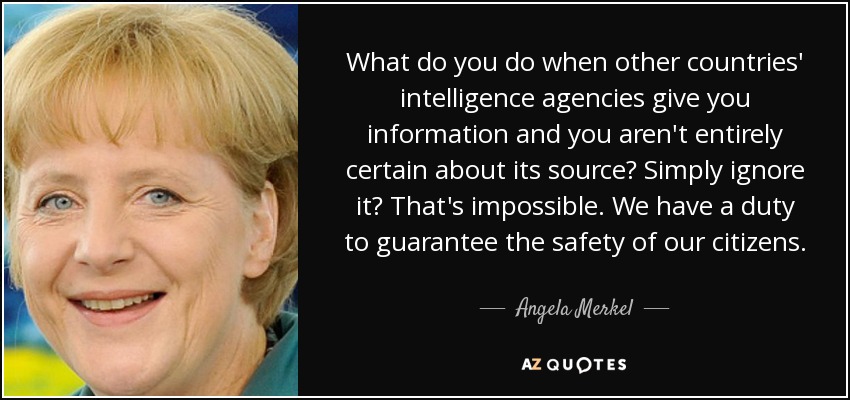
What do you do when other countries' intelligence agencies give you information and you aren't entirely certain about its source? Simply ignore it? That's impossible. We have a duty to guarantee the safety of our citizens.
The world is too full of information.
I'm a firm believer and always have been that there aren't all that many things that you should not express to children in an age-appropriate manner, and as a parent, that is your job - to be discerning as to whether or not your child can handle the information, provided you have the ability to express yourself in that age-appropriate way.
Information is floating around really fast. I write something, or a piece of my music comes out and I see people writing about it on the Internet as if I'm having a conversation with them. We've never met, but somehow, my music is communicating something to them. Very often, it really makes them feel something.
My job is essentially just corralling more and more and more facts and information, and occasionally seeing whether that leads to some action.
The country is only as strong as its journalism - that's the way democracies work. The higher the quality of the information, the better informed the electorate is and the better the government runs.
I think maybe 50 years ago people and businesses felt like they had to choose between maximizing profits and making customers happy or making employees happy, and I think we're actually living in a special time where everyone's hyperconnected, whether through Twitter or blogs and so on. Information travels so quickly that it's actually possible to have it all, to make customers happy through customer service, to make employees happy through strong company cultures, and have that actually drive growth and profits.
Internet becoming accessible everywhere, whether it was Wi-Fi at work, on your cell phone as you traveled. People had it at home with broadband. There was a big change.It used to be people used the Internet primarily at work, because that's where they had a good connection. Now they're using it at home. And the second big change is, they used it not just to get information, but to communicate with one another. And, so, it became not simply an information exchange, but a personal exchange, a communication mechanism.
Comedy makes everything accessible. Watching the news is kind of like being fed your evening pill. What's fun about it? Nothing. And so if you can get news and information about things going on in the world through a comic platform, everything's going to connect.
[T]he public library is where those without money, power, access, university affiliation, or advanced degrees can get information for free.
The general unreliability of all information presents a special problem in war: all action takes place, so to speak, in the twilight, which, like fog or moonlight, often tends to make things seem grotesque and larger than they really are. Whatever is hidden from full view in this feeble light has to be guessed at by talent, or simply left to chance. So once again for the lack of objective knowledge, one has to trust to talent or to luck.
If we consider the actual basis of this information [i.e., intelligence], how unreliable and transient it is, we soon realize that war is a flimsy structure that can easily collapse and bury us in its ruins. ... Many intelligence reports in war are contradictory; even more are false, and most are uncertain. This is true of all intelligence but even more so in the heat of battle, where such reports tend to contradict and cancel each other out. In short, most intelligence is false, and the effect of fear is to multiply lies and inaccuracies.
The Freedom of Information Act should be administered with a clear presumption: In the face of doubt, openness prevails.
I love the values football can teach. It gives young people a sense of how to defer present gratification for future success, it teaches self-discipline, it teaches teamwork, it gives them a bonding experience that can be hard to find somewhere else, it teaches the ability to process large amounts of information and apply it in real time.
Our civilization is experiencing unprecedented changes across many realms, largely due to the rapid advancement of information technology. The ability to code and understand the power of computing is crucial to success in today's hyper-connected world.
University, as institutions, pre-date the information economy by many centuries and are not for-profit cultural entities, whose reason of existence (purportedly) is to discover truth, codify it through techniques of scholarship, and then teach it. Universities are meant to pass the torch of civilization not just download data into student skulls.
To take full advantage of the potential in e-business, leaders must lead differently, and people must work together differently. Let's call this new way of working e-culture-the human side of the global information era, the heart and soul of the new economy.
How much of the national news that you report to the public each night consists of information you've actually gone out and dug up on your own?
An economy that adds value through information, ideas, and intelligence-the Three I Economy-offers a way out of the apparent clash between material growth and environmental resources.
Make me what Thou wouldst have me. I bargain for nothing. I make no terms. I seek for no previous information whither Thou art taking me. I will be what Thou wilt make me, and all that Thou wilt make me. I say not, I will follow Thee whithersoever Thou goest, for I am weak, but I give myself to Thee, to lead me anywhither.
Twitter and Facebook are brilliant- tools, the journalistic uses of which are still being plumbed. They are great for disseminating interesting material. They are useful for gathering information, including from places that are inaccessible.
There are three kinds of feedback and organizations must utilize all three to be effective: 1. Evaluation. This rates you against standards and peers. It lets you know where you stand. 2. Coaching. This information helps you get better and learn. It is an engine for learning. 3. Appreciation. Most desire for feedback is usually for appreciation. It motivates us.
Other people have all kinds of information about you that is invisible to you. How do you get feedback?
I find it more credible, since it is anterior information, that one man should know heaven, as the Chinese say, than that so many men should know the world.
It is easier taking the beaten path than making our way over bogs and precipices. The great difficulty in philosophy is to come to every question with a mind fresh and unshackled by former theories, though strengthened by exercise and information.
Follow AzQuotes on Facebook, Twitter and Google+. Every day we present the best quotes! Improve yourself, find your inspiration, share with friends
or simply: