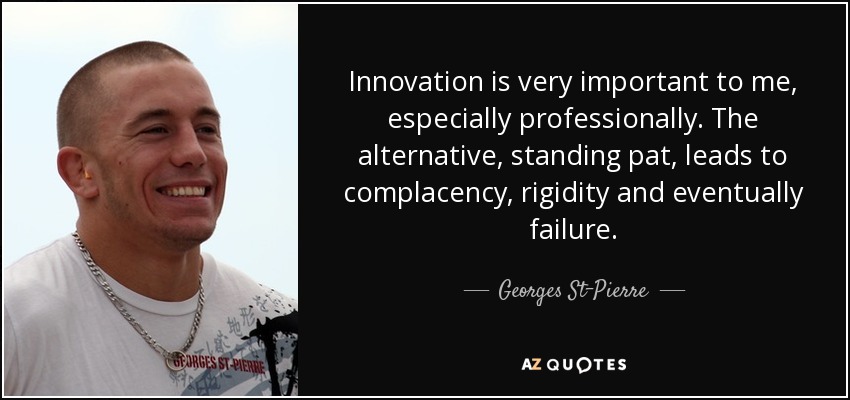
Innovation is very important to me, especially professionally. The alternative, standing pat, leads to complacency, rigidity and eventually failure.
It's like when IBM drove a lot of innovation out of the computer industry before the microprocessor came along. Eventually, Microsoft will crumble because of complacency, and maybe some new things will grow. But until that happens, until there's some fundamental technology shift, it's just over.
It is embarrassing that the United States is so far behind the rest of the world when it comes to mCommerce.
What drives innovation is abundance and ease, not the pressure of scarcity.
Language was such a profoundly new evolutionary innovation that our brains had to be completely redesigned in order to handle it.
America has always been a country of innovation and dynamism, entrepreneurship. And I think that one of the things that has made our country great too is its heterogeneous population where people come here from all over the world.
I know the rewards of focusing on innovation and outcomes as opposed to hours. I've been fortunate to work with brilliant entrepreneurs who didn't have years of experience and yet they changed the world.
At some point, every science fiction and fantasy story must challenge the reader's experience and learning. That's much of the reason why the genre is so open to experimentation and innovation that other genres reject--strangeness is our bread and butter. Spread it thick or slice it thin, it's still our staff of life.
In an age of multiple and massive innovations, obsolescence becomes the major obsession.
People who are not leaders automatically gravitate toward lines--limitations set by others. Many people are taught this in kindergarten when they are instructed to stay within the lines while coloring. But leaders are more creative than that. They look for options and opportunities. They try to take things in a new direction, or beyond the limit. Progress and innovation are made by people who think without lines.
Although I will deeply miss the talented team at SCEA and the passion demonstrated every day by our fans, I'm very excited about starting the next chapter of my career. I want to thank the employees, partners, and customers for their tireless commitment to the PlayStation brand and, of course, to our fans who have pushed us to new heights of innovation and entertainment over the past two decades. I leave PlayStation in a position of considerable strength and the future will only get brighter for PlayStation Nation.
Steve Jobs gave a small private presentation about the iTunes Music Store to some independent record label people. My favorite line of the day was when people kept raising their hand saying, "Does it do [x]?", "Do you plan to add [y]?". Finally Jobs said, "Wait wait - put your hands down. Listen: I know you have a thousand ideas for all the cool features iTunes could have. So do we. But we don't want a thousand features. That would be ugly. Innovation is not about saying yes to everything. It's about saying NO to all but the most crucial features.
At the crowded Costanzi Theater in Rome, while I was listening to the orchestral performance of your overwhelming Futurist music,1 together with my Futurist friends Marinetti, Boccioni, Carrà, Balla, Soffici, Papini, and Cavacchioli, there came to my mind the idea of a new art, one that only you can create: the Art of Noises, a logical consequence of your marvelous innovations.
The trouble with innovation is that truly innovative ideas often look like bad ideas at the time.
The musical theater is a glorious and distinctly American innovation in the history of theater.
I think innovation as a discipline needs to go back and get rethought and revived. There are so many models to talk about innovation, there are so many typologies of innovation, and you have to find a good innovation metric that truly captures the innovation performance of a company.
I wonder whether there has been too much emphasis on teaching women to conform, to fit into the system. Certainly that suits conservative organizations in conservative times. But now ... innovation and creativity are necessary.
There are 20 million unemployed and what does the Constitution offer us in the Europe of 25, 27 and soon to be 30: policies of unrestricted competition to the detriment of production, wages, research and innovation.
So many people have that kind of attitude and approach to learning that it gives me great hope for the world. I say hope in the sense that innovations in science and technology will be the engines of a 21st century economy and I don't want to go broke, as a nation. So, the hope I have is that, if people embrace it, we'll have a healthier, more secure, wealthier nation than we have.
When we think about immigration, we have to understand there are folks all around the world who still see America as the land of promise. And they provide us energy, and they provide us innovation. And they start companies like Intel and Google, and we want to encourage that.
Without investments in research and science that will create the next Apple, create the next new innovation that will sell products around the world, we will lose. If we're not training engineers to make sure that they are equipped here in this country, then companies won't come here. Those investments are what's going to help to make sure that we continue to lead this world economy not just next year, but 10 years from now, 50 years from now, a hundred years from now.
Innovation needs to be nurtured throughout an organization. Management is doing things right, whereas leadership is doing the right things.
Ever since Sir Isaac Newton's times, scientists have worked in the same sort of way: They show a great respect for experiment and observation, They don't cherry pick data, They take a skeptical approach to what they do. And then scientists work together to get a consensus as to what should be believed And that generates very reliable knowledge and that reliable knowledge drives innovation
Innovation and creativity are the juiciest parts of running a business.
Artists who have produced experimental innovations have been motivated by aesthetic criteria: they have aimed at presenting visual perceptions. Their goals are imprecise, so their procedure is tentative and incremental.
Follow AzQuotes on Facebook, Twitter and Google+. Every day we present the best quotes! Improve yourself, find your inspiration, share with friends
or simply: