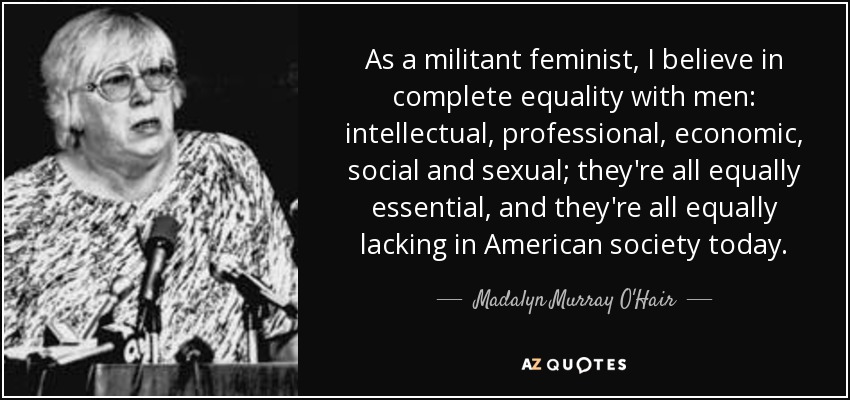
As a militant feminist, I believe in complete equality with men: intellectual, professional, economic, social and sexual; they're all equally essential, and they're all equally lacking in American society today.
I need somebody who can at least stand up to me and slug it out, toe to toe. I don't mean a physical battle. I mean a man who would lay me, and when he was done, I'd say: "Oh, brother, I've been laid." Or if we had an argument, he would stand up and engage in intellectual combat and not go off and mope in the corner, or take reprisals, or go to drink.
What is irreversible in the Arab world is this intellectual revolution, the awakening that we can get rid of dictators. That is here, and the people have this sentiment and this political power. They feel that they can do it, and it's still there. At the same time, we don't know what is going to happen. So to be very quick by saying, "Oh, revolutions and Arab Spring," and - you know, what I'm advocating is to take a cautious optimism as the starting point of our analysis and to look at what is happening.
I think there's a faith formula in that verse: believe plus receive equals become. So I think believing's important, having intellectual agreement with Christian doctrine is important, but there has to be a time when we receive God's gift of grace - not that we've earned it or merit it or deserve it - but receive this free gift of forgiveness and eternal life that Jesus purchased on the cross for us.
I came to the conclusion that most people in America would really like to be able to get a job where they think they're doing something noble and nice and good and it isn't just for the money. But the reason they hate what they call the cultural elite is that they see it as a class that's grabbed all the jobs where you can get paid to do something that isn't just for the money - if it's art, if it's charity, if it's intellectual, if it's political, whatever it might be.
If I write a paragraph and I don't get a certain lift from it, if I don't feel connected to it emotionally, then it's dead to me. When I'm reading other fiction writers, if I don't get any emotional investment from the writer, if it's just intellectual or clever - you know, most writing that passes as deep is just clever - I don't feel any connection.
That is my job as an intellectual, as an extension of my vocation: to engage in a serious reckoning with the present manifestation of both white supremacy, white refusal to acknowledge culpability, and the attempts of black people to re-describe the harm and trauma we've endured, as well as to say afresh what it is that must be done if we are to be conscientious.
Whiteness itself is artifice, is fiction, is a construction, is narrative, is myth. And I seek to deconstruct all of that, to challenge the accretion, the intellectual accretion, the philosophical secretion that generates within the edifice of white supremacy that allows people easy escape, and egress. And I'm saying, "No, you can't leave now. You cannot afford to not know what I'm talking about, because you gotta be held accountable."
Today, practically every country outside the West is undergoing an intellectual, political, and cultural churning, from China to Bolivia, Egypt to Indonesia, but we haven't really had, after the 1960s, a major oppositional culture in Western Europe and America. The Occupy movement was so startling and welcome partly because it was the first such eruption of mass protests in decades.
One has to be cautious and respectful of the power of the "substance" guides. I don't advocate imbibing the "little saint children," as Maria Sabina calls the magic mushrooms, or anything else for everyone. I find that certain substances reconnect me to a primal context of purpose that goes beyond identity and ownership. The writing-when I've worked it this way-is the kind of information you take back from dreams. Or it's hypnotic writing rather than getting off on some sort of pleasure trip or intellectual trip.
Writing a book about Jeremy Corbyn, set out with two objectives. The first was simple: to explain how he became the leader of the Labour Party. I was disappointed - but not at all surprised - at the complete absence of intellectual curiosity on display. The second objective I had to try to capture for posterity the excitement and spirit of the first Corbyn campaign. Those moments when the impossible suddenly becomes possible are so powerful to those who experience them. I think it's politically valuable to relive such moments, to learn the lessons of what went right.
The most glorious vision of the intellectual life is still that which is loosely called humanist: the idea of a mind committed yet dispassionate, ready to stand alone, curious, eager, skeptical. The banner of critical independence, ragged and torn though it may be, is still the best we have.
I teach a graduate seminar called "Theorizing Improvisation" that is pretty interdisciplinary, but really makes students deal with black studies seriously. A lot of authors of color, a lot of women of color - those become central to the intellectual trajectory. It considers music, but it also considers areas of thought that might seem unrelated to music. That's partly because we're expanding the notion of what music is beyond objects, beyond scores, beyond things.
Take a look at the current debates in Washington, and of course, everything in the media. Only one issue is discussed: the deficit - the least significant issue, but the most significant issue for the banks. The big problem, joblessness, is barely discussed, even though that's what the public wants, as polls clearly show. That's even what the business press supports, but the financial institutions are so powerful that the only issue is the deficit, and this runs right through the intellectual culture.
There is always the working out of things, and you have to have sort of a gut response to it. And an intellectual response. And an aesthetic response. All that comes from having done this for a long time. Instead of saying, "That's a really good rock track, and that will do," I'm looking for something that is more original and fresh. There are a lot of elements to get into it: a level or sophistication, passion and excitement.
Often, we separate intellectual discourse from emotional reaction. But I take such genuine pleasure in things that are intellectually well architected. It's definitely an integrated experience for me. Much more than any kind of cheap, emotional pulls that you get in popular culture, when I read a sentence and it's beautifully written, it can bring me to tears.
Intuition is the key to everything, in painting, filmmaking, business - everything. I think you could have an intellectual ability, but if you can sharpen your intuition, which they say is emotion and intellect joining together, then a knowingness occurs. Feeling correct is a feeling I think everyone knows.
That's always my downfall - when I start not having fun or not feeling passionate about what I'm doing. But that's why I love Emilio Pucci. There are some design houses that operate on a more intellectual level, but the way Pucci has always worked is more spontaneous and instinctual.
What is work going to look like in the future? How are Democrats going to be able to give people a sense that they can have good jobs, or if they don't have good jobs, maybe they have to have universal basic income - we have to have a longer discussion about the future. This is not just an intellectual exercise; it's an exercise about giving people hope.
I'm not an ensemble actor, because it's always a lot of ego when you're all together in the scene. It's kind of intellectual fighting for something.
The pop world is popular, and it's about what the people want and connecting to the masses, whereas opera, although it was once popular - and I still believe it can be - it has become very elitist and intellectual, but that certainly doesn't sell tickets. It's a struggle, but I've always embraced struggle and thrived off of it, so it's the way my life needs to go.
Sometimes the former forces are in the ascendance, and "democratic governance" is eroded, though anyone familiar with intellectual history would expect that the slogans will be passionately proclaimed as they are drained of substantive content. We happen to be living in such an era, but as often before, there is no reason to suppose that the process is irreversible.
I don't really see what can be said about the role of faculty members, or universities, beyond the truisms voiced earlier, and their elaboration in various domains, ranging from focused intellectual pursuits to the concerns of the larger society and future generations.
In a lot of writing or intellectual discourse we're starting to use that model: "Oh, this is where it comes from!" I would like to concentrate on work which is more resistant to that procedure, as I think fiction is.
Stand-up is so rewarding, and I enjoy the acting opportunities I've had, but the only time I really feel bad is when I feel like I have this manufactured belief that I should be doing something else or there should be some type of recognition. On an intellectual level, I know it's stupid.
Follow AzQuotes on Facebook, Twitter and Google+. Every day we present the best quotes! Improve yourself, find your inspiration, share with friends
or simply: