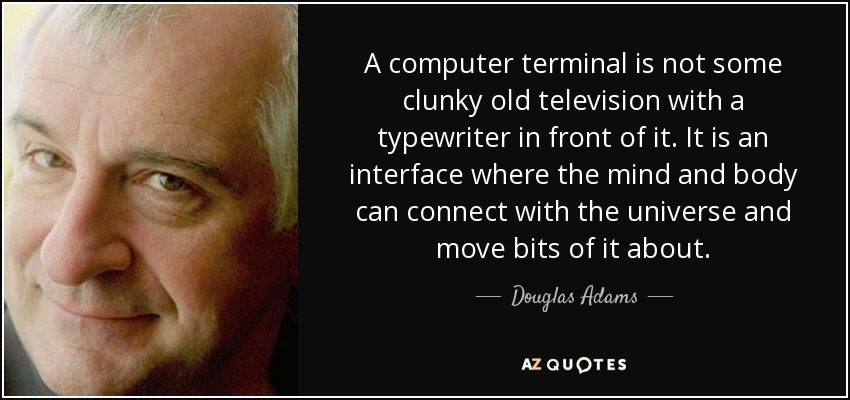
A computer terminal is not some clunky old television with a typewriter in front of it. It is an interface where the mind and body can connect with the universe and move bits of it about.
First was the mouse. The second was the click wheel. And now, we're going to bring multi-touch to the market. And each of these revolutionary interfaces has made possible a revolutionary product - the Mac, the iPod and now the iPhone.
A well-designed and humane interface does not have to be split into beginner and expert subsystems.
I am only a footnote, but proud of the footnote I have become. My subsequent work on eliciting principles and developing the theory of interface design, so that many people will be able to do what I did is probably also footnote-worthy. In looking back at this turn-of-the-century period, the rise of a worldwide network will be seen as the most significant part of the computer revolution.
A general principle for all user interface design is to go through all of your design elements and remove them one at a time.
A picture is worth a thousand words. An interface is worth a thousand pictures.
I am suggesting that we recognize that in network and interface research there is something as profound (and potential wild) as Artificial Intelligence.
I have discovered that there are two types of command interfaces in the world of computing: good interfaces and user interfaces.
First, I'd like to see the basic tools such as compilers, debuggers, profilers, database interfaces, GUI builders, CAD tools, and so forth fully support the ISO standard.
One of the problems with computers, particularly for the older people, is they were befuddled by them, and the computers have gotten better. They have gotten easier to use. They have gotten less expensive. The software interfaces have made things a lot more accessible
Once the product's task is known, design the interface first; then implement to the interface design.
As far as the customer is concerned, the interface is the product.
I think complexity is mostly sort of crummy stuff that is there because it's too expensive to change the interface.
In many cases the user interface to a program is the most important part for a commercial company: whether the programs works correctly or not seems to be secondary.
An interface is humane if it is responsive to human needs and considerate of human frailties.
People who work on the user interface side need to have empathy as a key characteristic. But if you are writing device drivers you don't really need to understand humans so well.
The user of the electric light - or a hammer, or a language, or a book - is the content. As such, there is a total metamorphosis of the user by the interface. It is the metamorphosis that I consider the message.
The librarian isn't a clerk who happens to work in a library. A librarian is a data hound, a guide, a sherpa and a teacher. The librarian is the interface between reams of data and the untrained but motivated user.
Since changing interfaces breaks clients you should consider them as immutable once you've published them.
A user interface is well-designed when the program behaves exactly how the user thought it would.
An interface can be a powerful narrative device. And as we collect more and more personally and socially relevant data, we have an opportunity, and maybe even an obligation, to maintain [our] humanity and tell some amazing stories.
Well, Apple invented the PC as we know it, and then it invented the graphical user interface as we know it eight years later (with the introduction of the Mac). But then, the company had a decade in which it took a nap.
Mindfulness practice means that we commit fully in each moment to be present; inviting ourselves to interface with this moment in full awareness, with the intention to embody as best we can an orientation of calmness, mindfulness, and equanimity right here and right now.
It is in everybody's interest to seek those [actions] that lead to happiness and avoid those which lead to suffering. And because our interests are inextricably linked, we are compelled to accept ethics as the indispensable interface between my desire to be happy and yours.
[The] dynamics of computational artifacts extend beyond the interface narrowly defined, to relations of people with each other and to the place of computing in their ongoing activities. System design, it follows, must include not only the design of innovative technologies, but their artful integration with the rest of the social and material world.
Follow AzQuotes on Facebook, Twitter and Google+. Every day we present the best quotes! Improve yourself, find your inspiration, share with friends
or simply: