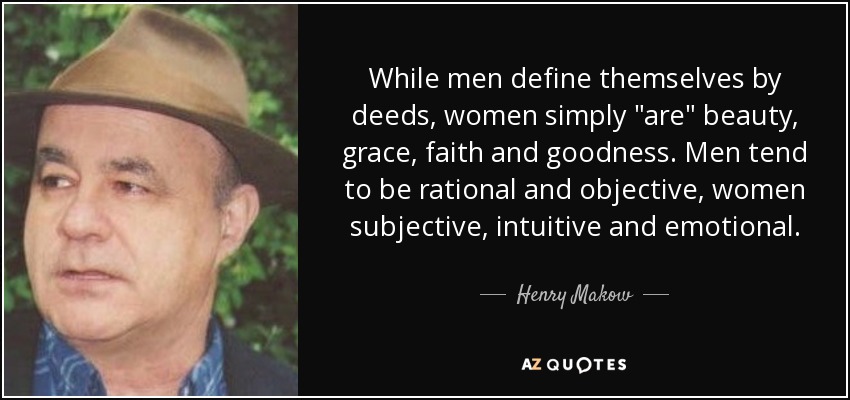
While men define themselves by deeds, women simply "are" beauty, grace, faith and goodness. Men tend to be rational and objective, women subjective, intuitive and emotional.
If you tell yourself something over and over again, right or wrong, it becomes intuitive.
[Heraclitus had] pride not in logical knowledge but rather in intuitive grasping of the truth.
The Beautiful arises from the perceived harmony of an object, whether sight or sound, with the inborn and constitutive rules of the judgment and imagination: and it is always intuitive.
Grace is thickly counter-intuitive. It feels risky and unfair. It's dangerous and disorderly. It wrestles control out of our hands. It is wild and unsettling. It turns everything that makes sense to us upside-down and inside-out.
I do not understand what makes me take a picture. Cartier-Bresson talks about the decisive moment, the necessity to function with lynx eyes and silk gloves. Perhaps what happens when you press the shutter is an intuitive act infused with all you have learned.
I'm not one of those actors who sits around the table and intellectualizing anything, or discusses much of anything. Everything for me is intuitive and instinctive.
A characteristic of intuitive solutions and new ideas is that of being obvious once they are discovered.
There are ages in which the rational man and the intuitive man stand side by side, the one in fear of intuition, the other with scorn for abstraction. The latter is just as irrational as the former is inartistic.
Some of my colleagues are surprised by how little personal interaction I've had with "my" authors, but I don't translate to go fishing for friends. Part of me suspects that they wouldn't like me, or that I wouldn't like them, which would inevitably get in the way of the mission. None of the theory built around translation matters to me anyway: much of the process, I find, is intuitive.
You just want to go off and be intuitive and wild, and that's what Bryan Cranston brings to the game.
Intuitive seeming is in my view an attraction to assent based on nothing more than understanding of the content that upon consideration attracts one's assent. But such understanding-based attraction can differ dramatically in epistemic quality. Some such attractions represent nothing more than superstition or bias absorbed from the culture, sans ratiocination.
We need to develop the intuitive capacities of the brain that some geniuses have manifested over humanity's lengthy history.
I have some sort of performing gene that's just there and I cannot explain it but I want to connect with people through a camera or on a stage. I just can do it. I just have an intuitive sense of it. So I love doing that, I love going into that trance.
When people are dying, they call their old enemies and try to forgive them and try to be forgiven by them. They call their old friends and affirm their love for them, as well as detach themselves from them, and they try to get into as free a space as they can so they're really ready to go. They give away all their possessions and are as generous as possible. They give up old hatreds and grudges, and that's a wise intuitive thing, because it's much freer to live like that.
I say that there is nothing deficient about our current theoretical grasp of mind-brain identities. The problem is only that they are counter-intuitive.
As a sensitive and highly intuitive person in the command-and-control corporate world, I always felt miscast.
I get emails from strangers every day asking for love advice, which is kind of counter-intuitive since I'm making a movie about what an idiot I am with relationships.
The course was more plodding than heroic: I did not strive valiantly against doubters but took incremental steps studded with a few intuitive leaps.
Anyone with great imagination, of course, is intuitive. Knowledge of any nature, unless put into practical use, becomes of little effect.
I have kind of an intuitive feeling as a composer as to what would be appropriate for those groups and how to feature certain paths in a certain way, whether there was dialogue in a scene, or whether there was no dialogue and music was telling the story at that point.
When I'm drafting, I suppose it's an intuitive process - figuring out when something just has a surreal glaze on it and when it grapples with something that could threaten a character's day-to-day reality.
When you walk to the end of a fiction, its procedure is 1) intuitive; and 2) emotional. Its intelligence is emotional, I think.
Looking at and shaping your own work is a very intuitive process. You see something you've written in your notebook. It's there on the page and either feels right or it doesn't, and it's hard sometimes to go beyond that and discover why it feels that way.
I wouldn't say I'm a very technical [guitar] player. I'm more intuitive - it's always more about chasing an abstraction.
Follow AzQuotes on Facebook, Twitter and Google+. Every day we present the best quotes! Improve yourself, find your inspiration, share with friends
or simply: