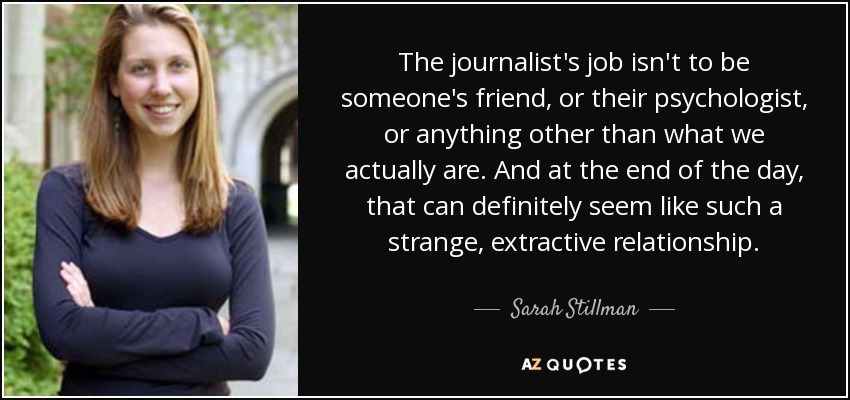
The journalist's job isn't to be someone's friend, or their psychologist, or anything other than what we actually are. And at the end of the day, that can definitely seem like such a strange, extractive relationship.
Speaking generally, I think it's useful to acknowledge explicitly the power imbalance between a journalist and the protagonists in a story about poor people, even to make that imbalance part of the story - and to redress it, narratively, where you can.
The professions of novelist and journalist are very separate. As a novelist, you are ultimately working for yourself. Yes, you need the approval of a publisher and an audience, but what is valued in fiction writing - style, individual voice, insight - is scorned by the editor who is combing through your newspaper article.
I have always had a hard time revising my work as a journalist, which was never much of a problem. You always have editors as backstops. Their job is to perfect your story. Most of them want to be useful.
As a journalist, or an anthropologist, the convention is that people are there for you to study, and they are your objects.
Being an American journalist can put people on the defensive. In countries where people assume the press is partisan, like in Lebanon, or where it had essentially become an extension of the government, like in Iraq, people tend to see a journalist as an agent of his or her government. That can be dangerous if the United States military is occupying their country, or aligned with their enemies.
have a lot of respect for the responsibility that journalists have to ask tough questions, to hold the administration accountable and to be advocates for the citizens of the United States.
The most important problem in Iran is that the courts have lost their independence, and they are under the influence of the Ministry of Intelligence and their people. This is why we witness a number of journalists and human rights activists, my colleagues, and a number of feminists, in prison.
I'd rather [the collection] have no title. Journalists like titles. That's why I give them to you.
I can't become naked for everybody. It's never going to be possible for the person to write the whole story completely, so I find bits of myself, bits of what I think in some articles. And I don't give lip service to journalists. I never make them feel comfortable. I say, "It's your job to make the story."
I was living in New York at the time of the 9/11 attacks. And I remember, you know, in those weeks that followed, when none of us spoke about anything else really, a number of friends of mine, people I knew, including very experienced journalists, I heard them saying things like, well, now we understand what happened to you.
I began my career in the arts as a model, before adding my hats as an actress, a photographer, a journalist and now, filmmaker. I've seen and experienced it all.
During the Gulf War, journalists used to challenge government news managers and insisted they wouldn't just accept the official version of events.
Not only do journalists not have a responsibility to report what skeptical scientists have to say about global warming. They have a responsibility not to report what these scientists say.
I posted some story about the Arizona State baseball coach getting into a fight with an autograph hound, and it was a disastrous thing. The guy rescinded his story. It proved to me that I'm not cut out to be a proper journalist. I'm much better sitting around and making fun of journalists and telling them what terrible journalists they are than being an actual journalist.
Citizen journalists can attend events traditional journalists are kept from - or have overlooked - or find and highlight the small but evocative story happening right next door. By tapping this resource, news sites can extend their reach and help redefine news gathering in the digital age.
It's harder now for journalists to do stories about billionaires, like Peter Thiel, without having at the back of their minds the fear that maybe somebody deep-pocketed, you know, with limited resources is going to come after us and can my organization afford to defend me?
We drank quite a lot and Tony Harrington said, "We're thinking of starting a record label at The Wire; how about you do a solo record?" I said, "Well, how am I going to do that?" I thought about it, and I'd been working on a lot of music in the years before, and I was working as a journalist, full time, really, up until that point; in whatever little spare time I had, I was working on music. So I said yes.
I feel that the term "new age" is used by basically hostile media to diminish and marginalize a conversation that is very significant. It's held in place by journalists who are constantly looking for hooks and sound bites to keep them from having to make the effort of a deeper understanding and a more profound level of communication with the public.
We wrote about having five kids and bringing them to church. A journalist at The Washington Post wrote this article where the headline was "The New Catholic Evangelism Of Jim Gaffigan." And it was a bit terrifying.
I love the idea of a shield law; I don't know of any journalist who doesn't love the idea of a shield law. It's all in the details. Some of the shield laws that were floating around sounded good, but when you looked at them, exceptions or exclusions or broadness in the language really invited some problems.
I can tell when I've met a bad journalist when they say, "I've met Madonna," or "I know Marilyn Manson." Because I haven't met anyone I've ever interviewed. I've sat down in the position of an interviewer, and they've sat down in the position of an artist trying to promote a product. We have no relationship. I'm able to ask them questions I'd never be allowed to ask them if we were casual friends. It's a completely constructed kind of situation.
The secret of success is an absolute ungovernable curiosity.
I started off as a journalist when I was young and I did not get paid unless I wrote three stories a day.
My fellow journalists called themselves correspondents; I preferred the title of reporter. I wrote what I saw. I took no action -- even an opinion is a kind of action.
Follow AzQuotes on Facebook, Twitter and Google+. Every day we present the best quotes! Improve yourself, find your inspiration, share with friends
or simply: