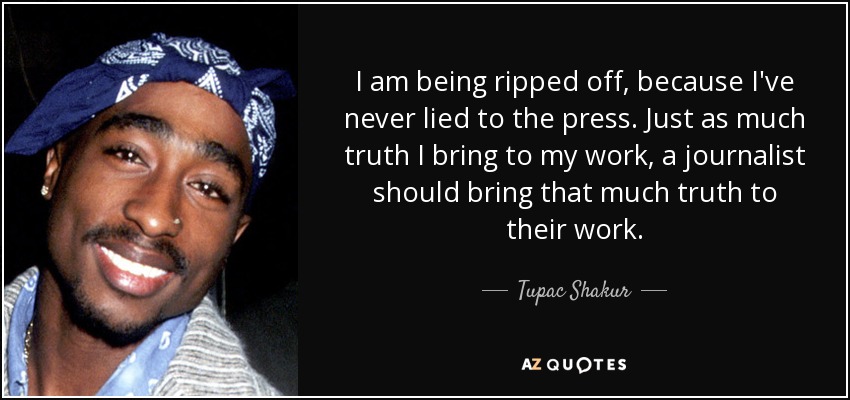
I am being ripped off, because I've never lied to the press. Just as much truth I bring to my work, a journalist should bring that much truth to their work.
Music journalists are some of the lazy, most uninspired, dull people I've ever met...
Like journalists. The police have an extremely sick sense of humor, very guarded, very private, very male, which they need to survive on an everyday level. I don't think anyone has ever managed to tap that on the screen - it would actually be too shocking.
I just got asked by another journalist 'Are you a feminist?' and I was just like... Is there a strange thing at the moment where you have to come out as a feminist? I've been asked if I'm a feminist so many times recently, and I'm just like 'Yes, yes, for God's sake, yes! Is there something that I give off that says I'm not?'
It's a lot of accumulated joy and tension and all kinds of emotions just pouring out of all us. We've all been preparing for this day and we all knew that one day we would just have to move on with our lives and careers even though we all love this show and love working together. But it's still an incredibly emotional time, especially for me with a lot of journalists asking me how it feels about FRIENDS coming to an end. It's started to make me think very deeply about what it's all meant to me and that's made me ever more emotional!
No news conferences? Interviews now only with friendly journalists? You can't be president or vice president and govern in that style, as a sequestered figure. This has been Mr. Bush's style the past few years, and see where it got us. You must address America in its entirety, not as a sliver or a series of slivers but as a full and whole entity, a great nation trying to hold together. When you don't, when you play only to your little piece, you contribute to its fracturing.
The most depressing thing about blogging is watching so-called 'citizen journalists' turn in to little more than easily offended partisan hacks. Any remark that is slightly less than completely and totally scripted and can give the slightest opportunity to offend some delicate soul somewhere is used to set off a series of partisan screeches and cries of outrage that would make the Church Lady jealous.
The prostitute journalist is a familiar and well-understood figure in the Middle East, and Saddam Hussein's regime made lavish use of the buyability of the regional press. Now we, too, have hired that clapped-out old floozy, Miss Rosie Scenario, and sent her whoring through the streets.
One time I was doing an interview for a gay magazine and halfway through the journalist found out I wasn't gay. He said, 'Sorry, I can't continue the interview.' Because they only had gay public figures in their magazine. I felt so crestfallen. I wanted to tell him: but I play fundraisers for gay marriage! I'd rather my kids were gay than straight!'
Moving forward, investigative journalists need to train themselves to be media amphibians - just as comfortable with the classic verities of great journalism as they are with video, Twitter, Facebook, and, most importantly, citizen journalism.
I don't think there's any question journalists have become targets, but then I think that - that anyone who tries to practice liberty becomes a target of fanatics.
One of the great weaknesses of journalists is they interview people and they think that's important. They think that they are going to show them their true hand. But more to the point, they're trapped.
Speaking generally, I think it's useful to acknowledge explicitly the power imbalance between a journalist and the protagonists in a story about poor people, even to make that imbalance part of the story - and to redress it, narratively, where you can.
I have always had a hard time revising my work as a journalist, which was never much of a problem. You always have editors as backstops. Their job is to perfect your story. Most of them want to be useful.
But being an American woman married to an Arab guy - and a Muslim to boot! - put me in a different category. People would open up, and tell me things that they would never tell another journalist, no matter how persistent.
I thought, "Oh, my god, that's what happens every time I talk with a journalist in the middle of shooting and I talk about my character. I describe him, I objectify him, and I kill him." So, I've never spoken with a journalist in the middle of a film. I don't do the EPK until the very end of a film. I can't talk about Kiefer's process, but what he brings to the table is beautiful.
I'm not a journalist. So I didn't down and let Assad charm me. I didn't walk away and say "my god he's got an Apple computer and he really likes Beyonce so he must be a liberal."
I'd rather [the collection] have no title. Journalists like titles. That's why I give them to you.
Most of the things I read from journalists are, you know, a little bit simplified and easy.
I was living in New York at the time of the 9/11 attacks. And I remember, you know, in those weeks that followed, when none of us spoke about anything else really, a number of friends of mine, people I knew, including very experienced journalists, I heard them saying things like, well, now we understand what happened to you.
I definitely care about how the concept of New York punk was constructed, and why it mattered. But I wasn't gonna do that. Partly because I'm not a great journalist...
During the Gulf War, journalists used to challenge government news managers and insisted they wouldn't just accept the official version of events.
As sonic journalists, we were increasingly becoming bombarded with global images. It was the early idea of the cut-up, the idea of images being juxtapositioned, which we were doing with sound. That was the early days of samples.
I posted some story about the Arizona State baseball coach getting into a fight with an autograph hound, and it was a disastrous thing. The guy rescinded his story. It proved to me that I'm not cut out to be a proper journalist. I'm much better sitting around and making fun of journalists and telling them what terrible journalists they are than being an actual journalist.
Sometimes journalists ask me, "What's the message?" There is no message. I think that fiction should not be trying to give messages. Just tell a story.
Follow AzQuotes on Facebook, Twitter and Google+. Every day we present the best quotes! Improve yourself, find your inspiration, share with friends
or simply: