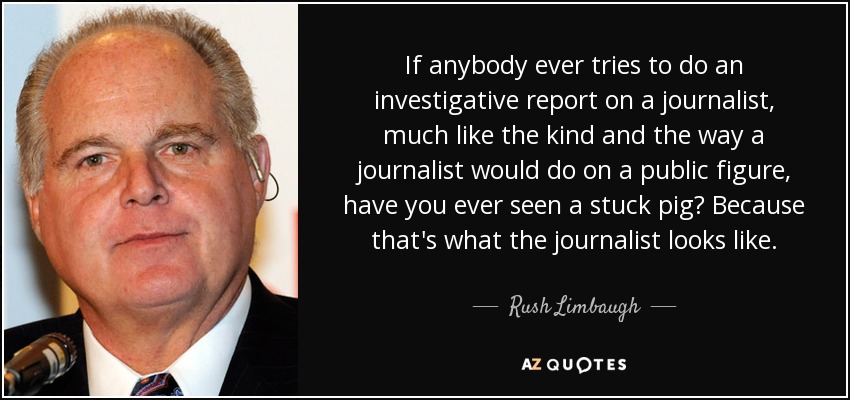
If anybody ever tries to do an investigative report on a journalist, much like the kind and the way a journalist would do on a public figure, have you ever seen a stuck pig? Because that's what the journalist looks like.
I'm not especially interested in the job of the historian or journalist of trying to figure out what was true and what was not.
I had two competing ambitions when I was a child: I wanted to be a Scientist and Discover Great Things, but I also wanted to be an Author and Write Great Things. I've always tried to combine the analytical with the creative, to some extent or another, because I find it hard to do one without the other. I've worked as a tech journalist, social media consultant, and now am self-publishing fiction.
The American journalist Barbara Ehrenreich has written about this in her book Smile or Die: How Positive Thinking Fooled America and the World (2009) . She talks about the happiness industry, the rise of medication to make us happy and of self-help books, and the influence of all this on religion. In many ways religion has become another form of self-help. We all suffer from over-exposure to positive thinking.
We've always been journalists - and have seen ourselves in that way. But we sort of recontextualized it through music.
I think that - not just as a journalist but as a human being - I have the ethical responsibility to avoid actions that can harm innocent people.
The issues for journalism and journalists, we see obvious places where presentation is very different in a digital space from traditional print. If you go to a New York Times homepage, you cannot get to a story about the Ukraine without a click-off on a banner ad or a slide show. They're not alone in that - you think you're clicking on a video about a news event and you have a 30-second ad that you have to watch before you can get to it.
I know of only one country, at least to my knowledge, which has a dissident culture where leading figures, I mean, the most famous writers, journalists, academics and so on, are not only critical of state policy, but are constantly carrying out civil disobedience and risking imprisonment and often being imprisoned, standing up for people's rights. That's Turkey.
I knew early on that I wanted to be a reporter, but I didn't know I was a political journalist until my first job in Boston, in the '70s, covering the public school committee at a time when busing was a huge issue. Children's lives were being directly affected by political decisions, and that's when I realized that everything is politics.
In this film [The Last King of Scotland] I am the rooky in the cast. Everyone has miles of experience than me and Della is in the same situation, so life imitated art in many ways. I don't think I could be a journalist. I wouldn't make a very good journalist, especially in Washington and working in politics, which I think would be really tough.
I met journalists that were on both sides of things. People who are young, enthusiastic and hard working journalists working on the online side and people who had been there forever. There was one journalist who had running shoes under her desk in case she had to kick of her heels and go out and cover a breaking news story.
Absolutely I'm going to be talking about it, because it's in the zeitgeist and it's happening. It's an election year. It's the biggest election. Every election is a big election, so whenever anybody says that it kinds of grates me, but it's a fiasco. It's turned into a complete circus act, so of course you have to make fun of it, but responsible journalists definitely are being irresponsible. They're giving [Donald Trump] so much air time.
But we must not forget the effort undertaken by the ruling elite in Russia to manipulate Western politicians, businessmen as well as journalists. That's why [Vladimir] Putin's "fifth column" is that powerful in the West.
[Donald] Trump`s hunt for a cheap enemy right now comes as journalists and members of Congress are looking at potentially serious conflicts of interest at Trump`s sprawling multinational business empire.
I don't pretend to be objective. There is no such thing as being an objective journalist.
I spend a lot of time talking to journalists.
What Malcolm X did not know is that back in 1962, a collaborator of Alex Haley, fellow named - a journalist named Alfred Balk had approached the F.B.I. regarding an article that he and Haley were writing together for The Saturday Evening Post, and the F.B.I. had an interest in castigating the Nation of Islam, and isolating it from the mainstream of Negro civil rights activity.
[Barack] Obama isn't pointing to anyone, and certainly doesn't like it when others note (correctly) that his influences were the likes of Saul Alinsky, the Chicagoan and modern founder of community organizing, or Frank Marshall Davis, the communist journalist and agitator from Chicago who mentored Obama in Hawaii in the latter 1970s, and who Obama warmly acknowledges in his memoirs.
A good American friend of mine who has lived in India for many years, working as a journalist, was recently denied entry to the country because he wrote on Kashmir. This is a reflection of fractures within society. Pakistan, too, has to focus on the Lashkar [Lashkar-i-Taiba] and other similar groups and work towards some sort of sensible compromise on Kashmir.
If you look at the Associated Press wires, there's a constant flow of information coming in. At that time I happened to have direct access to AP wires. The day the marines landed in Haiti and restored [ Jan Bètran] Aristide there was a lot of excitement about the dedication to democracy and so on. But the day before the marines landed, when every journalist was looking at Haiti because it was assumed that something big was happening, the AP wires reported that then [Bill] Clinton administration had authorized Texaco to ship oil illegally to the military junta.
First and foremost, I'm a journalist. My business is the truth. Now, I happen to be other things, too - a pop-culture phenomenon, the most in-demand speaker on the campus lecture circuit, whatever.
I was born in France. My father was a renowned French philosopher and journalist, and my mother was a painter. So I grew up in Parisian intellectual circles.
What's wrong with it is, it lowers, to say the least, the credibility of the magazine. And if I were writing for [The New Republic ], I would feel diminished because the owner had done such a thing [fire a journalist].
I do worry about the press and a President Trump. You know, I think it's dangerous the entire de-legitimization that he's engaged in against all of the media because the people, as much as it's fun to hate us, they do need us. You know, they need good, strong skeptical journalists to be covering whoever it is, whether it's Barack Obama or President Donald Trump.
I do think people need to recognize that a lot of journalists want to write a story a certain way because the story will be better or the portrayal will be better, or at least recognize that whenever you're looking at something, you're seeing it through somebody's eyes who may actually not be the person who is the most insightful.
Follow AzQuotes on Facebook, Twitter and Google+. Every day we present the best quotes! Improve yourself, find your inspiration, share with friends
or simply: