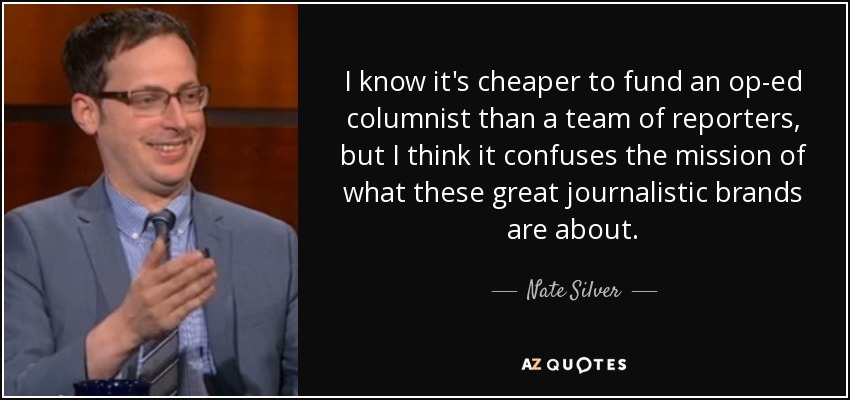
I know it's cheaper to fund an op-ed columnist than a team of reporters, but I think it confuses the mission of what these great journalistic brands are about.
I can't make something 'useful' to me in a writing sense for a very long time. I don't have any journalistic instinct. And I do keep a journal, but it's neither very revealing nor fruitful for work. Stuff just bubbles up from the swamp later.
We all work for media, we all make mistakes all the time. That's inevitable. What the difference between a responsible journalistic institution is, does it care whether it makes mistakes or not? And does it correct them?
We've always been observant of things, and I think Crackdown was very much like that and the film interpretation was that journalistic view of that situation.
When I began taking photographs I thought they might work better in magazines, in a journalistic sense, rather than as art.
Twitter and Facebook are brilliant- tools, the journalistic uses of which are still being plumbed. They are great for disseminating interesting material. They are useful for gathering information, including from places that are inaccessible.
The short stories tend to be a journalistic gathering of anecdotes that are put together to make something larger.
The traditional media does not have the kind of reporting muscle on the ground that it used to. I was very hopeful that the new digital media operations would pick up that slack, and a lot of them are trying and they're doing creative things. But none of them can scale appropriately to have enough journalistic firepower as well.
The images that people see in the media of black people - whether journalistic or narrative - remain horrible. And those images, combined with the lack of respect among black people in the poorer neighborhoods for themselves, and the part the police and other people coming into those neighborhoods play, it creates no value for life.
Journalism and the questions of journalistic ethics, and why certain stories are put on the air, when, how and for what reasons, are big questions in our culture and society.
Journalistic conventions make it hard for reporters to deal with a big, complicated lie.
The key question facing those of us working in the media (old and new) is whether we embrace and adapt to the radical changes brought about by the Internet or pretend that we can somehow hop into a journalistic Way Back Machine and return to a past that no longer exists and can't be resurrected. There is no question that, as the industry moves forward and we figure out the new rules of the road, there will be - and needs to be - a great deal of experimentation with new revenue models.
New York waiters, probably the surliest in the Western world . . . are better images of their city than that journalistic favorite the taxi driver.
In a way, I think we all want to look to that journalistic voice as a kind of global omniscience, a big eye to correct for our own limited purview: "Here's a realistic accounting of the world in which we live."
At Gatling-gun tempo word-perfect the first time out. the journalistic equivalent of a high-wire front somersault without a net.
The Obama administration has attempted to prosecute more journalists and journalistic sources under the same Espionage Act she was being investigated under in all previous presidencies combined.
I often notice how students can gain the capacity to use certain critical methodologies through engaging with very different texts - how a graphic novel about gentrification and an anthology about Hurricane Katrina and a journalistic account of war profiteering might all lead to very similar classroom conversations and critical engagement. I'm particularly interested in this when teaching law students who often resist reading interdisciplinary materials or materials they interpret as too theoretical.
The journalistic tradition so exalts novelty and flashy discovery, as reputable and newsworthy, that standard accounts for the public not only miss the usual activity of science but also, and more unfortunately, convey a false impression about what drives research.
When I started to be published I thought about Margaret Bourke-White and the whole journalistic approach to things. I believed I was supposed to catch life going by me - that I wasn't to alter it or tamper with it - that I was just to watch what was going on and report it as best I could. This shoot with John was different. I got involved, and I realized that you can't help but be touched by what goes on in front of you. I no longer believe that there is such a thing as objectivity.
When I need journalistic honesty, I have to turn to Al Jazeera, why is that? One cannot even deny the Holocaust in Europe, question 9/11 in America (unless you want the Ward Churchill treatment), but the West claims they're all about free speech.
I need to conduct myself differently in different communities. In my experience, the journalistic conventions - you know, I'm the reporter, you're the subject, the interviewee - actually tend to hold steady much more consistently in rural Africa than they do in the American inner city.
A picture that is ghostly and silent can be more eloquent and less clichéd than a noisier photo-journalistic approach and I have attempted to make pictures that whilst they are not documentary in the traditional sense, they are still documents, like forensic traces.
Journalistic information and presentation actually discourage action... we think we know, and because we think we know, we think we care. But it stops there.
A Machine to Make a Future is an insightful and creative contribution to the literature--both scholarly and journalistic--on contemporary genomics. By 'experimenting' with narrative genre, the authors hope to generate different insights into the world of genomics and biotechnology than ones generally presented in existing accounts. They succeed at that goal, providing an account that is ethnographically rich and analytically open to a world whose structure, implications, and outcomes are very much in the making.
Main thing is to publish. Blog, tweet, write, photograph, tweet, video, code, play around with data - or a combination of all of the above. a) it will keep your journalistic ‘muscle’ in practice. b) if you’re any good, you’ll get noticed. And bear in mind you can do these things at other places than conventional news organisations. Many businesses, NGOs, arts organisations, public bodies, universities, etc are now publishers of extremely high quality stuff. Good places to practise your craft before moving on.
Follow AzQuotes on Facebook, Twitter and Google+. Every day we present the best quotes! Improve yourself, find your inspiration, share with friends
or simply: