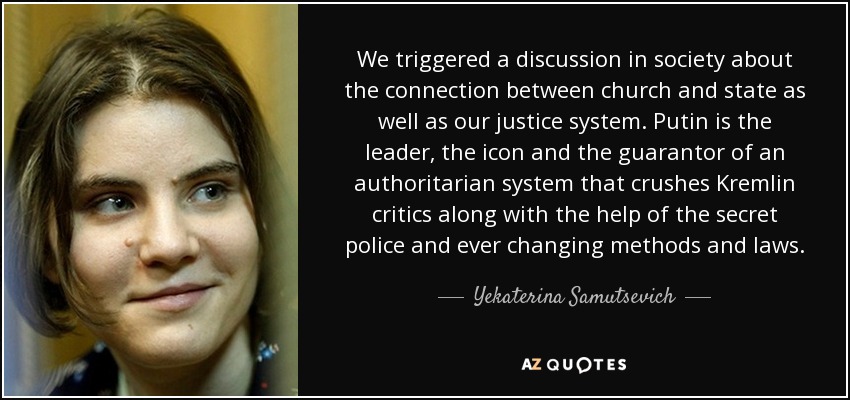
We triggered a discussion in society about the connection between church and state as well as our justice system. Putin is the leader, the icon and the guarantor of an authoritarian system that crushes Kremlin critics along with the help of the secret police and ever changing methods and laws.
The criminal justice system - although this applies less to the U.S., where rehabilitation is not seen as a valuable contribution to criminal justice - in Europe where rehab is supposed to be integral, we have no way of rehabilitating skilled hackers. On the contrary what we do is we demonize them and continue to do so after they come out of jail because we restrict their access to computers by law. Crazy world, crazy people.
I'm not a fan of the death penalty. At some level I think killing is wrong, but I don't have sympathy for most of the people sentenced - I'm not a passionate anti-death penalty person. In truth, given all the other problems of the justice system, the numbers are so small, I think there are bigger fish to fry. Ironically, in terms of mental health and care, death row is probably the best prison situation to be in. There's a little more public eye on that, to ensure at least minimal levels of official treatment are actually given to death row prisoners.
Just in general, when we look at our school system, there is so much overlap with our criminal justice system in terms of our low-income youth.
States and counties routinely bear the costs associated with incarcerating undocumented criminal aliens once they enter the criminal justice system.
I got interested in the justice system. If I was, I'd probably be a defense lawyer. I was headed that way, but luckily changed my track to film school.
I regularly see constituents, speak to people who feel let down by the justice system quite fundamentally, and these are people who don't make the headlines. These are people who have felt that their sense - their grief, their sense of injustice has been compounded by a system that just doesn't work, that just doesn't listen to victims, that effectively disempowers them all too often.
I think that we need to have an honest conversation in this country. This idea that somehow we're beyond sexism, beyond racism is just wrong. And this is where having an honest conversation with white men about their issues and their concerns, and having honest conversations about the experiences that African-Americans are still having, despite who's the president of the United States, in the criminal justice system that we see in sentencing, we see in policing and a lot of these issues.
I expect from our judges that their verdicts are also inspired by Talmudic law - and not only by common law or European justice systems.
Against the tyranny of forgetting, educators, young people, social activists, public intellectuals, workers and others can work to make visible and oppose the long legacy and current reality of state violence and the rise of the punishing state. Such a struggle suggests not only reclaiming, for instance, education as a public good but also reforming the criminal justice system and removing the police from schools.
The first thing we should be concerned about the BLM movement should be the issues that the Black Lives Matter movement is bringing forward. There's no fundamental platform being brought by activists in Oakland, Baltimore, or New Jersey. The main issues that you see, the commonality between activists all around the country, are trying to deal with the challenges in the criminal justice system, something that is very much central to my work. So my hope is that people stay focused on the urgency to create justice here at home.
[Michael Flynn] has just said that the U.S. Justice system is corrupt.
We have to face up to systemic racism. We see it in jobs, we see it in education, we see it in housing. But let's be really clear; it's a big part of what we're facing in the criminal justice system.
I don't want to exaggerate; having as many African American men as we've had in the criminal-justice system, and the amount of time it takes for the damage done by that to wash through our society and our communities, the disadvantages born out of kids being undiagnosed with mental-health problems early, or not getting the kind of exposure to reading and math when they're 4 or 5 or 6 years old, that carries a cost.
Courts in America seem to be so political, and it would be so great for our justice system if they would be able to read a statement and do what's right.
A subject I'm particularly passionate about is the criminal justice system and almost all of the policies that impact people's lives are determined on a local level.
What has changed since the collapse of Jim Crow has less to do with the basic structure of our society than with the language we use to justify it. In the era of colorblindness, it is no longer socially permissible to use race, explicitly, as a justification for discrimination, exclusion, and social contempt. So we don't. Rather than rely on race, we use our criminal justice system to label people of color "criminals" and then engage in all the practices we supposedly left behind.
The issue of the American justice system is so much broader than any one party, or any area of the country, or any one policy, because the totality of it is that it's driven by the underlying politics. The underlying politics are white fear and wrath and punishment. And that's what tends to be consistent. As I say in the book, that's the magnet that's drawing the iron filings into alignment. That's the thing that's powering all of it. The gravitational pole of those politics operate on each of these disparate little actors.
The various roles we incorporate into the criminal justice system as well as the ways in which we construe such roles, lend themselves to the kind of ethical reflection that is open to us all. That said, once we have determined roles and their contours, those who act within them may have special duties and privileges that others may lack. Specific roles may generate ethical inquiries with novel forms, just as new technologies may push us in new directions.
Be critical of these institutions that we love, whether they be our sports teams or the criminal justice system. Be critical of what the police department is doing about sexual assault. Be critical of why prosecutors are not prosecuting sexual assault.
I see, from my vantage point as the vice-chair of the Legal Services Corporation, a serious crisis going on in this country. Eighty percent of low-income people have no access to the civil justice system, meaning anything but criminal law.
People are offering competing visions of what happened in the past. And the justice system is willing to accept either of those competing visions and to impose consequences as a result. When you think of it that way, it's a little bit startling, because we want to believe that there is one truth and, therefore, one justice, whereas, if you have practiced law as long as I have, you realize that there is actually a range of acceptable outcomes.
Ignorance of the law excuses no man from practicing it.
Ignorance of the law excuses no man.
Given the inefficiencies of what DC laughingly calls the 'criminal justice system,' I think we can safely assume that 95 percent of the black males in that city are semi-criminal or entirely criminal.
Follow AzQuotes on Facebook, Twitter and Google+. Every day we present the best quotes! Improve yourself, find your inspiration, share with friends
or simply: