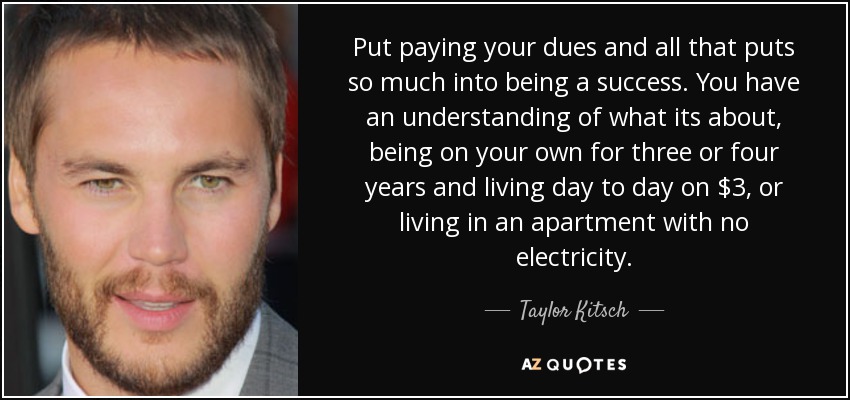
Put paying your dues and all that puts so much into being a success. You have an understanding of what its about, being on your own for three or four years and living day to day on $3, or living in an apartment with no electricity.
I have like 20 snap-up shirts in my closet, and I never, never would have thought before FNL would I have had that.
I played pretty darn competitive-level hockey. Then the good old knee injury. Obviously, it's a blessing in disguise, but growing up Canadian, that's our religion, that's our football.
How can we prevent this telescoping of cultures and styles from ending up in kitsch eclecticism, a cool hellenism excluding all critical judgment?
The 1950s to me is darkness, hidden history, perversion behind most doors waiting to creep out. The 1950s to most people is kitsch and Mickey Mouse watches and all this intolerable stuff.
My real desire is to see people live in the modus of our time, to participate in the contemporary world, to release themselves from nostalgia, antiquated traditions, old rituals, meaningless kitsch and meaningless paradigms.
I certainly don't object to [writers] trying to imagine the lives of other societies, but you have to do it with a certain amount of humility and respect. If it were not for the ethnographic material that had been collected by missionaries and anthropologists and so forth, much of past Native American society would no longer be accessible. What I object to is making kitsch of things that are very serious.
To call a work of art Kitsch is to condemn it for being bad art. But there is a great deal of bad art that we do not condemn as Kitsch. To condemn something as Kitsch is to condemn it on moral grounds.
Kitsch evokes a future utopia looking back at a past that is selectively (mis)remembered, thereby helping to stabilize the present toward which kitsch is otherwise deeply anatagonistic.
Kitsch is: a species of beauty, which, as it is florid and superficial, pleases at first; but soon palls upon the taste, and is rejected with disdain, at least rated at much lower value.
Mirabelle replaces the absent friends with books and television mysteries of the PBS kind. The books are mostly nineteenth-century novels in which women are poisoned or are doing the poisoning. She does not read these books as a romantic lonely hearts turning pages in the isolation of her room, not at all. She is instead an educated spirit with a sense of irony. She loves the gloom of these period novels, especially as kitsch, but beneath it all she finds that a part of her indentifies with all that darkness.
The goddess of beauty is the goddess Kitsch.
Because modernism has conquered art, kitsch is the savior of talent and devotion.
If the embodiment of the fundamental idea of our age were to be found in Victorian architecture, in the Church of Cristo Re in Rome or the Church in Brasilia, in Moscow University or the Capitol in Washington, then our age would undoubtedly be called the 'age of kitsch.'
Indeed, some kitsch seems to be flawed by its very perfection, its technical virtuosity and its precise execution, its explicit knowledge of the tradition
Have we not huddled in bunkers, while some premonition of tomorrow hung in the air and a comrade started singing? Oh, it felt so melancholy! And it was kitsch.
Where Picasso paints cause, Repin paints effect. Repin predigests art for the spectator and provides a short cut to the pleasure of art that is necessarily difficult in genuine art. Repin, or kitsch, is synthetic art.
Don't we all have an itch for kitsch?
If you fall asleep on horseback, the horse will stop by the rock. Art is a car. Kitsch is a horse.
At a certain point in history monuments became associated with kitsch, (it had never previously been so) and one might well ask why this unforeseen aesthetic and ethnic debasement of their values came about, or why monuments have not adapted to the times. Perhaps, instead of evoking authentic religious, patriotic or mystical sentiments, they evoke only the customary ersatz for these sentiments and have suffered the fate of becoming sentimental.
Vermeer's woman reading a letter is as full of latent or subliminal kitsch as Tolstoy's War and Peace.
The techniques of kitsch, which are based on imitation, are rational and operate according to formulas; the remain rational even when their result has a highly irrational, even crazy, quality.
We meet thus in kitsch with a reappropriation of the results of past struggles.
Not all kitsch is sweet.
The Kitsch consumer wants to be enchanted.
Follow AzQuotes on Facebook, Twitter and Google+. Every day we present the best quotes! Improve yourself, find your inspiration, share with friends
or simply: