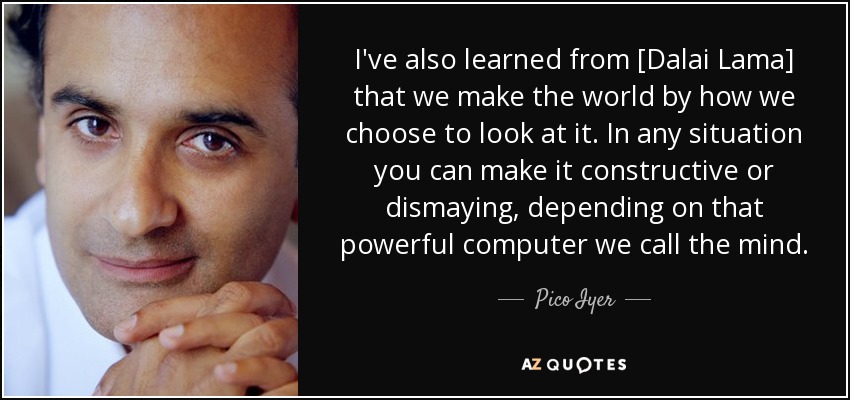
I've also learned from [Dalai Lama] that we make the world by how we choose to look at it. In any situation you can make it constructive or dismaying, depending on that powerful computer we call the mind.
Often when we think of exile we think of destruction or loss. But the Dalai Lama always says exile is reality, it's something we can make use of, and he has used it to get rid of everything that he thought was stifling and old, and to create a new, improved and much healthier Tibet.
I remember many years ago, I asked [Dalai Lama] about exile and he said: "Well, exile is good because it's brought me and my people closer to reality," and reality is almost a shrine before which he sits. Exile brings us up against the wall and forces us to rise to the challenge of the moment.
Dalai Lama has made new opportunities for women that they never had in Tibet, introduced science into the monks' curriculum and had Tibetan students in exile take their classes in English after the age of ten so that they will know more about the outside world. But one of the great things he's done is to bring all the Tibetan groups together in exile, as perhaps they couldn't have been when they weren't in exile and they weren't under such pressure.
He [The Dalai Lama] has made it his mission to say, "We can't afford to squabble over minor differences, we have to concentrate on what we have in common, our common mission, our common culture - and indeed what we have in common with the rest of the world."
Most of us who have been lucky enough to hear, read and see the Dalai Lama, often come away thinking, "What a kind, inspiring and golden human being!" That is true, but I think it does him an injustice.
Dalai Lama has not coming to show us his kindness, so that we can enjoy his charisma, he's coming with a specific message for the specific circumstances of the world today.
If you'd asked me some years ago, I would have said [Dalai Lama] is an extraordinarily compassionate, clear-sighted, calm human being. But now, I'm more convinced than ever that his political positions as well as his spiritual positions arise out of such precise and realistic thinking that they're extremely sound.
I think [Dalai Lama]is far and away the most solid, deep-thinking, far-sighted politician I've met, and I've been a journalist for 26 years for Time magazine, so I've met a lot of politicians.
It's impressive that a man [Dalai Lama], on the day after his Nobel Prize was announced, in October, 1989, said to me, "I really wonder if my efforts are enough?" Most of us, if we just won the Nobel Prize, would think this is vindication, or at last there's a chance for Tibet. He's the rare person who thinks, as a Buddha would, "I don't know if I've done enough, I don't know if I will do enough."
I think Dalai Lama efforts have been heroic.
We need a sense of the oneness of the 7 billion human beings alive today. When I meet people, I don't think about being different from them, about being Tibetan, Buddhist or even the Dalai Lama. I only think about being a human being. We all share the potential for positive and negative emotions, yet one of our special qualities is our human mind, our intelligence. If we use it well we'll be successful and happy.
The Dalai Lama once said that 'If science proves some belief of Buddhism wrong, then Buddhism will have to change!' This is a great thought! And great thoughts belong to great men only!
Dalai Lama's got nothing on me.
I think, that in the twenty-second century, there will be more female reincarnations at female institutions. Then there'll be competition between male lama institutions and female lama institutions. It'll be a positive sort of competition.
One Mongolian leader became a very, very brutal dictator and eventually became a murderer. Previously, he was a monk, and then he became a revolutionary. Under the influence of his new ideology, he actually killed his own teacher. Pol Pot's family background was Buddhist. Whether he himself was a Buddhist at a young age, I don't know. Even Chairman Mao's family background was Buddhist. So one day, if the Dalai Lama becomes a mass murderer, he will become the most deadly of mass murderers.
Democratic institutions are necessary and very important, and if I remained at the head of government, it could be an obstacle to democratic practice. Also, if I were to remain, then I would have to join one of the parties. If the Dalai Lama joins one party, then that makes it hard for the system to work.
If the situation was such that there was only one learned lama or genuine practitioner alive, a person whose death would cause the whole of Tibet to lose all hope of keeping its Buddhist way of life, then it is conceivable that in order to protect that one person it might be justified for one or 10 enemies to be eliminated if there was no other way.
A Tibetan Lama said to me, "The best place to stand, Ram Dass, is halfway between hope and hopelessness." So I can write a scenario for the 21st century in either direction. One is that it all goes to hell and that it's truly the dark age.
This is quotes copyright © By Pumpkin Limited
The word 'heart' can refer to an emotional bond between people, and also to the precious faculty of empathy, an 'open heart', which means sharing the feelings of another and includes an outflow of goodwill towards our fellow humans and all life forms. This, of course, is what the Dalai Lama refers to when he says "my religion is kindness", and is closely related to the ability to feel compassion.
So I phoned up the spiritual leader of tibet, he sent me a large goat with a long neck, turns out I phoned dial a lama.
A female Dalai Lama must be very attractive, otherwise not much use.
The Dalai Lama would say that meditation is something that can help everyone. But he's aware that it can be misused or things can go wrong.
I think Dalai Lama is always careful about stressing that people be led into the practice by somebody who knows what's going on.
When I was two years old, I heard about his [Dalai Lama] flight from Tibet. Being very little, I said, "Oh, good Tibetans, bad Chinese." Those were the black-and-white ways that I thought.
Follow AzQuotes on Facebook, Twitter and Google+. Every day we present the best quotes! Improve yourself, find your inspiration, share with friends
or simply: