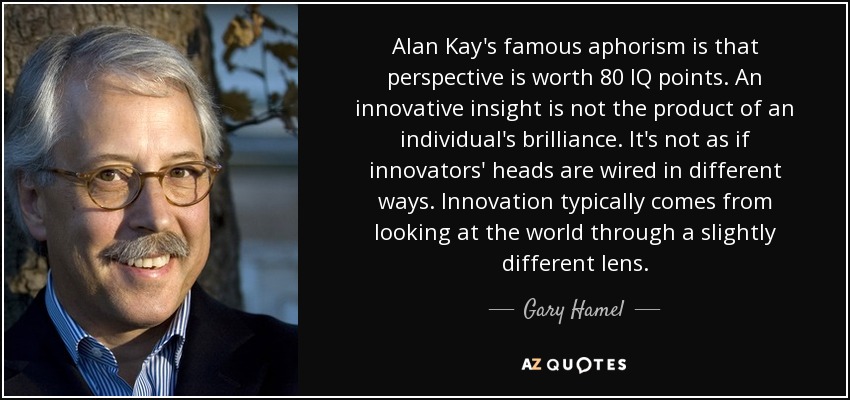
Alan Kay's famous aphorism is that perspective is worth 80 IQ points. An innovative insight is not the product of an individual's brilliance. It's not as if innovators' heads are wired in different ways. Innovation typically comes from looking at the world through a slightly different lens.
In a period piece, particularly a fantasy, the lighting is your own choice, the lenses are your own choice. It's really a great thing for a cinematographer to do. Everything is open for you. You can even be more creative and you can use more shadows than usual.
Actors work with their look. I come from the Lon Chaney Sr. school of acting. I'll wear wigs, I'll wear nose pieces, I'll wear green contact lenses in my eyes. I'll do whatever I need to do to create a character.
I am a Mormon woman, I am not orthodox. It is the lens through which I see the world. I hear the Tabernacle Choir and it still makes me weep.
The menu of this kitchen will have more than soup; it will serve as an opportunity to explore the vast untapped power of food as a force for participatory democracy, as a means of empowerment for those who have little and as a lens through which we embrace, and in fact relish, our differences but see and live through our commonalities. If you eat, then you are a part of this.
3D needs a trained eye. It can't be done by everybody. People who just do 3D just for the sake of commercializing their movie another five or six percent and they don't know really how to do it, they should care how to do it better by bringing other directors and collaborators into their lives to help teach and instruct how you really make a 3D movie because it's not just like putting a new lens on a camera and forgetting it. It takes a lot of very careful consideration. It will change your approach to where you put the cameras. So, 3D isn't for everybody.
If you're a certain type of actor, then eventually stepping into a director's shoes is a natural transition. I've always been the actor who's very focused on the narrative, where my character is in the story, and how I can benefit the story. I've always had a technical aspect of what the lens is, how the camera is going to move, how I can feed the information the director applies within that move. If you're that type of actor, narrative-based, technically proficient, the next step is actually not that far.
I take bits and pieces from every director. I'd say Sylvain [White] and Nimrod [Antal]. They were more about teaching me lens sizes and depth of field and how to move the camera and lighting. I do want to direct and I didn't go to film school, so having a director that are very much hands on that way and looking to let me learn, that is a key factor.
Contact lenses make me miserable, as soon as I put them in. That's what creates the pouting and brooding character.
The best zoom lens is your legs.
Best wide-angle lens? Two steps backward. Look for the 'ah-ha'.
I put contact lenses in my dog's eyes. They had little pictures of cats on them. Then I took one out and he ran around in circles.
The world can only appear monochromatic to those who persist in interpreting what they experience through the lens of a single cultural paradigm, their own. For those with the eyes to see and the heart to feel, it remains a rich and complex topography of the spirit.
The most important lens you have is your legs
I remember coming on my first set and it being a playground of things I wanted to ask questions about: cameras and lenses and what the lenses do, what's the focus puller doing and how does that work? Why is there less margin for error when there's less light? I was always asking questions and watching directors closely.
I didn't think that and I didn't verbalize that to myself or within meetings that we ever had, but we wanted to make a hard-nosed, gritty, realistic spy thriller. Roger talked about using lenses. He shot hi-def, but using anamorphic lenses that he'd found from this warehouse. He was so thrilled with that. Him and Romain [Lacourbas] were just like kids in a toy store with their lenses.
We are talking about mutated women, the result of cruel genetic experiments performed by fashion designers so lacking in any sense of human decency that they think nothing of putting their initials on your eyeglass lenses. The leading cause of death among fashion models is falling through street grates. If a normal woman puts on clothing designed for these unfortunate people, she is quite naturally going to look like Revenge of the Pork Person.
The camera follows a young woman as she makes her way through the stands to an area set aside for repentance and conversion. But Jesus' stories imply that far more may be going on out there: beyond that stadium scene, in a place concealed from all camera lenses, a great party has erupted, a gigantic celebration in the unseen world.
You have to kind of be invisible when you photograph children, so you use a longer lens.
But perhaps more important, as someone wishing to make a comment or two about contemporary life and values, I don't have to dig through libraries or travel to exotic lands to arrive at a view of our modern situation refracted through the lens of the preindustrial world, or the uncommercialized, unfranchised, perhaps unsanitized-and therefore supposedly more "authentic"-perspective ofthe Third World. Very simply, this is because that "other" world, as alien as if separated by centuries in time, is the one from which I came
Humility is the only lens though which great things can be seen--and once we have seen them, humility is the only posture possible.
You need to marry the qualitative with the quantitative. It better informs us so we can decide what to do. We can't be afraid of data and analysis. We have to use that lens.
The camera has its own kind of consciousness; in the lens the Garden of Eden itself would become ever so slightly too perfect.
The world I feel, within the realm of art, is more genuine than the wrorld of matter. Artistic feeling is not tape measures, spectrographs, or flash camera lens.
Astronomers have built telescopes which can show myriads of stars unseen before; but when a man looks through a tear in his own eye, that is a lens which opens reaches into the unknown, and reveals orbs which no telescope, however skilfully constructed, could do.
Follow AzQuotes on Facebook, Twitter and Google+. Every day we present the best quotes! Improve yourself, find your inspiration, share with friends
or simply: