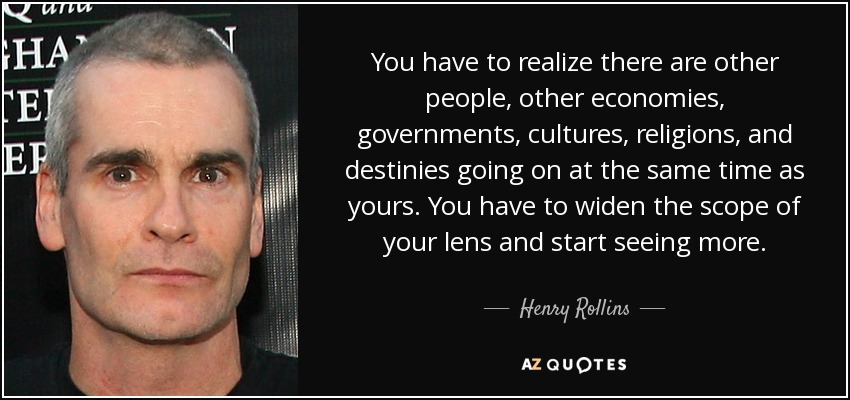
You have to realize there are other people, other economies, governments, cultures, religions, and destinies going on at the same time as yours. You have to widen the scope of your lens and start seeing more.
To me, feminism in literature deals with the female characters being in some way central to the thematic concerns of the book, or that they are agents of change to some degree. In other words, the lens is focused deeply and intensely on the female characters and doesn't waver, which allows for a glimpse into the rich inner lives of the characters.
I shot the way I wanted to shoot [in The Hateful Eight]. The only real disadvantage I felt at the time, but I don't feel now, was that we weren't able to get a zoom lens, and I had really gotten used to using a zoom lens for that little zoom creep. But it was also a nice thing to be forced to not use all the tools that you've gotten used to, from time to time, and to be able to work in a different way.
I was photographing the photographer Brassaï. He had very prominent eyes, like a frog's. As I focused my lens, he brought his hand up and pretended to focus his eye. It was a joke, but it added mystery to the picture. There's a sense of action in a very small world. Or with Allen Ginsberg there were people smoking cigarettes and in the smoke there's a sense of motion. It makes much out of very little.
In Ethiopia, food is often looked at through a strong spiritual lens, stronger than anywhere else I know. It's the focal point of weddings, births and funerals and is a daily ceremony from the preparation of the meal and the washing of hands to the sharing of meals.
No film is made without the people behind the lens. Of course, most people, even I, tend to look at films in the most simplistic way, and say, "Wow, so-and-so is in this film." We talk about who's in it, as opposed to who got it made. But there are financial and technical aspects which go along with it, that should be addressed and acknowledged, including those minorities who are doing excellent work as well.
What I was interested in is the lens organizing my sovereign space. I avoid the term outsider and also exile for the same reason. Outsider implies a kind of nobility.
Finally I got to the point where I said, I'd like to start a project where we can actually talk about race and poverty, not through the lens of a particular case, but much more broadly.
I feel like I'm at a place in my life where I'm really strangely happy, and in awe of how great the world can be, and I think that's because I have gone through periods of looking at the world through a really melancholy lenses. It's all just flip sides of the same coin.
I was also writing in a tradition and trying to do something different with it, something that hadn't necessarily been done before, which was a risk, but it made it interesting. My relationship with food has been complicated and rocky and not always wonderful, and it's a lens through which my entire life and identity are refracted.
What I do is create a lens through my work that corrects my readers' cognitive dissonance and says: you will see all of it - not what you want or what makes you comfortable, but all of it. And you will not erase what displeases you.
Many nightclubs from this era were very loud and very dark. Plus some of the best ones were incredibly crowded. To begin with, I could seldom get back far enough to get people into frame from head to foot and when I could, people would be constantly walking in front of me all the time. Then I bought a 24-mm lens and only had to be four or five feet away.
I admire narcissism in Momus and others who "own" it and use it as a way to explore ideas/themselves and also as a form of humor. I don't think of myself as narcissistic, but I'm definitely incredibly self absorbed. I guess I wonder if seeing the world through the lens of yourself is necessarily less valid than other ways of thinking/seeing though.
Camera's are cheap. It's the lenses that are expensive.
Anamorphic is very difficult because the distance from the lens to the person to focus is very long so you need a lot of distance from the camera to the person so that means that you need a lot of space.
It's hard to do a camera inside of a car. Non-Stop would have been impossible. Usually modern lenses you can focus up to the lens pretty much, but anamorphic you can't. You need like three feet.
If you clear that negative feeling and forgive yourself, then you can see the world from a different lens. You stop attracting that same type of experience. You can set yourself free.
There was a band in San Diego, Bluegrass Etc, that played a weekly gig. My parents would take my brother and me every Saturday night for 7 or 8 years. Sean and I started taking lessons with them and they gave us a great foundation in bluegrass instrumentation. They were the lens through which I saw music for a very long time.
Artists see the world in a very different way than everyone else, and it's important when the artist points a lens at the law.
Perhaps we are looking at this from a wrong perspective; this search for the truth, the meaning of life, the reason of God. We all have this mindset that the answers are so complex and so vast that it is almost impossible to comprehend. I think, on the contrary, that the answers are so simple; so simple that it is staring us straight in the face, screaming its lungs out, and yet we fail to notice it. We're looking through a telescope, searching the stars for the answer, when the answer is actually a speck of dirt on the telescope lens.
When you see what you express through photography, you realize all the things that can no longer be the objectives of painting. Why should an artist persist in treating subjects that can be established so clearly with the lens of a camera?
You do not see with the lens of the eye. You seen through that, and by means of that, but you see with the soul of the eye.
The mind can be thought of as containing reels and reels of motion picture film about our past experiences. These images are superimposed not only on each other but also on the lens through which we experience the present.
The lens is a tyranny.
Literally as well as metaphorically, the man accustomed to inverting lenses has undergone a revolutionary transformation of vision.
Follow AzQuotes on Facebook, Twitter and Google+. Every day we present the best quotes! Improve yourself, find your inspiration, share with friends
or simply: