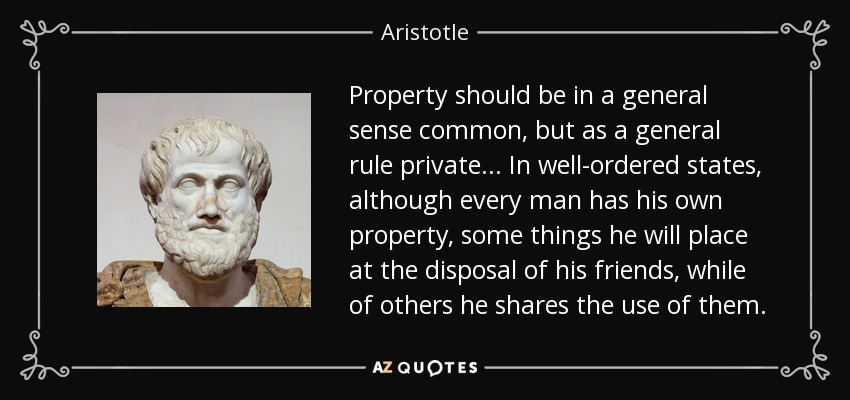
Property should be in a general sense common, but as a general rule private... In well-ordered states, although every man has his own property, some things he will place at the disposal of his friends, while of others he shares the use of them.
Tools may be animate as well as inanimate; for instance, a ship's captain uses a lifeless rudder, but a living man for watch; for a servant is, from the point of view of his craft, categorized as one of its tools. So any piece of property can be regarded as a tool enabling a man to live, and his property is an assemblage of such tools; a slave is a sort of living piece of property; and like any other servant is a tool in charge of other tools.
For suppose that every tool we had could perform its task, either at our bidding or itself perceiving the need, and if-like the statues made by Dædalus or the tripods of Hephæstus, of which the poet says that "self-moved they enter the assembly of the gods" - shuttles in a loom could fly to and fro and a plectrum play a lyre all self-moved, then master-craftsmen would have no need of servants nor masters of slaves.
We must speak first about the division of land and about those who cultivate it: who should they be and what kind of person? We do not agree with those who have said that property should be communally owned, but we do believe that there should be a friendly arrangement for its common use, and that none of the citizens should be without means of support.
To seek the greatest good is to live well, and to live well is nothing other than to love God with the whole heart, the whole soul, and the whole mind: It is therefore obvious that this love must be kept whole and uncorrupt, that is temperance; it should not be overcome with difficulties, that is fortitude, it must not be subservient to anything else, that is justice; it must discriminate among things so as not to be deceived by falsity or fraud, that is prudence.
Justice being taken away, then, what are kingdoms but great robberies? For what are robberies themselves, but little kingdoms.
The origin of civilization is man's determination to do nothing for himself which he can get done for him.
Collective property and individual property, these two banners will be the standards under which, from now on, the great battles of the future will be fought.
We hold from God the gift which includes all others. This gift is life - physical, intellectual, and moral life.
But life cannot maintain itself alone. The Creator of life has entrusted us with the responsibility of preserving, developing, and perfecting it. In order that we may accomplish this, He has provided us with a collection of marvelous faculties. And He has put us in the midst of a variety of natural resources. By the application of our faculties to these natural resources we convert them into products, and use them. The process is necessary in order that life may run its appointed course.
It depends on the consent of the people to decide whether kings or consuls or other magistrates are to be established in authority over them, and if there is legitimate cause, the people can change a kingdom into an aristocracy, or an aristocracy into a democracy, and vice versa, as we read was done in Rome.
Political rule is so natural and necessary to the human race that it cannot be withdrawn without destroying nature itself; for the nature of man is such that he is a social animal.
But though Usury is in itself immoral, and justly condemned by every ethical code, its chief and worst defect in the particular case we are now examining, the growth of Capitalism and its increasing proletariat, is the centralization of irresponsible control over the lives of men: the putting power over the proletariat into the hands of a few who can direct the loans of currency and credit without which that proletariat could not be fed and clothed and maintained in work.
Capitalism had arisen through the misuse and exaggeration of certain rights, notably the right of property - the basis of economic freedom - and the right of contract, which is one of the main functions of economic freedom. Therefore, even under Capitalism, so long as the old principles were remembered it was possible to recall the principles whereby Society had once been sane and well ordered.
... But as a Godless greed pursued its career from excess to excess, it provoked a sort of twin hostile brother, equally Godless, born in the same atmosphere of utter disregard for the foundational virtues of humility and charity. This hostile twin brother of Capitalism was destined to be called Communism, and is today setting out to murder its elder.
Communism worked honestly by officials devoid of human frailties and devoted to nothing but the good of its slaves, would have certain manifest material advantages as compared with a proletarian wage-system where millions live in semi-starvation, and many millions more in permanent dread thereof. But even if it were administered thus Communism would only produce its benefits through imposing slavery.
Consider in what way the industrial system developed upon capitalist lines. Why were a few rich men put with such ease into possession of the new methods? Why was it normal and natural in their eyes and in that of contemporary society that those who produced the new wealth with the new machinery should be proletarian and dispossessed?
Political freedom without economic freedom is almost worthless, and it is because the modern proletariat has the one kind of freedom without the other that its rebellion is now threatening the very structure of the modern world.
Economic freedom is in our eyes a good. It is among the highest of temporal goods because it is necessary to the highest life of society through the dignity of man and through the multiplicity of his action, in which multiplicity is life. Through well-divided property alone can the units of society react upon the State. Through it alone can a public opinion flourish. Only where the bulk of the cells are healthy can the whole organism thrive.
It is therefore our business to restore economic freedom through the restoration of the only institution under which it flourishes, which institution is Property. The problem before us is, how to restore Property so that it shall be, as it was not so long ago, a general institution.
Even if the wealth and power be well distributed throughout a community, its members will not be happy unless they are inwardly so, and obviously where the distribution is bad, where the few have a vast superfluity and the many are consumed by anxiety or want, or where a few controllers can exercise their will over the many, society has failed, even though its total wealth and power be increased.
Had there been any existent vital and energetic institution left in Society after the Reformation for the use of small property in coordinated form-that is, in combination, so that the average man's holding could be put to useful purpose in company with the holdings of a great number of other men of his own sort, the new evils would not have arisen.
In the form of security and sufficiency for the men who labor to the profit of others, and in the form of registering and controlling them in the form of an organized public supervision of their labor, slavery is already afoot. When slavery shall succeed it will succeed through the acquiescence of those who will be enslaved, for they will prefer sufficiency and security with enslavement, to freedom, responsibility, insecurity and the threat of insufficiency.
What does it say about a president's policies when he has to use a cartoon character rather than real people to justify his record?
The belief that recipients of government aid are better off the more we spend on them is remarkably persistent. No matter how many times this central tenet of liberalism gets debunked, like Brett Favre, it just keeps coming back.
Follow AzQuotes on Facebook, Twitter and Google+. Every day we present the best quotes! Improve yourself, find your inspiration, share with friends
or simply: