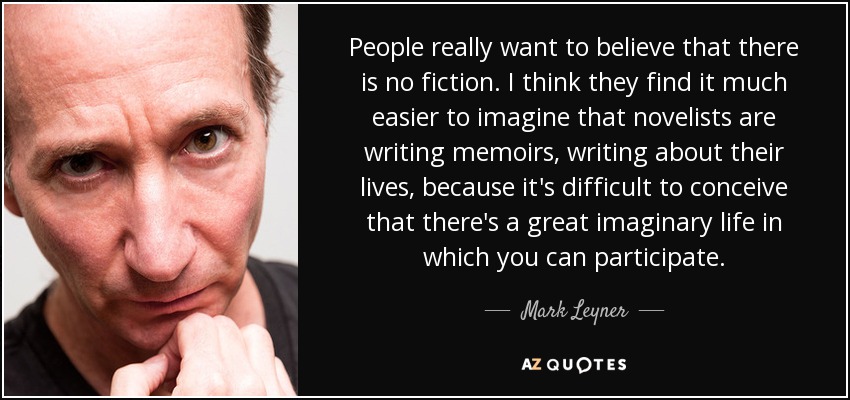
People really want to believe that there is no fiction. I think they find it much easier to imagine that novelists are writing memoirs, writing about their lives, because it's difficult to conceive that there's a great imaginary life in which you can participate.
People think that because a novel's invented, it isn't true. Exactly the reverse is the case. Biography and memoirs can never be wholly true, since they cannot include every conceivable circumstance of what happened. The novel can do that.
When people ask what kind of nonfiction I write, I say 'all kinds,' but really I mean I don’t write any kind at all: I’m trying to dissolve the borders between memoir and journalism and criticism by weaving them together.
Novels are completed when they are finished, but the memoir changes its own conclusion by virtue of being written... I was not at all the same person, when I handed the manuscript to the publisher, as I had been when I began. A memoir may always be retrospective, but the past is not where its action takes place.
Bush's memoir is 512 pages. To be fair, 200 of those pages are just games and puzzles.
Former president George W. Bush released his new memoir. By the way, 'memoir' is just a fancy word for 'a bunch of stuff that happened to me.
Don't think of Diana Vreeland's memoir as a book; it's more like a lunch. A bit of souffle, a glass of champagne, some green grapes - light, bubbly and slightly tart - all served up by an egocentric but inventive hostess.
Two temptations that impair the value of their work inevitably beset public men who write memoirs. One is a tendency to reconstruct the past to suit the present views and feelings of the writer; the other is a natual desire to set his own part in affairs in a pleasing light.
Going from memoir to fiction was fantastic. I had been afraid to move away from memoir; I'd written some novel drafts, but they weren't well received by my agent at the time, and it had been drilled into me that "memoir outsells fiction two to one" (not sure if that's true anymore, or if it ever was), so I felt like the only smart thing to do, professionally, was to keep mining my life for painful moments to recapitulate.
You read so much about the healing power of memoir, but you don't read about the wounding power it has first. The recollection of past events is not, in and of itself, therapeutic.
Those of us who obsess over every word and action are constantly recalling past events, but that doesn't make them any less painful, nor does it help us transcend them. To write memoir, you have to not only recollect past events, you have to revisit them. You have to get back to the mental and emotional state you were in during those events.
Writing a memoir has a particularly excited sense of narcissism.
When I was writing the memoir, every page was a battle with myself because I knew I had to tell the truth. That's what the memoir form demands. I also had to figure out how much of the truth do I tell, how do I make the truth as balanced as I possibly can? How do I make these people as complicated and as human and as unique and as multifaceted as I possibly can? For me, that was the way I attempted to counteract some of that criticism.
Though I consider The Chronology of Water to be an anti-memoir for very precise reasons, it is an art form, and thus as open to "critique" as any other art form. Memoir has a form, formal strategies, issues of composition and craft, style, structure, all the elements of fiction or nonfiction or painting or music or what have you.
Memoirs have at their heart a content that "happened" to someone in real life. Is that what you are itching at in your question, so that if you are a reviewer or you are writing a critique you might feel as if you are stepping on someone's actual face?
On a spectrum of literary productions, memoir is just another form. If the person doing the reviewing or critiquing was ill-educated about literary forms, they could write something dunderheaded about the author or their life (I've seen these and barfed at them), but anyone who is well-practiced and educated in literature - why would they leave that at the door when entering memoir?
Fiction and poetry expose intimate things from a person's life every bit as much as memoir does, and sometimes more. I don't quite see or live the distinction you are making about the forms.
One thing about humans is that we all have them - lifestories. We live by and through them. But writers of memoir are particularly good at bringing literary strategies and form to experience (at least the good ones are).
The WRITER of memoir gets incoming weirdness in very odd ways. I was recently talking to a memoir writer whose work just went meteoric - but some of the comments and communications and gestures she gets in the wake of that success are stunningly and atrociously over-personal, as if suddenly people feel like they know her and her life intimately, and have permission to transgress all her "life" boundaries.
To a certain extent that happens with all kinds of successful writers and artists and celebrities, but there is also something about the form of memoir that creates an eerie reader space of intimacy that is only "real" in the space of the text.
The memoir as a somewhat indistinct form is absolutely true. So many of the memoirs I've read, and the ones I have gravitated toward most, somehow upend what I expect from memoir and the project seems greater than just the exposition of a life.
As far as being territorial about one's own life, that's a mistake for ANY writer. All writers everywhere, in every genre, are drawing from their life and the lives of those around them for "material." Memoirs just make transparent and even amplify that activity.
The best memoirs - like This Boy's Life, or Crazy Brave [by Joy Harjo], for instance - bring you through a private river of storytelling that joins a major ocean of human struggle and joy. The act of enunciation - the forms and strategies of storytelling - are every bit as literarily serious as they are in poetry or other prose forms.
I look for the moment(s) in the story where the writer risked abandoning the glory of the self in favor of the possible relationship with an other. I don't ever let the market tell me what a memoir is. The first best memoir I ever read was Leaves of Grass by Walt Whitman.
I cut a lot of cringy sex stuff and a lot of stuff I thought was too personal. I think secret gardens are very special. I think we all have to have them. I think the secret of memoirs is keeping those parts of yourself off the page, which makes what you do share more valuable.
Follow AzQuotes on Facebook, Twitter and Google+. Every day we present the best quotes! Improve yourself, find your inspiration, share with friends
or simply: