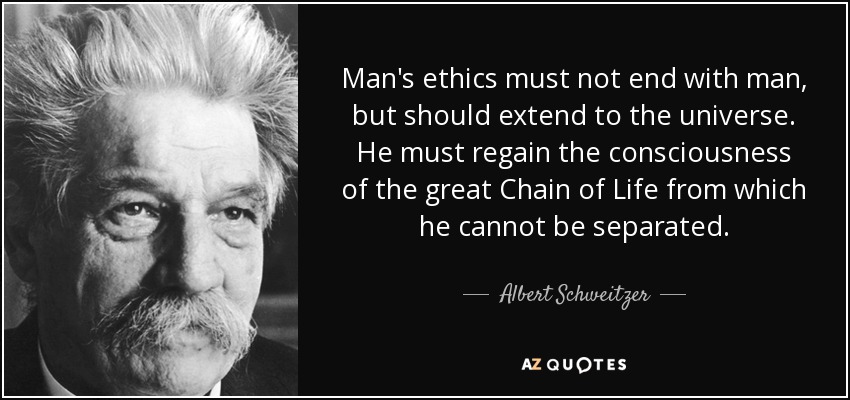
Man's ethics must not end with man, but should extend to the universe. He must regain the consciousness of the great Chain of Life from which he cannot be separated.
No marvel if the worldling escape earthly afflictions. God corrects him not. He is base born and begot. God will not do him the favour to whip him. The world afflicts him not, because it loves him: for each man is indulgent to his own. God uses not the rod where He means to use the Word. The pillory or scourge is for those malefactors that shall escape execution.
If a man that is desperately sick today, did believe he should arise sound the next morning; or a man today, in despicable poverty, had assurance that he should tomorrow arise a prince: would they be afraid to go to bed....?
Both in thy private sessions, and the universal assizes, thou shalt be sure of the same Judge, the same jury, the same witnesses, the same verdict. How certain thou art to die, thou knowest; how soon to die, thou knowest not. Measure not thy life with the longest; that were to piece it out with flattery. Thou canst name no living man, not the sickest, which thou art sure shall die before thee.
Exercising the right of occasional suppression and slight modification, it is truly absurd to see how plastic a limited number of observations become, in the hands of men with preconceived ideas.
I would by all means have men beware, lest Æsop's pretty fable of the fly that sate [sic] on the pole of a chariot at the Olympic races and said, 'What a dust do I raise,' be verified in them. For so it is that some small observation, and that disturbed sometimes by the instrument, sometimes by the eye, sometimes by the calculation, and which may be owing to some real change in the heaven, raises new heavens and new spheres and circles.
Man, as the minister and interpreter of nature, is limited in act and understanding by his observation of the order of nature; neither his understanding nor his power extends further.
Man, being the servant and interpreter of Nature, can do and understand so much and so much only as he has observed in fact or thought of the course of nature; beyond this he neither knows anything nor can do anything.
The history of men of science has one peculiar advantage, as it shows the importance of little things in producing great results. Smeaton learned his principle of constructing a lighthouse, by noticing the trunk of a tree to be diminished from a curve to a cyclinder ... and Newton, turning an old box into a water-clock, or the yard of a house into a sundial, are examples of those habits of patient observation which scientific biography attractively recommends.
To study men, we must look close by; to study man, we must learn to look afar; if we are to discover essential characteristics, we must first observe differences.
It is in man's heart that the life of nature's spectacle exists; to see it, one must feel it.
Know thyself! This is the source of all wisdom, said the great thinkers of the past, and the sentence was written in golden letters on the temple of the gods. To know himself, Linnæus declared to be the essential indisputable distinction of man above all other creatures. I know, indeed, in study nothing more worthy of free and thoughtful man than the study of himself. For if we look for the purpose of our existence, we cannot possibly find it outside ourselves. We are here for our own sake.
I cannot anyhow be contented to view this wonderful universe, and especially the nature of man, and to conclude that everything is the result of brute force. I am inclined to look at everything as resulting from designed laws, with the details, whether good or bad, left to the working out of what we call chance. Not that this notion at all satisfies me. I feel most deeply that the whole subject is too profound for the human intellect. A dog might as well speculate on the mind of Newton. Let each man hope and believe what he can.
If a man will comprehend the richness and variety of the universe, and inspire his mind with a due measure of wonder and awe, he must contemplate the human intellect not only on its heights of genius but in its abysses of ineptitude.
There ought not to be anything in the whole universe that man can't poke his nose into-that's the way we're built and I assume that there's some reason for that.
We find it hard to picture to ourselves the state of mind of a man of older days who firmly believed that the Earth was the centre of the Universe, and that all the heavenly bodies revolved around it. He could feel beneath his feet the writhings of the damned amid the flames; very likely he had seen with his own eyes and smelt with his own nostrils the sulphurous fumes of Hell escaping from some fissure in the rocks. Looking upwards, he beheld ... the incorruptible firmament, wherein the stars hung like so many lamps.
When understanding of the universe has become widespread, when the majority of men know that the stars are not sources of light but worlds, perhaps inhabited worlds like ours, then the Christian doctrine will be convicted of absurdity.
[About Pierre de Fermat] It cannot be denied that he has had many exceptional ideas, and that he is a highly intelligent man. For my part, however, I have always been taught to take a broad overview of things, in order to be able to deduce from them general rules, which might be applicable elsewhere.
Man carries the world in his head, the whole astronomy and chemistry suspended in a thought. Because the history of nature is charactered in his brain, therefore he is the prophet and discoverer of her secrets. Every known fact in natural science was divined by the presentiment of somebody, before it was actually verified.
Scientists constantly get clobbered with the idea that we spent 27 billion dollars on the Apollo programs, and are asked "What more do you want?" We didn't spend it; it was done for political reasons. ... Apollo was a response to the Bay of Pigs fiasco and to the successful orbital flight of Yuri Gagarin. President Kennedy's objective was not to find out the origin of the moon by the end of the decade; rather it was to put a man on the moon and bring him back, and we did that.
I felt a great dislike to journeys, especially when they were long. But once I had started, I thought nothing of them, thinking of Him for Whose service they were undertaken and remembering that Our Lord would be praised and the most Holy Sacrament would dwell in the house I was going to found... It should be a great consolation to us - though many of us do not think of it - that Jesus Christ, true God and true man, dwells as He does in so many places in the most Holy Sacrament
You heard me, only Friend whom I love. To ravish my heart, you became man. You shed your blood, what a supreme mystery!... And you still live for me on the Altar. If I cannot see the brilliance of your Face Or hear your sweet voice, O my God, I can live by your grace, I can rest on your Sacred Heart!
Only so far as a man believes strongly, mightily, can he act cheerfully, or do anything that is worth doing.
Let every man of whatsoever craft or occupation he be of... serve his brethren.
It is just as hard to do your duty when men are sneering at you as when they are shouting at you.
Follow AzQuotes on Facebook, Twitter and Google+. Every day we present the best quotes! Improve yourself, find your inspiration, share with friends
or simply: