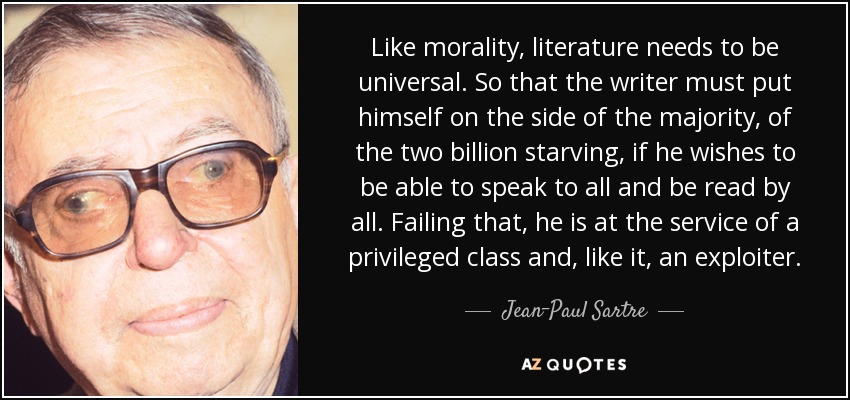
Like morality, literature needs to be universal. So that the writer must put himself on the side of the majority, of the two billion starving, if he wishes to be able to speak to all and be read by all. Failing that, he is at the service of a privileged class and, like it, an exploiter.
Buzzing at the Sill is from a Theodore Roethke poem called "In a Dark Time." I'd heard a small part of it in a play, a sort of sci-fi play about morality in a virtual reality universe. Nothing to do with the book precisely, but it was a great play.
Capitalism doesn't consider morality. It considers profitability.
According to "matter-ism," matter is all that exists. The only things that are real are physical things in motion governed by natural law. That story starts, "In the beginning were the particles," or, as one famous person put it, "The cosmos is all that is, or ever was, or ever will be." No God. No souls. No Heaven or Hell. No miracles. No transcendent morality. Just molecules in motion following the patterns of natural law. This is the story that most atheists, most "skeptics," most humanists, and most Marxists believe is true.
I think it was 50 million people across the world who marched against the war in Iraq. It was perhaps the biggest display of public morality in the world - you know, I mean, before the war happened. Before the war happened, everybody knew that they were being fed lies.
There is not a single person in the media today that could wear Dr. Benjamin Carson's uniform, whatever uniform he puts on in a day, a business suit, if it's surgical scrubs, there's not a single member of the media that could do anything close to what Ben Carson has done with his life. But he gets - and he's not the only one - ripped to shreds, denigrated, destroyed, and for what? He holds to traditional values. He believes in morality. He is just a decent guy and he ends up a target for destruction. And he's not the only one.
When people say "the people" or "the public" as though it's the final repository of all morality, I sometimes flinch.
If I open a book and see that the author is accusing an adversary of "infantile leftism" I shut it again right away. That's not my way of doing things; I don't belong to the world of people who do things that way. I insist on this difference as something essential: a whole morality is at stake; the one that concerns the search for truth and the relation to the other.
Life is a joyous thing essentially, but when you bind life by all these rigid moralities and traditions, and dogmas and creeds, then there is misery.
We used to have adults who set standards, moral standards, cultural standards, legal standards. They were better than we were. They gave us something to aspire to. They were people that we described as having dignity and character. That's all gone now, particularly the upper levels of the Democrat Party. There isn't any of that kind of decency, dignity, character, morality.
I've never seen a Western that was really truthful. Most are just morality plays. Good guys and bad guys - and the good guys always win, whereas in reality most of the sheriffs were as bad as the gangsters they were after.
Even if we ignore the 'non-theoretical' knowledge which we acquire through experience (such as the knowledge of what something tastes like) and concentrate on theoretical knowledge, there is no good reason to think that physics can literally give the theory of everything. Here I want to be really pedantic. Although everything may be subject to physical law, not everything can be explained or described in physical terms. Physics has literally nothing to say about society, morality and the mind, for example - but of course these are parts of 'everything'.
Police have both extra constraints and extra permissions - on the one hand, they can't dodge involvement in social disorder as the rest of us can and they may be required to conduct themselves privately in a way that does not undermine their public authority; on the other hand, they have permission to engage in deceptions, invasions of privacy and uses of force that are forbidden to the rest of us. But this does not put them beyond common morality.
What we have to ask is this: what can we morally expect of and allow to people whom we deploy to fulfill this or that social role :police officer, school teacher, physician? This may sometimes lead to difficult social decisions - e.g. should police be permitted to illegally import drugs as part of a sting operation? In the end, I think "common - that is, critical - morality" should determine the limits of the police role.
Some people think that in order to lead a morally decent life one may sometimes have to forego the possibility of having a good life oneself. Even if that is true, it does not render morality incredible, but it does raise a question about morality's authority: about what one has most reason to do when one is faced with a conflict of this kind.
In contrast to the values of morality, which depend on and encourage our similarities to each other, values like friendship or beauty depend on and encourage our differences. Ultimately, friendship is essential to our fashioning ourselves in ways that don't simply repeat the fashions of our surroundings: it is a mechanism of individuality.
I think that all moralities adequately serving the function of fostering social cooperation must contain a norm of reciprocity - a norm of returning good for good received. Such a norm is a necessity, I argue, because it helps relieve the strains on motivation of contributing to social cooperation when it comes into conflict with self-interest.
Different moralities must share some general features if they are to perform their functions of coordinating beings having particular kinds of motivations. Morality is a cultural construction in something like the way bridges are. There would be no bridges unless human beings used them to move across bodies of waters or depressions in the earth, but a good bridge cannot be designed according to whim, but rather according to what would adequately fulfill their function and the nature of the materials that are available for their construction.
We can cooperate more easily with those who more easily intelligible to us, who are more familiar to us. But the advantages of specialization of labor often push us in the direction working with people who have different strengths and viewpoints than we do. I think that this is one major reason why moralities are always subject to change, because some of the people we cooperate with are going to be different from us in ways that often lead them to have different value orientations than we have; and interacting with them can change us.
I suspect the popularity of young adults and dystopian novels has something to do with a desire for allegory and old-fashioned morality tales. In fact, you might find your religious framework here in dystopian, post-apocalyptic fiction. Here, and in videogames, you find strict codes of authority, the "rules of the game," the life-or-death quest and struggle that people crave.
The gay rights movement of recent years has been an inspiring victory for humanity and it is in the tradition of the civil rights movement when I was a young boy in the South, the women's suffrage movement when my mother was a young woman in Tennessee, the abolition movement much farther back, and the anti-apartheid movement when I was in the House of Representatives. All of these movements have one thing in common: the opposition to progress was rooted in an outdated understanding of morality.
I am glad that Angela Merkel is the German Chancellor, as she tries to combine a sense of responsibility with morality and values. Because this is the essence of Europe.
We certainly did take the country from the Indians. Right. So, but what's going on here, as I would call it a, sort of, morality tale. What the progressives do is, they take a few nuggets of American history, Columbus' arrival, then the founder's compromise with slavery, and what they do is they fast forward to their favorite episode, so to speak, and they create a story out of that leaving a whole bunch of facts out.
Mindfulness is about love and loving life. When you cultivate this love, it gives you clarity and compassion for life, and your actions happen in accordance with that. All ethics and morality, and a sense of interconnectedness, come out of the act of paying attention.
I think moral philosophy is speculation on how we ought to live together done by people who have very little clue how people work. So I think most moral philosophy is disconnected from the species that we happen to be. In fact, they like it that way. Many moral philosophers insist that morality grows out of our rationality, that it applies to any rational being anywhere in the universe, and that it is not based on contingent or coincidental facts about our evolution.
Follow AzQuotes on Facebook, Twitter and Google+. Every day we present the best quotes! Improve yourself, find your inspiration, share with friends
or simply: