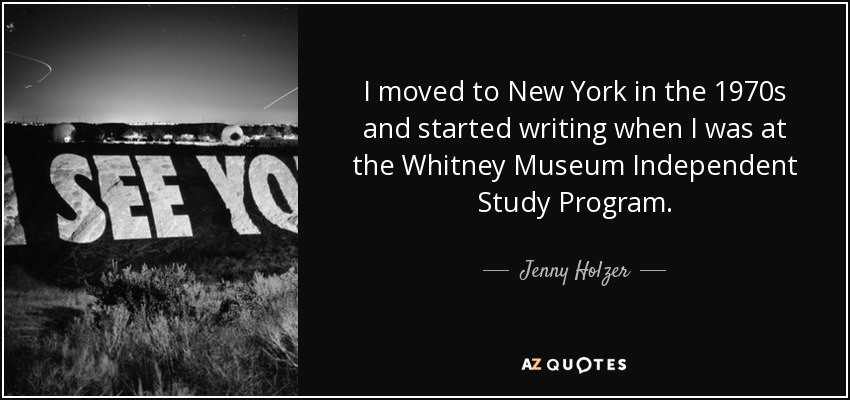
I moved to New York in the 1970s and started writing when I was at the Whitney Museum Independent Study Program.
What I hope is I'll eventually be seen as an actual individual, not as some abstraction - an art dealer running a museum.
It was 1975. I had spent the year at the Boston Museum School doing some very bizarre performance works. The last one included going to the North Magnetic Pole and spending all of my money.
I care much more about saving the lives of mothers and babies than I do about a fancy museum somewhere.
I don't know a single collector or museum director who says: 'Oh, he's on a list, so I think I'll buy something of his.' The people who buy my art put a little more thought into it than that.
Japan suffered terribly from the atomic bomb but never adopted a pose of moral superiority, implying: 'We would never have done it!' The Japanese know perfectly well they would have used it had they had it. They accept the idea that war is war; they give no quarter and accept none. Total war, they recognize, knows no Queensberry Rules. If you develop a devastating new weapon during a total war, you use it; you do not put it into the War Museum.
Yes, my works... are enshrined in museums, but I don't care if the pieces fall apart in 20 years.
I'd love to open a private museum in Paris, London, or New York, but I don't have the money. If I were Bill Gates or Paul Allen, the first thing I would do is build a museum.
If there are no films or plays of interest to me, I don't go. I know how to go to a museum or a library or pick up a good magazine or I can watch the sun set. I know how to live. There's a whole creation out there full of magic and wonder to be explored.
I've met others [people] who simply responded to me, "You're Kehinde Wiley. I know your work. I saw it at the Brooklyn Museum [Brooklyn, NY] And I'd be honored to be in your work."
SAD, BUT ONE DAY OUR KIDS WILL HAVE TO VISIT MUSEUMS TO SEE WHAT A LADY LOOKS LIKE.
Our time and attention is scarce. Art is not that important to us, no matter what we might like to believe... Our love of art is often quite temporary, dependent upon our moods, and our love of art is subservient to our demand for a positive self image. How we look at art should account for those imperfections and work around them. Keep in mind that books, like art museums, are not always geared to the desires of the reader. Maybe we think we are supposed to like tough books, but are we? Who says? Many writers (and art museums) produce for quite a small subsample of the... public.
There's so much that I like about Pittsburgh, actually. The cultural district and museums are wonderful, and I encourage everyone to check them out. And the food is excellent, too!
I think my love for books sprang from my need to escape the world I was born into, to slide into another where words were straightforward and honest, where there was clearly delineated good and evil, where I found girls who were strong and smart and creative and foolish enough to fight dragons, to run away from home to live in museums, to become child spies, to make new friends and build secret gardens.
For many, the icon of the British Museum is the Rosetta Stone, that administrative by-product of the Greek imperial adventure in Africa.
I remember when I first started putting things on the web and people were writing about it. I totally didn't keep up with what was going on because I wanted to present stuff in museums and galleries and have some presence on the web. I feel fortunate to have posted stuff in the beginning.
I almost feel like if I didn't have the gallery and museum content it would be easy to get lost. People's attention spans are so short; they see something and it trends for a few days and then it goes away and something else comes.
I have no intention of selling any more of the historical Apollo 11 items in my possession for the remainder of my life. I intend to pass a portion of these items on to my children and to loan the most important items for permanent display in suitable museums around the country.
The church is not a museum for pristine saints, but a hospital ward for broken sinners.
Museums that aren't perfect are the ones that I love. Museums that aren't overdesigned. I always like to visit the strange, odd museums. In New York, the Frick is absolutely my favorite, favorite place because I like to think that it was someone's home not that long ago.
So, though there was still some store of weapons in the Shire, these were used mostly as trophies, hanging above hearths or on walls, or gathered into the museum at Michel Delving. The Mathom-house it was called; for anything that Hobbits had no immediate use for, but were unwilling to throw away, they called a mathom. Their dwellings were apt to become rather crowded with mathoms, and many of the presents that passed from hand to hand were of that sort.
Psychedelic drugs, especially psilocybin, allow a searchlight to be thrown on these deeper levels of the psyche, as Jung correctly stated. But it is not a museum of archetypes or psychic constructs, as he seemed to assume. It is a frontier of wholeness into which any person, so motivated and so courageous as to wish to do it, can go and leave the mundane plane far behind.
We are still struggling with people who don't feel comfortable going into museums. As a visual artist I ask how artists can be part of enacting a change.
I think, at the L.A. County Museum of Art, I saw my first example of Kerry James Marshall, who had a very sort of heroic, oversized painting of black men in a barbershop. But it was painted on the same level and with the same urgency that you would see in a grand-scale [Anthony] van Dyck or [Diego] Velazquez. The composition was classically informed; the painting technique was masterful. And it was something that really inspired me because, you know, these were images of young, black men in painting on the museum walls of one of the more sanctified and sacred institutions in Los Angeles.
I think that once you're able to sort of get in line with who and how you relate to the world, you'll become closer to this index that I'm referring to. Because what you want is this card that relates to that book. What you want is this human that relates to this world, rather than having this art school society scattering that point of view somewhere in between. It becomes diffused. And that level of clarity, I think, was gained at the Studio Museum in Harlem.
Follow AzQuotes on Facebook, Twitter and Google+. Every day we present the best quotes! Improve yourself, find your inspiration, share with friends
or simply: