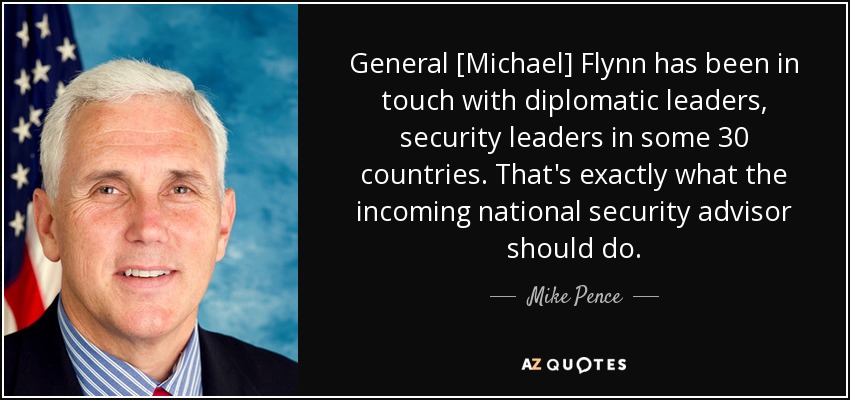
General [Michael] Flynn has been in touch with diplomatic leaders, security leaders in some 30 countries. That's exactly what the incoming national security advisor should do.
The fact that some former national security officials challenge the policy wisdom of the order, while other national security officials - most notably those of this [Donald Trump's] administration - support it, merely demonstrates that these are policy disputes that the judiciary is both ill-equipped and constitutionally barred from arbitrating.
One of the principal qualities that you need as national security adviser is trust, the trust of the president. And that depends on truth and it depends on honesty.
That's the job of the National Security Council is to try to be a disciplined clearinghouse, gathering the views from across multiple agencies, teeing up decisions that make sense for the president.
We ought to be doing much more in North America. We are on the cusp of an energy revolution. And we do need to be doing more at home. The biggest national security threats facing the United States right now are not in the Middle East. They are domestic.
In our counterterrorism cases and our counterintelligence cases, we can issue all kinds of - of layers of approval in the FBI, a national security letter to find out the subscriber to a particular telephone number and to find out what numbers that telephone number was in contact with. Not the content of those communications, but just the connection.
Iraq both poses a continuing threat to the national security of the United States and international peace and security in the Persian Gulf region and remains in material and unacceptable breach of its international obligations by, among other things, continuing to possess and develop a significant chemical and biological weapons capability, actively seeking a nuclear weapons capability, and supporting and harboring terrorist organizations.
Only by providing leading-edge human capital and knowledge capital can American continue to maintain a high standard of living, including providing national security for its citizens.
It should never be the goal of U.S. foreign policy towards any country to have a - quote, unquote - "good relation." Then what? What do we get out of that? We get - Trump is helping the approval ratings amongst Russians. How does that advance American national security interests?
Our forbearance should never be misunderstood. Our reluctance for conflict should not be misjudged as a failure of will. When action is required to preserve our national security, we will act.
Why should one U.S. airman give up his life when our national security is not in imminent danger?
Reaffirming the justice of the American system bolsters our legitimacy with allies, thereby encouraging further cooperation and improving our national security.
The president recognizes that funding global health is good for national security, domestic health and global diplomacy. Consequently, President Obama has steadily increased funding for the President's Emergency Plan for AIDS Relief, or PEPFAR, which was created by President Bush and has strong bipartisan support.
The American people demand results, not rhetoric, especially when it comes to national security issues.
Therefore, if we are a Nation of laws and a Nation of immigrants, immigration should occur within a legal framework, not through the machinations of illegal schemes and scams that threaten our national security.
The war on terrorism has made national security a legitimate concern, and a rising deficit, changes brought on by globalization and even the price of oil have thrown the nation's economic health into question.
Fundamentally, I believe that the U.S. can improve its international standing and its national security by expanding trade and strengthening its relationships with moderate Muslim countries.
Back in March, before Donald Trump secured the Republican nomination for president, a group of national security heavyweights signed an open letter that called Trump fundamentally dishonest and utterly unfit for the presidency. Now, two days after Trump's victory, some in the national security establishment are wondering whether to return to the fold.
In the national security establishment, it is somewhat frowned upon for people to take extremely harsh partisan roles in campaigns.
In the area of international security, taking into account that the United States and Russia are the largest nuclear powers: We are ready to jointly work to strengthen the non-proliferation regime for weapons of mass destruction and their means of delivery. We are ready to work together, and much closer than before, on the problem of fighting terrorism, international terrorism, and here we certainly have vast opportunities.
I am encouraged by the president-elect's [Donald Trump] insistence that NATO is a commitment that does not change. And his full commitment to NATO as the foundation for our international security I think is very important.
I think that Mr. Snowden raised some legitimate concerns. How he did it was something that did not follow the procedures and practices of our intelligence community. If everybody took the approach that I make my own decisions about these issues, then it would be very hard to have an organized government or any kind of national security system.
The Fourth Amendment is on life support and the chief agent of that is the National Security Agency.
I think it's very, very important that in foreign policy and national security decision making, as in any other realm, that there be a range of diversity that reflects the full complexity of America. We should draw on those experiences to inform our decision making.
If you've got a brand new administration coming into office you want to have, at the very least, a national security team in place on day one.
Follow AzQuotes on Facebook, Twitter and Google+. Every day we present the best quotes! Improve yourself, find your inspiration, share with friends
or simply: