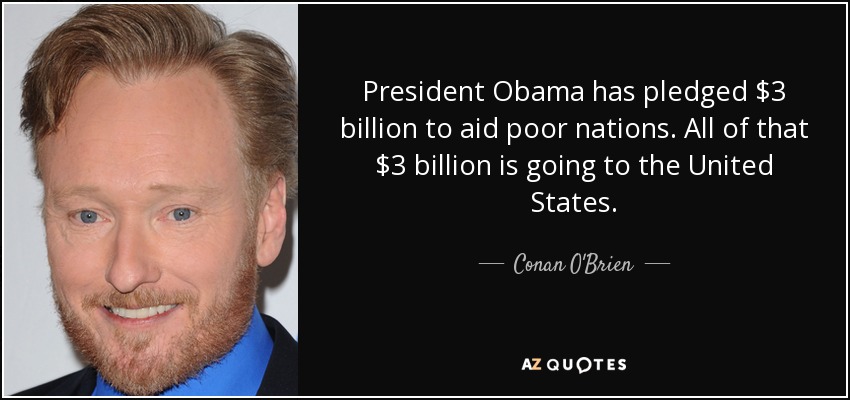
President Obama has pledged $3 billion to aid poor nations. All of that $3 billion is going to the United States.
Joe Biden will speak to the nation's largest gay rights group during a human rights convention on Friday. Then on Saturday, he is scheduled to speak to them again to apologize for whatever he said in Friday's speech.
Both President Obama and former President George W. Bush were interviewed on 'Face the Nation' over the weekend. President Bush said there's a 50 percent chance his brother Jeb will run for president in 2016. Then he said, 'But there's an 80 percent chance he won't.'
To draw around the whole nation the strength of the General Government as a barrier against foreign foes... is [one of the] functions of the General Government on which [our citizens] have a right to call.
I am ever unwilling that [peace] should be disturbed as long as the rights and interests of the nations can be preserved. But whensoever hostile aggressions on these require a resort to war, we must meet our duty and convince the world that we are just friends and brave enemies.
We cannot allow the defense of American lives to be held hostage by the United Nations -- which has already given Saddam Hussein a final warning, and now wants to give him another final warning. And, if he doesn't heed that, they will threaten him with yet another warning.
The Middle Eastern states aren't nations; they're quarrels with borders.
Teller contended, not implausibly, that hydrogen bombs keep the peace, or at least prevent thermonuclear war, because the consequences of warfare between nuclear powers are now too dangerous. We haven't had a nuclear war yet, have we? But all such arguments assume that the nuclear-armed nations are and always will be, without exception, rational actors, and that bouts of anger and revenge and madness will never overtake their leaders (or military and secret police officers in charge of nuclear weapons). In the century of Hitler and Stalin, this seems ingenuous.
The potential beauty of human life is constantly made ugly by man's ever recurring song of retaliation. The oceans of history are made turbulent by the ever rising tides of revenge. Man has never risen above the injunction of the lex talionis: "Life for life, eye for eye, tooth for tooth, hand for hand, foot for foot." In spite of the fact that the law of revenge solves no social problems, men continue to follow its disastrous leading. History is cluttered with the wreckage of nations and individuals that pursued this self-defeating path.
If our nation is ever taken over, it will be taken over from within.
Take away a nation's heritage and they are more easily persuaded.
My brothers, family of our nation, secured Kuwait shall be, and secured you shall all be from every evil and long live Kuwait. And may you all live as her saviors, virtuous sons to her soil, and be her envoys. May she long live, may you long live adhering to her propitious principles, defending her kind and humanitarian lifespan, and her immaculate and tolerant Islamic faith.
There is a groan that unites men and women, rich and poor, in any nation. These muscle pains are "explained" in every culture, but the universal fact of this persistence must mean that no adequate therapy exists.
This is a war between good and evil. And we have made it clear to the world that we will stand strong on the side of good, and we expect other nations to join us. This is not a war between our world and their world. It is a war to save the world.
The creatures with whom we share the planet and whom, in our arrogance, we wrongly patronize for being lesser forms, they are not brethren, they are not underlings, they are other nations, caught with ourselves in the net of life and time, fellow prisoners of the splendour and travail of the Earth.
Truth, like beauty, varies its fashions, and is best recommended by different dresses to different minds; and he that recalls the attention of mankind to any part of learning which time has left behind it, may be truly said to advance the literatures of his own age. As the manners of nations vary, new topicks of persuasion become necessary, and new combinations of imagery are produced; and he that can accommodate himself to the reigning taste, may always have readers who perhaps would not have looked upon better performances.
The authors that in any nation last from age to age are very few, because there are very few that have any other claim to notice than that they catch hold on present curiosity, and gratify some accidental desire, or produce some temporary conveniency.
Wealth from trade was the mainspring of Western material advance; the visible agents of change were great guns. These came of age in Europe in the 15th century. On land their potency in reducing castle walls favoured central over local power, since in general only monarchs could afford siege-trains; so nation-states were consolidated and extended into great territorial empires. At sea, guns transformed sailing ships into mobile castles virtually impregnable to opponents who lacked equally powerful ordnance. With the ocean-going gunned warship, western Europe began to extend around the globe.
Nations, as well as man, almost always betray the most prominent features of their future destiny in their earliest years. When I contemplate the ardour with which the Anglo-Americans prosecute commercial enterprise, the advantages which befriend them, and the success of their undertakings, I cannot refrain from believing that they will one day become the first maritime power of the globe. They are born to rule the seas, as the Romans were to conquer the world.
'A Naval History of Britain' which begins in the 7th century has to explain what it means by Britain. My meaning is simply the British Isles as a whole, but not any particular nation or state or our own day... 'Britain' is not a perfect word for this purpose, but 'Britain and Ireland' would be both cumbersome and misleading, implying an equality of treatment which is not possible. Ireland and the Irish figure often in this book, but Irish naval history, in the sense of the history of Irish fleets, is largely a history of what might have been rather than what actually happened.
The country (England) which was called a nation of pirates in the years around 1600 would eventually become the pirates' greatest scourge, not just in English waters but throughout the world.
Here is an educational bombshell: Take from all of today's industrial nations all their industrial machinery and all their energy-distributing networks, and leave them all their ideologies, all their political leaders, and all their political organizations, and I can tell you that within six months, two billion people will die of starvation, having gone through great pain and deprivation along the way.
But if not Kelso, then something else, because a free people must own the nation they live in.
In our time, in particular, there exists another form of ownership which is becoming no less important than land: the possession of know-how, technology and skill. The wealth of the industrialized nations is based much more on this kind of ownership than on natural resources.
A nation that will keep people in slavery for 244 years will "thingify" them and make them things. And therefore, they will exploit them and poor people generally economically. And a nation that will exploit economically will have to have foreign investments and everything else, and it will have to use its military might to protect them. All of these problems are tied together. What I'm saying today is that we must go from this convention and say, "America, you must be born again!"
Follow AzQuotes on Facebook, Twitter and Google+. Every day we present the best quotes! Improve yourself, find your inspiration, share with friends
or simply: