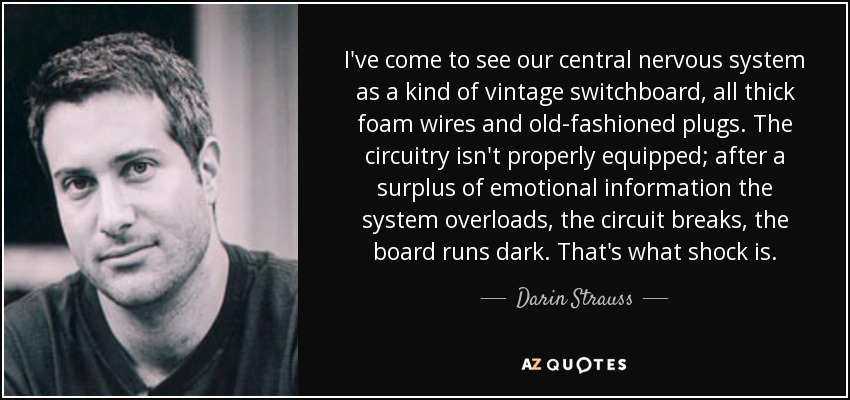
I've come to see our central nervous system as a kind of vintage switchboard, all thick foam wires and old-fashioned plugs. The circuitry isn't properly equipped; after a surplus of emotional information the system overloads, the circuit breaks, the board runs dark. That's what shock is.
The brain controls pain. It controls fear. Sleep. Empathy. Hunger. Everything we associate with the heart or the soul or the nervous system is actually controlled by the brain. Everything. What if you could control it?
Schwartz's research suggests something important: we can stretch our personalities, but only up to a point. Our inborn temperaments influence us, regardless of the lives we lead. A sizeable part of who we are is ordained by our genes, by our brains, by our nervous systems. And yet the elasticity that Schwartz found in some of the high-reactive teens also suggests the converse: we have free will and can use it to shape our personalities.
A town is a thing like a colonial animal. A town has a nervous system and a head and shoulders and feet. A town is a thing separate from all other towns alike. And a town has a whole emotion. How news travels through a town is a mystery not easily to be solved. News seems to move faster than small boys can scramble and dart to tell it, faster than women can call it over the fences.
If the human race develops an electronic nervous system, outside the bodies of individual people, thus giving us all one mind and one global body, this is almost precisely what has happened in the organization of cells which compose our own bodies. We have already done it. [...] If all this ends with the human race leaving no more trace of itself in the universe than a system of electronic patterns, why should that trouble us? For that is exactly what we are now!
English is capable of defining sentiments that the human nervous system is quite incapable of experiencing.
The experience of truth has to be felt on the central nervous system.
As scientists you must keep your minds open. There is no use having blind faith in Me, in Sahaja Yoga, in anything because blindness will never give you reality. But you should be open like scientists are and whatever hypothesis I am putting before you, you have to feel it on your central nervous system.
One has to know what is the ultimate goal of our life. The ultimate goal of our evolution is to become the Spirit, which is the reflection of God Almighty in our heart. That is self identity and also self knowledge. Also, one becomes one with the all-pervading Divine power of love. Our awareness is enlightened by the Spirit and Divine vibrations start flowing through our central nervous system enlightening our being.
You cannot intellectualize the Divine. You have to experience it on your central nervous system.
What we have to understand that we have to believe into things which can be proved. Now the time has come that Divine itself has to be proved. That God Almighty has to be proved. That Christ as a son of God has to be proved, that His birth as immaculate conception has to be proved. Not by argument, not by reasoning, nor by blind faith but by actualization on your central nervous system.
It is only the Sahasrara has to grow, not the Spirit. The more sensitive the Sahasrara is, the more it receives the spiritual qualities of the Spirit. Actually the peace is felt in the Sahasrara. The bliss is also felt in the Sahasrara because that is the brain and the brain is the epitome of our nervous system, central nervous system, of consciousness itself.
Now the truth is that the Spirit is within you and you are the Spirit. You are the beauty, the bliss and the joy of that Spirit. That's what you are . Because your attention is not there, that's why you cannot feel your Spirit. But your Spirit exists; it is within you, in your heart, waiting for a moment to come into your conscious mind, to be felt by you in your central nervous system. It's all there, built within you.
Freedom is when you really get your own powers which are within you. In your central nervous system and in your conscious mind, you must feel the existence of the spirit.
I can say, if I like, that social insects behave like the working parts of an immense central nervous system: the termite colony is an enormous brain on millions of legs; the individual termite is a mobile neurone.
Up till now, we can suppose, nervous systems solved the 'Now what do I do?' problem by a relatively simple balancing act between a strictly limited repertoire of actions - if not the famous four F's (fight, flee, feed, or mate), then a modest elaboration of them.
I'd just like to see thinking come back in style. I haven't heard a new idea in eight years. Let's get ordinary people arguing and talking again. I want to trigger new circuits in their nervous systems. That's the philosopher's job and I am the most important philosopher at this time.
He was one of those inexplicable gifts of nature, an artist who leaps over boundaries, changes our nervous systems, creates a new language, transmits new kinds of joy to our startled senses and spirits.
...the nervous systems of other animals were not artificially constructed - as a robot might be artificially constructed - to mimic the pain behavior of humans. A capacity to feel pain obviously enhances a species' prospects of survival...it is surely unreasonable to suppose that nervous systems that are virtually identical physiologically, have a common origin and a common evolutionary function, and result in similar forms of behavior in similar circumstances should actually operate in an entirely different manner on the level of subjective feelings.
Typically, defenders of experiments on animals do not deny that animals suffer. They cannot deny the animals' suffering, because they need to stress the similarities between humans and other animals in order to claim that their experiments may have some relevance for human purposes. The experimenter who forces rats to choose between starvation and electric shock to see if they develop ulcers (which they do) does so because the rat has a nervous system very similar to a human being's, and presumably feels an electric shock in a similar way.
I engaged - started engaging in yoga as a physical practice, but very quickly found out there was something broader to it, and that it was actually helpful for my pain, and started to get into meditation, started to study the Upanishads and the Bhagavad Gita and a lot of the scriptures associated with yoga, the Yoga Sutras, and very quickly came to this conclusion that this had a huge impact on my ability to lead, but, more importantly, the ability to control my sympathetic nervous system, which had a direct tie to the pain in my arm.
It is a fact that plants also have life like animals. But animals are endowed with mind, and nervous systems too while the plants do not possess the same.
Perfect replication is the enemy of any robust system... Lacking a central nervous system much less a brain the parasite is a simple system designed to compromise a very specific target host. The more uniform the host, the more effective the infestation.
Poetry is the inner life of a culture, its nervous system, its deepest way of imagining the world. A culture that ignores its poets, chokes off its nervous system and becomes mortally ill.
A tendency to resume the same mode of action at stated times is peculiarly the characteristic of the nervous system; and on this account regularity is of great consequence in exercising the moral and intellectual power. All nervous diseases have a marked tendency to observe regular periods; and the natural inclination to sleep at the approach of night is another instance of the same fact.
Follow AzQuotes on Facebook, Twitter and Google+. Every day we present the best quotes! Improve yourself, find your inspiration, share with friends
or simply: