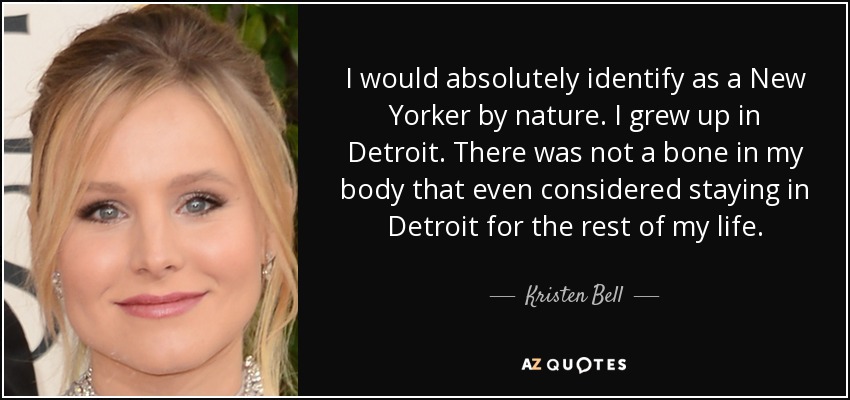
I would absolutely identify as a New Yorker by nature. I grew up in Detroit. There was not a bone in my body that even considered staying in Detroit for the rest of my life.
I wasn't even in a newspaper office where I was getting assignments in competition with other people. I remember earlier, though, that I knew a young woman who had been published in the New Yorker, and I was so jealous of her. It wasn't exactly a personal competition. I just envied that accomplishment.
I'm always pointing things out to native New Yorkers that I think are weird about this place and their culture and all that. But I feel like my friends and family from California feel like I've totally "become a New Yorker."
I wasn't aware I'd write the novel when I wrote the New Yorker story either. And the narration of their construction in 10:04 is fiction, however flickering.
I'm aware of narrating certain experiences as they happen or obliterating those experiences with narrative and then those stories - not the experiences themselves - might become material for art. This kind of transformation shows up a lot in 10:04 because the book tracks the transposition of fact into fiction in the New Yorker stor
I get a little sick of these New Yorkers who want me to make some psychic thing, like 'The Left-Handed Gun.' They don't know anything about Western history.
New York is a place that can grind you down and spit you out. A true New Yorker doesn't get ground down, he gets polished.
Just like New Yorkers themselves, the trees in New York [city] work harder than any others in the world.
For most visitors to Manhattan, both foreign and domestic, New York is the Shrine of the Good Time. "I don't see how you stand it," they often say to the native New Yorker who has been sitting up past his bedtime for a week in an attempt to tire his guest out. "It's all right for a week or so, but give me the little old home town when it comes to living." And, under his breath, the New Yorker endorses the transfer and wonders himself how he stands it.
We New Yorkers see more death and violence than most soldiers do, grow a thick chitin on our backs, grimace like a rat and learn to do a disappearing act. Long ago we outgrew the need to be blowhards about our masculinity; we leave that to the Alaskans and Texans, who have more time for it.
The 'New Yorker' asked me to shoot a story on climate change in 2005, and I wound up going to Iceland to shoot a glacier. The real story wasn't the beautiful white top. It ended up being at the terminus of the glacier where it's dying.
New Yorkers always hate LA! I love both cities! I do love the sunshine and the beach after growing up in rainy England.
Im a New Yorker. My background is in theater, so staying here, I have the opportunity to get back to that, which I would love to do.
One of the perks of being a New Yorker cartoonist is that you get to hang around with interesting people. My fellow cartoonists are all interesting, and all highly creative.
I think it's a greater risk not to write about 9\11. If you're in my position - a New Yorker who felt the event very deeply and a writer who wants to write about things he feels deeply about - I think it's risky to avoid what's right in front of you.
I've always believed that thoughtful people don't really take the tabloids seriously. They're basically a form of entertainment. I enjoy them as much as the next New Yorker.
Writing helped to have jobs that involved running around, pushing things like dish carts and wheelbarrows. It would be hard to sit at a desk all day, and then come to sit at another desk. Also, it helps to abandon hope. If I sit at my computer, determined to write a New Yorker story I won't get beyond the first sentence. It's better to put no pressure on it. What would happen if I followed the previous sentence with this one, I'll think. If the eighth draft is torture, the first should be fun. At least if you're writing humor.
I was first published in the newspaper put out by School of The Art Institute of Chicago, where I was a student. I wince to read that story nowadays, but I published it with an odd photo I'd found in a junk shop, and at least I still like the picture. I had a few things in the school paper, and then I got published in a small literary magazine. I hoped I would one day get published in The New Yorker, but I never allowed myself to actually believe it. Getting published is one of those things that feels just as good as you'd hoped it would.
I feel like I'm a New Yorker because I really know the city. I actually tell the drivers where to go - I have this bad habit, I always question the drivers. I do that all the time because I feel like I know the best way, when really it's like, 'Yo, man, shut up. This dude does this every day of his life.'
I was 30 when 9/11 happened and I had lived exactly 15 years of life in America, so I was half American. I was a full-fledged New Yorker.
With the Tonys it's a little tricky because a lot of the funnier jokes are more insider, so people watching at home may not get a Julie Taymor reference the way that New Yorkers would. So you have to figure out what comedy plays to a large audience and still respect the individuals who are there.
I'm a born and bred New Yorker. I belong here. Everytime I leave it's like losing a leg.
I'm a New Yorker now, and believe me, there's no comparison between the Big Apple and Kalamazoo, no similarity at all. New York City's hectic, always in fast-forward, and Kalamazoo's more laid-back, smaller, slower.
I never studied art, but taught myself to draw by imitating the New Yorker cartoonists of that day, instead of doing my homework.
After the 9/11 apocalypse happened in New York City, people, particularly New Yorkers, who breathed in the ash, or saw the results of that, have a tendency to keep seeing echoes and having flashbacks to it.
Follow AzQuotes on Facebook, Twitter and Google+. Every day we present the best quotes! Improve yourself, find your inspiration, share with friends
or simply: