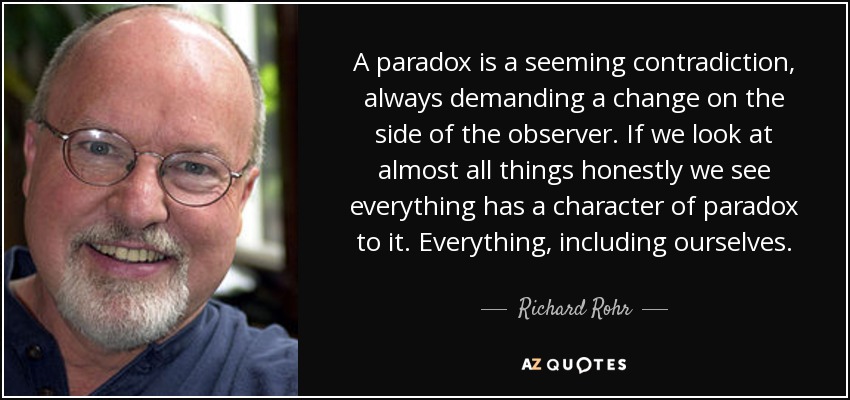
A paradox is a seeming contradiction, always demanding a change on the side of the observer. If we look at almost all things honestly we see everything has a character of paradox to it. Everything, including ourselves.
I learned how to direct by being in the trenches of movies. Getting to be a student from the inside looking out, and if you're a respectful observer you can sponge lots of information. That was my film school.
The moment I am aware that I am aware, I am not aware. Awareness means the observer is not.
The most formidable of all the ills that threaten the future of the Union arises from the presence of a black population upon its territory; and in contemplating the cause of the present embarrassments, or the future dangers of the United States, the observer is invariably led to this as a primary fact.
A comic writer should of all others be the least excused for deviating from nature, since it may not be always so easy for a serious poet to meet with the great and the admirable; but life every where furnishes an accurate observer with the ridiculous.
Thinking isn't something you think about. It comes naturally. Thinking involves many things. It involves being an observer. It involves analyzing things, taking in what's around you in the world and finding how to make it inspire your work or turn it into a lesson to teach your children; it's paying attention to details. That's what thinking is: processing.
I often told the fanatics of realism that there is no such thing as realism in art: it only exists in the mind of the observer. Art is a symbol, a thing conjuring up reality in our mental image. That is why I don't see any contradiction between abstract and figurative art either.
That's a mistake I think that a lot of Western observers make is to assume that Korean nationalism is hundreds if not thousands of years old. When in fact nationalism is incompatible with Korean Confucian tradition.
Why chase after thoughts, which are superficial ripples of present awareness? Rather look directly into the naked, empty nature of thoughts; then there is no duality, no observer, and nothing observed. Simply rest in this transparent, nondual present awareness. Make yourself at home in the natural state of pure presence, just being, not doing anything in particular.
In general the languages of most unpolished people have a great force and energy of expression; and this is but natural. Uncultivated people are but ordinary observers of things, and not critical in distinguishing them; but, for that reason, they admire more, and are more affected with what they see, and therefore express themselves in a warmer and more passionate manner.
The birth of a new fact is always a wonderful thing to experience. It's dualistically called a "discovery" because of the presumption that it has an existence independent of anyone's awareness of it. When it comes along, it always has, at first, a low value. Then, depending on the value-looseness of the observer and the potential quality of the fact, its value increases, either slowly or rapidly, or the value wanes and the fact disappears.
To those who feel that their values are THE values, the less controlled systems necessarily present a spectacle of "chaos," simply because such systems respond to a diversity of values. The more successfully such systems respond to diversity, the more "chaos" there will be, by definition, according to the standards of ANY specific set of values- other than diversity or freedom as values. Looked at another way, the more self-righteous observers there are, the more chaos (and "waste") will be seen.
Few poets have made a more interesting rhetoric out of just fooling around: turning things upside down, looking at them from under the sofa, considering them (and their observer) curiously enough to make the reader protest, "That were to consider it too curiously.
The great events of history are often due to secular changes in the growth of population and other fundamental economic causes, which, escaping by their gradual character the notice of contemporary observers, are attributed to the follies of statesmen or the fanaticism of atheists .
Precise, graceful, and generous, the poems in SuperLoop, seem to be born out of a deep, careful attention and a profound compassion. Sometimes the quiet observer, sometimes the kid in the center of the messed-up carnival, these poems are the fireflies you’ve missed all winter, the longed-for return of the bees. Unaffected and inherently hopeful, Callihan’s work is as merciful as it is moving.
In a car you're always in a compartment, and because you're used to it you don't realize that through that car window everything you see is just more TV. You're a passive observer and it is all moving by you boringly in a frame. On a cycle the frame is gone. You're completely in contact with it all. You're in the scene, not just watching it anymore, and the sense of presence is overwhelming.
Hamlet is egotism as it appears to itself, and Don Quixote is egotism as it appears to the detached observer.
The evolution of life, and the evolutionary origin of mankind, are scientifically established as firmly and completely as any historical event not witnessed by human observers. Any concession to anti-evolutionists, suggesting that there are scientific reasons to doubt the facticity of evolution, would be propagating a plain untruth.
Art begins when an observer's sensibilities engage with the understatements of a calculating craftsman.
Some authors state that the last stage in this chain of measurements involves "consciousness," or the "intellectual inner life" of the observer, by virtue of the "principle of psycho-physical parallelism." Other authors introduce a wave function for the entire universe. In this book, I shall refrain from using concepts that I do not understand.
The philosophical anthropologist ... can know the wholeness of the person and through it the wholeness of man only when he does not leave his subjectivity out and does not remain an untouched observer.
Our initial sensory data are always "first derivatives," statements about differences which exist among external objects or statements about changes which occur either in them or in our relationship to them. Objects and circumstances which remain absolutely constant relative to the observer, unchanged either by his own movement or by external events, are in general difficult and perhaps always impossible to perceive. What we perceive easily is difference and change and difference is a relationship.
The general misunderstanding of a work of art is often due to the fact that the key to its spiritual content and technical means is missed. Unless the observer is trained to a certain degree in the artistic idiom, he is apt to search for things which have little to do with the aesthetic content of a picture. He is likely to look for pure representational values when the emphasis is really upon music-like relationships.
We have preachers and savants who dilate endlessly on the sanctity of family and childhood but who tolerate a system in which a casual observer can correlate a child's social origin with its physical well-being.
Be an observer of providence; for God is showing you ever, by the way in which He leads you, whither He means to lead. Study your trials, your talents, the world's wants, and stand ready to serve God now, in whatever He brings to your hand.
Follow AzQuotes on Facebook, Twitter and Google+. Every day we present the best quotes! Improve yourself, find your inspiration, share with friends
or simply: