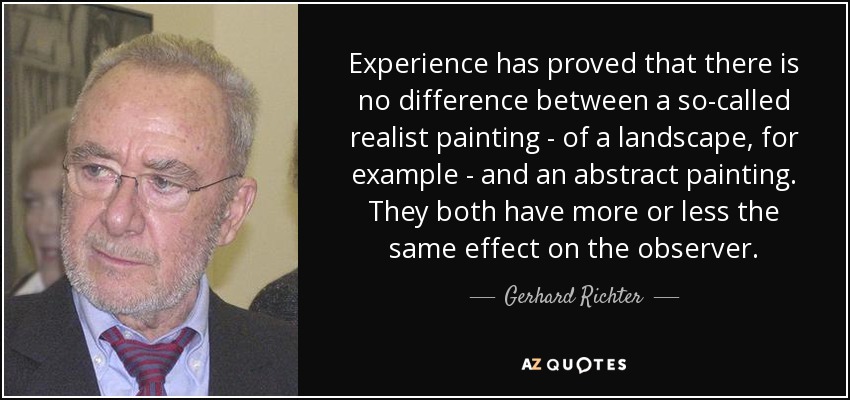
Experience has proved that there is no difference between a so-called realist painting - of a landscape, for example - and an abstract painting. They both have more or less the same effect on the observer.
Mitt Romney's rally in Mansfield, Ohio, on Monday began the way every political event begins. 'Please stand for the Pledge of Allegiance and our country's national anthem.' This is always an uncomfortable moment for me. While I sat at my laptop, most of the reporters around me stood and put their hands over their hearts. This time instead of just sitting and working, I tweeted what I was feeling: 'Ari_Shapiro: As a reporter I'm torn about joining in the pledge of allegiance/national anthem at rallies. I'm a rally observer, not a participant.'
Well, I'm not sure, but of one thing I am certain: History judges one differently than contemporary observers, and so I think that as time passes, I hope that not me personally so much, but our administration will be seen for some of the things that we accomplished.
The material presence of the work only serves as a conveyer launching an invitation to the observer to take part of the comprehensive game of the thousand and one emotions and visions.
If no one remembers a misdeed or names it publically, it remains invisible. To the observer, its victim is not a victim and its perpetrator is not a perpetrator; both are misperceived because the suffering of the one and the violence of the other go unseen. A double injustice occurs-the first when the original deed is done and the second when it disappears.
Where the observer is at first a real goodness realized, later it is a sophisticated power holder. The observer is given power and control that belongs to oneness. When oneness has that power and that control, there is love.
...though every thinking being longs for God, the First Cause, it is powerless... to grasp Him. Tired with the yearning it chafes at the bit and, careless of the cost, it tries a second tack. Either it looks at things visible and makes of these a god - a gross mistake, for what visible thing is more sublime, more godlike, than its observer... - or else it discovers God through the beauty and order of things seen, using sight as a guide to what transcends sight without losing God through the grandeur of what it sees.
The universe and the observer exist as a pair. I cannot imagine a consistent theory of the universe that ignores consciousness.
The way to start writing isn't by writing at all. But by living. It isn't about creating something from thin air, but about documenting our personal feelings about the things that we see. Or to put it crudely, how are you going to be a storyteller if you have no story to tell? Perhaps, in the end, there are no such things as creative people; they are only sharp observers with sensitive hearts.
You've got to be an observer. And you've got to take time to listen to people, talk, to watch what they do.
I'm never bored, never ever bored. If I've got a day off I'll sit in a cafe and watch and observe. I'm a great observer.
Rationalism belongs to the cool observer. But because of the stupidity of the average person, they follow not reason, but faith. This naïve faith, requires necessary illusions and emotionally potent oversimplifications, which are provided by the myth maker to keep the ordinary person on course.
Every single person is unlike anyone else. Therefore, in creating a portrait of someone... we must look carefully to catch that particular unique quality. In fact, we can neglect nothing because everything we select or do sends a message to the observer.
A French observer is surprised to hear how often an English or an American lawyer quotes the opinions of others, and how little he alludes to his own; ... This abnegation of his own opinion, and this implicit deference to the opinion of his forefathers, which are common to the English and American lawyer, this servitude of thought which he is obliged to profess, necessarily give him more timid habits and more conservative inclinations in England and America than in France.
Dear young people, please, don’t be observers of life, but get involved. Jesus did not remain an observer, but he immersed himself. Don’t be observers, but immerse yourself in the reality of life, as Jesus did.
You cannot do silhouettes in fantasy. Ah, no, you must be faithful. It is, the art, a, what you call, paradox. It is always that you must be simple, and then, if you are simple, you will stimulate the imagination of the observer.
Perception without the perceiver in meditation is to commune with the height and depth of the immense. This perception is entirely different from seeing an object without an observer, because in the perception of meditation there is no object and therefore no experience. can, however, take place when the eyes are open and one is surrounded by objects of every kind. But then these objects have no importance at all. One sees them but there is no process of recognition, which means there is no experiencing.
To those who feel that their values are THE values, the less controlled systems necessarily present a spectacle of "chaos," simply because such systems respond to a diversity of values. The more successfully such systems respond to diversity, the more "chaos" there will be, by definition, according to the standards of ANY specific set of values- other than diversity or freedom as values. Looked at another way, the more self-righteous observers there are, the more chaos (and "waste") will be seen.
There is in every human countenance either a history or a prophecy which must sadden, or at least soften every reflecting observer.
In the end, science as we know it has two basic types of practitioners. One is the educated man who still has a controlled sense of wonder before the universal mystery, whether it hides in a snail's eye or within the light that impinges on that delicate organ. The second kind of observer is the extreme reductionist who is so busy stripping things apart that the tremendous mystery has been reduced to a trifle, to intangibles not worth troubling one's head about.
The sculptor does not work for the anatomist, but for the common observer of life and nature.
I made a promise to keep a watch over myself, to remain master of myself, so that I might become a sure observer.
My aim is to escape from the medium with which I work; to leave no residue of technical mannerisms to stand between my expression and the observer. To seek freedom through significant form and design rather than through the diversion of so-called free and accidental brush handling.
A paradox is a seeming contradiction, always demanding a change on the side of the observer. If we look at almost all things honestly we see everything has a character of paradox to it. Everything, including ourselves.
I learned how to direct by being in the trenches of movies. Getting to be a student from the inside looking out, and if you're a respectful observer you can sponge lots of information. That was my film school.
Follow AzQuotes on Facebook, Twitter and Google+. Every day we present the best quotes! Improve yourself, find your inspiration, share with friends
or simply: