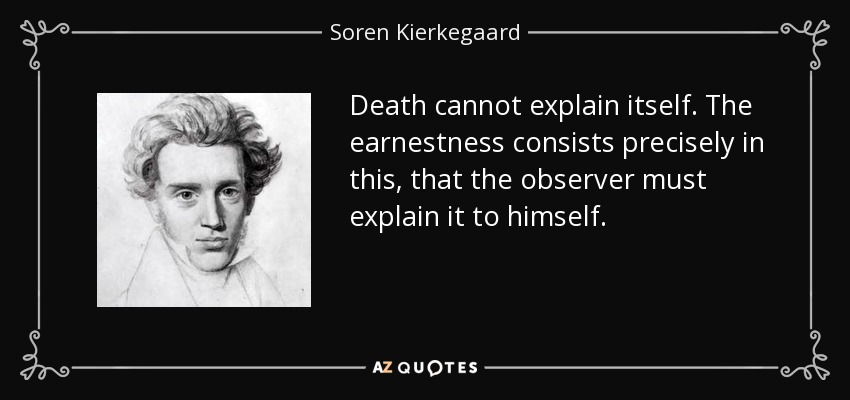
Death cannot explain itself. The earnestness consists precisely in this, that the observer must explain it to himself.
To say then, the majority are wicked, means no malice, no bad heart in the observer, but, simply that the majority are unripe, andhave not yet come to themselves, do not yet know their opinion.
Impartial observers from other planets would consider ours an utterly bizarre enclave if it were populated by birds, defined as flying animals, that nevertheless rarely or never actually flew. They would also be perplexed if they encountered in our seas, lakes, rivers, and ponds, creatures defined as swimmers that never did any swimming. But they would be even more surprised to encounter a species defined as a thinking animal if, in fact, the creature very rarely indulged in actual thinking.
I can go to a lot of games, but I'm not a player. I'm kind of an observer. That's why I think I do what I do in life. I just observe. That's what I find fascinating.
I'm a great observer of delicate situations and women. I really like that bygone type of movement, and for a long time I had been looking for it.
Conscience is the virtue of the observers not the agents of action
Objectivity is the delusion that observations could be made without an observer.
All observers not laboring under hallucinations of the senses are agreed, or can be made to agree, about facts of sensible experience, through evidence toward which the intellect is merely passive, and over which the individual will and character have no control.
S. J. Keyser is a shrewd and insightful observer of academe. His experiences in three universities, Brandeis, UMass, and MIT, enrich his perspectives about the way universities work, and his exploration of the culture of MIT is brilliant.
Delude not yourself with the notion that you may be untrue and uncertain in trifles and in important things the contrary. Trifles make up existence, and give the observer the measure by which to try us; and the fearful power of habit, after a time, suffers not the best will to ripen into action.
The observer cannot be left out of the description of the observation.
Let the painter composing narrative pictures take pleasure in wealth and variety, and avoid repeating any part that occurs in it, so that the uniqueness and abundance attract people to it and delight the eye of the observer. I say that a narrative painting requires (depending on the scene), wherever the eye falls, a mixture of men of diverse appearances, of diverse ages and dress, combined together with women, children, dogs, horses, buildings, fields, and hills.
But Shakespeare knows what the sphinx thinks, if anybody does. His genius is penetrative as cold midwinter entering every room, and making warmth shiver in ague fits. I think Shakespeare never errs in his logical sequence in character. He surprises us, seems unnatural to us, but because we have been superficial observers; while genius will disclose those truths to which we are blind.
Superficial observers have long criticized the United States for making a fetish of youth. This is unfair. Uniquely among modern organs of public and private administration, its national legislature rewards senility.
Has it been found that bodies of men act with more rectitude or greater disinterestedness than individuals? The contrary of this has been inferred by all accurate observers of the conduct of mankind; and the inference is founded upon obvious reasons. Regard to reputation has a less active influence, when the infamy of a bad action is to be divided among a number than when it is to fall singly upon one.
Gravity is neither a force nor a consequence of any space-time curvature. It is simply an orderly spatial illusion to non-spatial observer/s.
But what we know, we who are either observers of a business we once were in and loved, or are people within it now, our business as a whole, when it is not obsessed with the business of business, is eaten up with a form of cultural conservatism which is truly amazing. Indeed, more often than not it is eaten up with pure reactionary-ism.
If fact were enough, you could take a photo of the subject. Unlike the sensitive observer, however, the camera never selects or comments, never adds or subtracts.
The late great Horace Lloyd Swithin (1844-1917), British essayist, lecturer, satirist, and social observer, wrote in his autobiographical Appointments, 1890-1901 (1902), "When one travels abroad, one doesn't so much discover the hidden Wonders of the World, but the hidden wonders of the individuals with whom one is traveling. They may turn out to afford a stirring view, a rather dull landscape, or a terrain so treacherous one finds it's best to forget the entire affair and return home.
I believe in evidence. I believe in observation, measurement, and reasoning, confirmed by independent observers. I'll believe anything, no matter how wild and ridiculous, if there is evidence for it. The wilder and more ridiculous something is, however, the firmer and more solid the evidence will have to be.
The peculiar striations that define someone's personality are too numerous to know, no matter how close the observer. A person we think we know can suddenly become someone else when previously hidden strands of his character are called to the fore by circumstance.
The true nature of bureaucracy may be nowhere more obvious to the observer than in a developing country, for only there will it still be made manifest by the full complement of documents, files, veneered desks and cabinets - which convey the strict and inverse relationship between productivity and paperwork.
A picture lives by companionship, expanding and quickening in the eyes of the sensitive observer. It dies by the same token. It is therefore risky to send it out into the world. How often it must be impaired by the eyes of the unfeeling and the cruelty of the impotent.
Do not allow yourself to suppress your thoughts. Instead, let the thoughts come before you and become a sort of observer. Start observing your own mind. Do not try to escape; do not be afraid of your thinking.
The observer is the observed.
Follow AzQuotes on Facebook, Twitter and Google+. Every day we present the best quotes! Improve yourself, find your inspiration, share with friends
or simply: