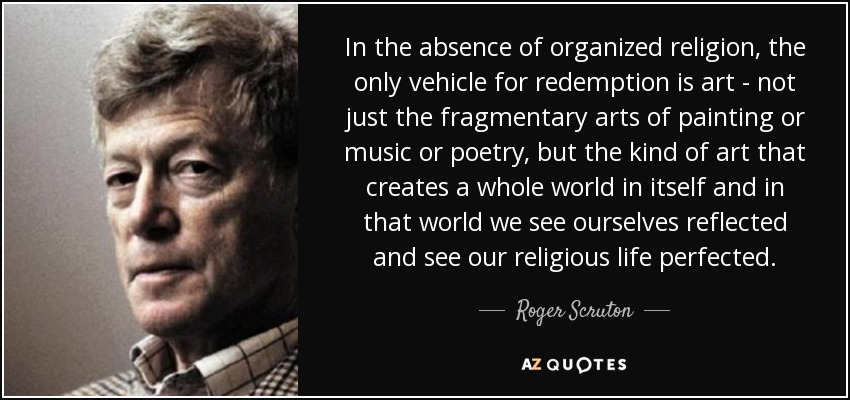
In the absence of organized religion, the only vehicle for redemption is art - not just the fragmentary arts of painting or music or poetry, but the kind of art that creates a whole world in itself and in that world we see ourselves reflected and see our religious life perfected.
The strengthening of faith, I think, is the ultimate goal of organized religion altogether.
When you say you don't get religion, you're just saying that you don't get organized religion.
Organized religion is in substance a mystification, a means of hiding the wickedness of the social system. If the Christian principles of love, equality, and freedom were really practiced instead of only preached, there would be no need for a special institution(the church) to take care of those principles.
To keep the middle coming back, you can't say some radically conservative or radically progressive things. That's been the bane of organized religion. It makes me wonder if Jesus' first definition of the church as "two or three gathered in my name" is not still the best way.
I have no faith in much organized religion because I think it's by a bunch of hypocrites and practiced by a bunch of hypocrites. They don't mean what they say because all of them are in the slave trade one way or the other.
I don't follow any organized religion, but I do believe in the idea of god as a verb - being love and light. And that we are part of everything as everything is part of us.
The three religions because I wanted to discuss faith, not organized religion, so wanted to relativize organized religion by having Pi practice three. I would have like PI to be a Jew, too, to practice Judaism, but there are two religions that are explicitly incompatible: Christianity and Judaism. Where one begins, the other ends, according to Christians, and where one endures, the other strays, according to Jews.
I believe that organized religion is an ornament to the truth, and that aesthetics are part of its power.
I think I could make the case for any kind of organized religion, but I'm not an expert in those, so let me narrow my focus to talk about Christianity.
I don't attend any particular church now. I don't believe in denominations, nor do I believe in organized religion.
I don't believe in organized religion. I believe that people should try to connect with their own life force and let it lead them to do with their lives what they will find satisfying.
I'd say my religious life has shaped my worldview; my writing, I'd say too, is an extension of the pulpit...it reaches folks who don't care for organized religion in a different way.
I have to move away from organized religion. The toxic confusion and anger I was feeling in church had become too great.
I also don't have organized religion on Pern. I figured - since there were four holy wars going on at the time of writing - that religion was one problem Pern didn't need.
[To] me organized religion, the formalities and routines, [is] like being marched in formation to look at a sunset.
There's often a distressing disconnect between the good words we speak and the way we live our lives. In personal relations and politics, the mass media, the academy and organized religion, our good words tend to float away even as they leave our lips, ascending to an altitude where they neither reflect nor connect with the human condition. We long for words like love, truth, and justice to become flesh and dwell among us. But in our violent world, it's risky business to wrap our frail flesh around words like those, and we don't like the odds.
In my opinion, most organized religion does neither agentic service nor relational nurturance very well.
Some scholars have been arguing that a civilizational clash between organized religions is the next step in human history.
It's unlikely that the organized religions will get more sectarian... or is it? I am not at all sure.
Just in our lifetime our society has become looser and more private, it becomes extremely difficult to hold to any permanent commitment whatever, least of all to organized religion.
My biggest problem with organized religion is that God has been imagined as a human being with emotions. I feel if you let go of that, then it's possible to see God as a force, to connect to him or her spiritually.
You don't believe in organized religion, yet a major theme in so many of your works seems to be a quest for God.
... organized religion, in a dominating business society, can do only one of two things. It can either assure the communicant with uneasy bluster that God Himself likes money -- a theory which convinces nobody -- or it can give him an apologetic, halfhearted invitation to go out and get himself crucified.
So Marxism, Freudianism: any one of these things I think is an irrational cult. They're theology, so they're whatever you think of theology; I don't think much of it. In fact, in my view that's exactly the right analogy: notions like Marxism and Freudianism belong to the history of organized religion.
Follow AzQuotes on Facebook, Twitter and Google+. Every day we present the best quotes! Improve yourself, find your inspiration, share with friends
or simply: