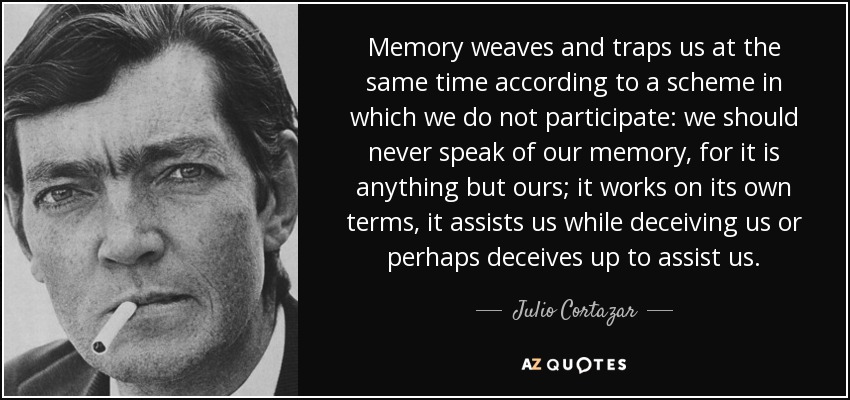
Memory weaves and traps us at the same time according to a scheme in which we do not participate: we should never speak of our memory, for it is anything but ours; it works on its own terms, it assists us while deceiving us or perhaps deceives up to assist us.
The names are the first things to go, after the breath has gone, and the beating of the heart. We keep our memories longer than our names.
Dates are convenient hooks on which we can hang our memories of events. But history is all about people - people like you and me who did things to change the world.
What are we after all our dreams, after all our memories?
Just as real events are forgotten, some that never were can be in our memories as if they happened.
All we have to believe with is our senses, the tools we use to perceive the world: our sight, our touch, our memory. If they lie to us, then nothing can be trusted. And even if we do not believe, then still we cannot travel in any other way than the road our senses show us; and we must walk that road to the end.
Of course, thanks to the house, a great many of our memories are housed, and if the house is a bit elaborate, if it has a cellar and a garret, nooks and corridors, our memories have refuges that are all the more clearly delineated. All our lives we come back to them in our daydreams. A psychoanalyst should, therefore, turn his attention to this simple localization of our memories. I should like to give the name of topoanalysis to this auxiliary of pyschoanalysis. Topoanalysis, then would be the systematic psychological study of the sites of our intimate lives.
By showing hunger, deprivation, starvation and brutality, as well as endurance and nobility, documentaries inform, prod our memories, even stir us to action. Such films do battle for our very soul.
Over the last few millennia we've invented a series of technologies - from the alphabet to the scroll to the codex, the printing press, photography, the computer, the smartphone - that have made it progressively easier and easier for us to externalize our memories, for us to essentially outsource this fundamental human capacity.
I cannot walk through the suburbs in the solitude of the night without thinking that the night pleases us because it suppresses idle details, just as our memory does.
I teach you that there is no other aim than to live with such totality that each moment becomes a celebration. The very idea of "aim" brings future into the mind, because any aim, any end, any goal, needs future. All your goals deprive you of your present, which is the only reality you have. The future is only your imagination, and the past is just footprints left in the sands of your memory. Neither is the past real anymore, nor is the future real yet. This moment is the only reality.
Pithy sentences are like sharp nails which force truth upon our memory.
We've outsourced our memories to digital devices, and the result is that we no longer trust our memories. We see every small forgotten thing as evidence that they're failing us.
'The Simpsons' from the very beginning was based on our memories of brash '60s sitcoms - you had a main title theme that was bombastic and grabbed your attention - and when you look at TV shows of the 1970s and '80s, things got very mild and toned down and... obsequious.
History ... may be regarded as an artificial extension and : broadening of our memories and may be used to overcome the natural bewilderment of all unfamiliar situations.
Did you ever think about all of the nights you lived through and can't remember The ones that were so mundane your brain just didn't bother to record them. Hundreds, maybe thousands of nights come and go without being preserved by our memory. Does that ever freak you out? Like maybe your mind recorded all of the wrong nights?
I cannot imagine how I will cope when I discover that my life is behind me, has already happened, and I have nothing to show for it. No treasure house of collection, no wealth of experience, no accumulated wisdom to pass on. What are we, if not an accumulation of our memories?
Every day I'll wear your memory like a favorite shirt upon my back
The moments of the past do not remain still; they retain in our memory the motion which drew them towards the future, towards a future which has itself become the past, and draw us on in their train.
How blazing and alive the past is. The color of the wallpaper in the bedroom you had as a girl. It's not so much that you've lost your memory, more like you're submerged in it, like you're living in the brightly vivid underwater world of the past.
Live as long as you may, the first twenty years are the longest half of your life. They appear so while they are passing; they seem to have been so when we look back on them; and they take up more room in our memory than all the years that succeed them.
To be successful we must live from our imaginations, not from our memories.
Database: the information you lose when your memory crashes.
We've left the moment. It's gone. We're somewhere else now, and that's okay. We've still got that moment with us somewhere, deep in our memory, seeping into our DNA. And when our cells get scattered , whenever that happens, this moment will still exist in them. Those cells might be the biulding block of something new. A planet or star or a sunflower, a baby. Maybe even a cockroach. Who knows? Whatever it is, it'll be a part of us, this thing right here and now, and we'll be a part of it.
Our lives are the sum of our memories. How much are we willing to lose from our already short lives by … not paying attention?
Follow AzQuotes on Facebook, Twitter and Google+. Every day we present the best quotes! Improve yourself, find your inspiration, share with friends
or simply: