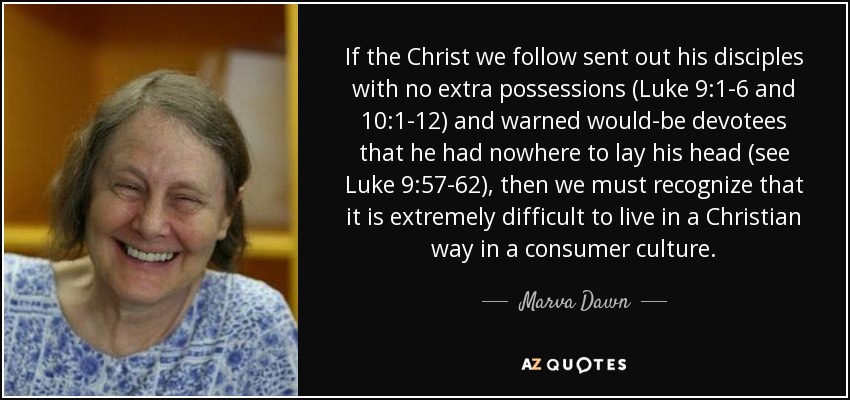
If the Christ we follow sent out his disciples with no extra possessions (Luke 9:1-6 and 10:1-12) and warned would-be devotees that he had nowhere to lay his head (see Luke 9:57-62), then we must recognize that it is extremely difficult to live in a Christian way in a consumer culture.
New pressures are causing ever more people to find their main satisfaction in their consumptive role rather than in their productive role. And these pressures are bringing forward such traits as pleasure-mindedness, self-indulgence, materialism, and passivity as conspicuous elements of the American character.
The contemporary tendency in our society is to base our distribution on scarcity, which has vanished, and to compress our abundance into the overfed mouths of the middle and upper classes until they gag with superfluity. If democracy is to have breadth of meaning, it is necessary to adjust this inequity. It is not only moral, but it is also intelligent. We are wasting and degrading human life by clinging to archaic thinking.
The cultural propaganda embodied in two liquor advertisements, "Living well is the best revenge" and "Sip it with arrogance," have a curious, perhaps demonic appeal. Consumerism indeed has its own spirituality.
The gospel preached during every television show is 'You only go around once in life, so get all the gusto you can.' It is a statement about theology; it is a statement about beer. It's lousy beer and even worse theology.
The hopes of the Republic cannot forever tolerate either undeserved poverty or self-serving wealth.
The horseman serves the horse, The neat-herd serves the neat, The merchant serves the purse, The eater serves his meat; 'Tis the day of the chattel, Web to weave, and corn to grind, Things are in the saddle, And ride mankind.
The most outstanding characteristic of Eastern civilization is to know contentment, whereas that of Western civilization is not to know contentment. Contented Easterners are satisfied with their simple life and therefore do not seek to increase their material enjoyment... They are satisfied with their present lot and environment and therefore do not want to conquer nature but merely be at home with nature and at peace with their lot.
The possessions God allows us to have are intended for our use, not our enjoyment. Trying to squeeze something out of them that was never in them in the first place is a futile endeavor. A cow's udders, gently pressed, will yield sweet milk, nourishing and refreshing. Applying more and more pressure will not produce greater quantities of milk. We lose the good of material things by expecting too much from them. Those who try hardest to please themselves with earthly goods find the least satisfaction in them.
The surplus of society overrides all our traditions and shapes all our philosophies.
There are not enough rich and powerful people to consume the whole world; for that, the rich and powerful need the help of countless ordinary people.
There is, indeed, a most dangerous passage in the history of a democratic people. When the taste for physical gratifications among them has grown more rapidly than their education and their experience of free institutions, the time will come when men are carried away and lose all self-restraint at the sight of new possessions they are about to obtain. In their intense and exclusive anxiety to make a fortune they lose sight of the close connection that exists between the private fortune of each and the prosperity of all.
Thinking to get at once all the gold the goose could give, he killed it and opened it only to find-nothing.
This drive to always want more is based on the misconceptions that having more will make me more happy, more important, and more secure, but all three ideas are untrue. Possessions only provide temporary happiness. Because things do not change, we eventually become bored with them and then want newer, bigger, better versions.
I want a change, and a radical change. I want a change from an acquisitive society to a functional society, from a society of go-getters to a society of go-givers.
Let us be bold enough to ask ourselves as Christians whether the Church of the Lord Jesus in the United States has anything to say to our nation and its ideologies of materialism, possessiveness, and the worship of financial security. Are we courageous enough to be a sign of contradiction to consumerism through our living faith in Jesus Christ? Are we committed enough to his gospel to become a countercurrent to the drift?
Democracy encourages a taste for physical gratification; this taste, if it becomes excessive, soon disposes men to believe that all is matter only; and materialism, in its turn, hurries them on with mad impatience to these same delights; such is the fatal circle within which democratic nations are driven round. It were well that they should see the danger and hold back.
The sense that materialism has gotten out of hand is magnified by the pressures facing middle-class American families.
It was only in the late nineteenth century and then the twentieth century, with the maturation of consumer capitalism, that a shift was made toward the cultivation of unbounded desire. We must appreciate this to realize that late modern consumption, consumption as we now know it, is not fundamentally about materialism or the consumption of physical goods. Affluence and consumer-oriented capitalism have moved us well beyond the undeniable efficiencies and benefits of refrigeration and indoor plumbing.
All left-wing parties in the highly industrialized countries are at bottom a sham, because they make it their business to fight against something which they do not really wish to destroy. They have internationalist aims, and at the same time they struggle to keep up a standard of life with which those aims are incompatible. We all live by robbing Asiatic coolies, and those of us who are 'enlightened' all maintain that those coolies ought to be set free; but our standard of living, and hence our 'enlightenment,' demands that the robbery shall continue.
Can we reasonably expect happiness from an insatiable appetite which, no matter how it stuffs its belly, is still psychologically like Oliver Twist in the poorhouse, holding up an empty bowl and begging, "I want some more"? Isn't it possible that our dream of the good society contained, from the beginning, a hidden violation of the Tenth Commandment "Thou shalt not covet thy neighbor's goods"?
Consumer sales depend on the habits and behaviors of consumers, and those who manipulate consumer markets cannot but address behavior and attitude. That is presumably the object of the multibillion-dollar global advertising industry. Tea drinkers are improbable prospects for Coke sales.
Likewise, the world of action, of politics, is reduced to a conflict of views about how to keep the cycle of production and consumption going. Questions of ultimate purpose are excluded from the public world.
When I lost my faith in people I put my trust in things To avoid the disappointment Trusting people brings... I tried to do it all myself then Surrounded by my stuff All I found were limitations I could not rise above There are gadgets and contraptions Immaculate machines There's a program you can download now That will even dream your dreams It'll even dream you dreams For a monthly fee Clear up your complexion You get a hundred hours free Possessions cannot save you.
Based on technological research and the transformation of nature, industrialization constantly goes forward, giving proof of incessant creativity. While certain enterprises develop and are concentrated, others die or change their location. Thus new social problems are created: professional or regional unemployment, redeployment and mobility of persons, permanent adaptation of workers and disparity of conditions in the different branches of industry.
Follow AzQuotes on Facebook, Twitter and Google+. Every day we present the best quotes! Improve yourself, find your inspiration, share with friends
or simply: