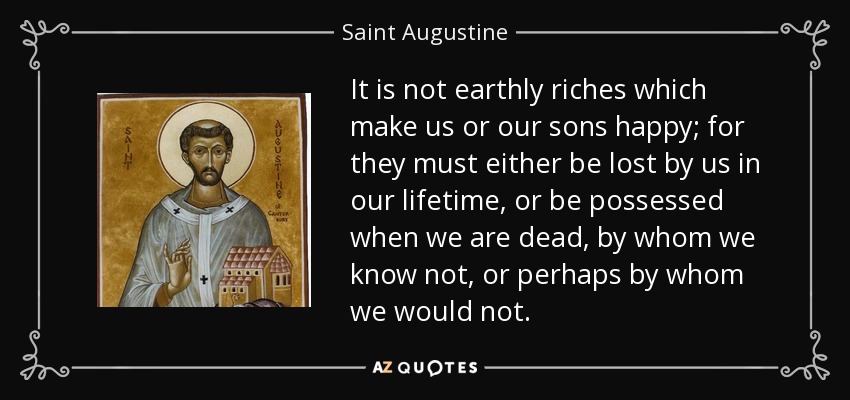
It is not earthly riches which make us or our sons happy; for they must either be lost by us in our lifetime, or be possessed when we are dead, by whom we know not, or perhaps by whom we would not.
It is partly to avoid consciousness of greed that we prefer to associate with those who are at least as greedy as we ourselves. Those who consume much less are a reproach.
Many Christians, though keenly sensitive to the dangers of greed and discontent that come with an economy of continually increasing consumption, nevertheless feel that it is worth risking if only it can end man's physical miseries. The trouble is that it can't. In a finite world, continually increasing consumption is just not possible.
Our present culture, however, specializes in inflaming endless lust for possessions with advertisements that constantly convince us that we need more (particularly to create the ease we have never found). The marketers don't tell us much about their products, but they spend a great deal of energy (and enormous amounts of money) appealing to our fears and dreams. Thus, the idolatry of possessions plays to the deeper idolatry of our selves-and in an endlessly consuming society, persons are always remaking themselves with new belongings.
We are being made aware that the organization of society on the principle of private profit, as well as public destruction, is leading both to the deformation of humanity by unregulated industrialism, and to the exhaustion of natural resources, and that a good deal of our material progress is a progress for which succeeding generations may have to pay dearly.
The future depends more upon our choice of institutions which support a life of action than on our developing new ideologies and technologies.
When the poor farmer of India is unable to buy a gallon of gasoline to run his simple water pump because the world's demand has priced him out of the market, who is to blame?
What does a man need - really need? A few pounds of food each day, heat and shelter, six feet to lie down in - and some form of working activity that will yield a sense of accomplishment. That's all - in the material sense, and we know it. But we are brainwashed by our economic system until we end up in a tomb beneath a pyramid of time payments, mortgages, preposterous gadgetry, playthings that divert our attention from the sheer idiocy of the charade. The years thunder by.
I understand that it's the music that keeps me alive... That's my lifeblood. And to give that up for, like, the TV, the cars, the houses - that's not the American dream. That's the booby prize, in the end. Those are the booby prizes. And if you fall for them - if, when you achieve them, you believe that this is the end in and of itself - then you've been suckered in. Because those are the consolation prizes, if you're not careful, for selling yourself out, or letting the best of yourself slip away.
Everyone should educate themselves in more wise and responsible consumption; promote personal responsibility, along with the social dimension of rural activities, which are based on perennial values, such as hospitality, solidarity, and the sharing of the toil of labor.
The danger, then, is that materialism is not only shaping how we live but the way we think as well. It influences our consumer tastes and our preference for high-paying jobs, but it also alters our capacity to pray, the nature of our prayers, and the ways in which religious tutelage instructs our values.
Commercial conquest is far more thorough and final than military defeat.
The goals of development are always and everywhere stated in terms of consumer value packages standardized around the North Atlantic-and therefore always and everywhere imply more privileges for a few... Underdevelopment is the result of a state of mind common to both socialist and capitalist countries. Present development goals are neither desirable nor reasonable. Unfortunately antiimperialism is no antidote.
The illusion that consumption - and its correlative, income - is desirable probably stems from too great preoccupation with what Knight calls "one-use goods," such as food and fuel, where the utilization and consumption of the good are tightly bound together in a single act or event. ... any economy in the consumption of fuel that enables us to maintain warmth or to generate power with lessened consumption again leaves us better off. ... there is no great value in consumption itself.
We did not choose to believe that personal choice is the highest human virtue. Rather, we were taught, formed, forced to believe nothing is important in life other than that which we have personally chosen. The irony is that the belief that nothing is important in life other than that which we have personally chosen is a belief that we have not personally chosen! The supermarket and shopping mall have been our school.
We had learned how to invent things, and the question of why we invent things receded in importance. The idea that if something could be done it should be done was born in the nineteenth century. And along with it, there developed a profound belief in all the principles through which invention succeeds: objectivity, efficiency, expertise, standardization, measurement, and progress. It also came to be believed that the engine of technological progress worked most efficiently when people are conceived of not as children of God or even as citizens but as consumers-that is to say, as markets.
We must surely appear to the world as exactly what we are: a nation that organizes its economy around consuming twice as much oil as it produces, and around the profligate wastefulness of the wars and campaigns required to defend such consumption. In recent years we have defined our national interest largely in terms of the oil fields and pipelines we need to procure fuel.
We, all of us in the First World, have participated in something of a binge, a half century of unbelievable prosperity and ease. We may have had some intuition that it was a binge and the earth couldn't support it, but aside from the easy things (biodegradable detergent, slightly smaller cars) we didn't do much. We didn't turn our lives around to prevent it. Our sadness is almost an aesthetic response - appropriate because we have marred a great, mad, profligate work of art, taken a hammer to the most perfectly proportioned of sculptures.
These are the true and only God, mighty and supreme.
It would appear that the traditional parliamentary democracies can offer no fundamental opposition to that automatism of technological civilization and the industrial-consumer society, for they too are being dragged helplessly along by it. People are manipulated in ways that are infinitely more subtle and refined than the brutal methods used in post-totalitarian societies.
McWorld is a product of popular culture driven by expansionist commerce. Its template is American, its form style. Its goods are as much images as matériel, an aesthetic as well as a product line. It is about culture as commodity, apparel as ideology. Its symbols are Harley-Davidson motorcycles and Cadillac motorcars hoisted from the roadways, where they once represented a mode of transportation, to the marquees of global market cafés like Harley-Davidson's and the Hard Rock where they become icons of lifestyle.
Most persons think that a state in order to be happy ought to be large; but even if they are right, they have no idea of what is a large and what a small state.... To the size of states there is a limit, as there is to other things, plants, animals, implements; for none of these retain their natural power when they are too large or too small, but they either wholly lose their nature, or are spoiled.
The idea that the profits of capital are really the rewards of a just society for the foresight and thrift of those who sacrificed the immediate pleasures of spending in order that society might have productive capital, had a certain validity in the early days of capitalism, when productive enterprise was frequently initiated through capital saved out of modest incomes.
Nobody who gets enough food and clothing in a world where most are hungry and cold has any business to talk about 'misery.'
O America, how you've taken necessities from the masses to give luxuries to the classes.
Follow AzQuotes on Facebook, Twitter and Google+. Every day we present the best quotes! Improve yourself, find your inspiration, share with friends
or simply: