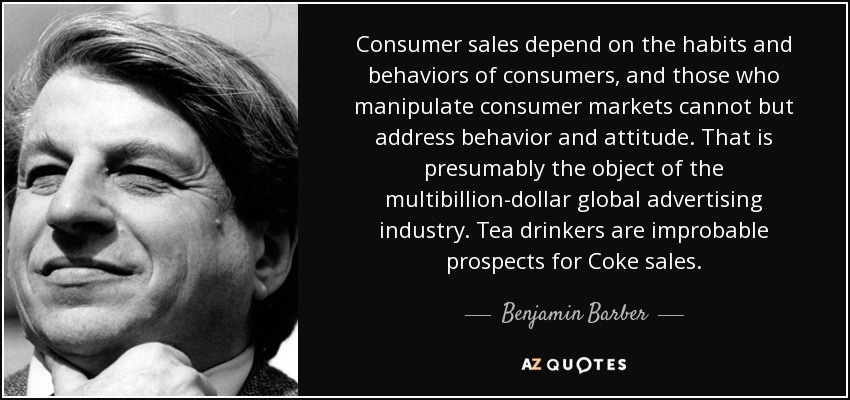
Consumer sales depend on the habits and behaviors of consumers, and those who manipulate consumer markets cannot but address behavior and attitude. That is presumably the object of the multibillion-dollar global advertising industry. Tea drinkers are improbable prospects for Coke sales.
Likewise, the world of action, of politics, is reduced to a conflict of views about how to keep the cycle of production and consumption going. Questions of ultimate purpose are excluded from the public world.
When I lost my faith in people I put my trust in things To avoid the disappointment Trusting people brings... I tried to do it all myself then Surrounded by my stuff All I found were limitations I could not rise above There are gadgets and contraptions Immaculate machines There's a program you can download now That will even dream your dreams It'll even dream you dreams For a monthly fee Clear up your complexion You get a hundred hours free Possessions cannot save you.
Based on technological research and the transformation of nature, industrialization constantly goes forward, giving proof of incessant creativity. While certain enterprises develop and are concentrated, others die or change their location. Thus new social problems are created: professional or regional unemployment, redeployment and mobility of persons, permanent adaptation of workers and disparity of conditions in the different branches of industry.
Before our eyes we have the results of ideologies such as Marxism, Nazism and fascism, and also of myths like racial superiority, nationalism and ethnic exclusivism. No less pernicious, though not always as obvious, are the effects of materialistic consumerism, in which the exaltation of the individual and the selfish satisfaction of personal aspirations become the ultimate goal of life. In this outlook, the negative effects on others are considered completely irrelevant.
The religion and the environmentalism of the highly industrialized countries are at bottom a sham, because they make it their business to fight against something that they do not really wish to destroy. We all live by robbing nature, but our standard of living demands that the robbery shall continue. We must achieve the character and acquire the skills to live much poorer than we do.
The sense that materialism has gotten out of hand is magnified by the pressures facing middle-class American families.
Their property held them in chains...chains which shackled their courage and choked their faith and hampered their judgment and throttled their soul...If they stored up their treasure in heaven, they would not now have an enemy and a thief within their own household...They think of themselves as owners, whereas it is they rather who are owned: enslaved as they are to their own property, they are not the masters of their money but its slaves.
We can be content with simplicity because the deepest most satisfying delights God gives us through creation are free gifts from nature and from loving relationships with people. After your basic needs are met, accumulated money begins to diminish your capacity for these pleasures rather than increase them. Buying things contributes absolutely nothing to the heart's capacity for joy.
What worries some people about consumption (and I confess at the outset to be one of these ambivalent creatures, fat but troubled in paradise) is that the affluent, technologically advanced West seems more and more focused not on consuming to live but living to consume. The problem with consumption, and the consumer capitalism that has pushed it to feverish historical extremes, is that it has become so all-consuming.
It was only in the late nineteenth century and then the twentieth century, with the maturation of consumer capitalism, that a shift was made toward the cultivation of unbounded desire. We must appreciate this to realize that late modern consumption, consumption as we now know it, is not fundamentally about materialism or the consumption of physical goods. Affluence and consumer-oriented capitalism have moved us well beyond the undeniable efficiencies and benefits of refrigeration and indoor plumbing.
Sufficient for the day is all that we can enjoy. We cannot eat or drink or wear more than the day's supply of food and raiment; the surplus gives us the care of storing it, and the anxiety of watching against a thief. One staff aids a traveller, but a bundle of staves is a heavy burden. Enough is not only as good as a feast, but is all that the greatest glutton can truly enjoy. This is all that we should expect; a craving for more than this is ungrateful. When our Father does not give us more, we should be content with his daily allowance.
It is more blessed to give than to receive, but then it is also more blessed to be able to do without than to have to have.
Every man is rich or poor according to the proportion between his desires and his enjoyments.
Our desires always increase with our possessions. The knowledge that something remains yet unenjoyed impairs our enjoyment of the good before us.
Living well is the best revenge.
Human beings are themselves considered consumer goods to be used and then discarded. We have created a 'disposable' culture which is now spreading. It is no longer simply about exploitation and oppression, but something new.
...the tragedy of consumerism: one acquires more and more things without taking the time to ever see and know them, and thus one never truly enjoys them. One has without truly having. The consumer is right-there is pleasure to be had in good things, a sacred and almost unspeakable pleasure, but the consumer wrongly thinks that one finds this pleasure by having more and more possessions instead of possessing them more truly through grateful contemplation. And here we are, living in an economy that perpetuates this tragedy.
We have created new idols. The worship of the ancient golden calf (cf. Ex 32:1-35) has returned in a new and ruthless guise in the idolatry of money and the dictatorship of an impersonal economy lacking a truly human purpose. The worldwide crisis affecting finance and the economy lays bare their imbalances and, above all, their lack of real concern for human beings; man is reduced to one of his needs alone: consumption.
The man who dies rich, dies disgraced.
Follow AzQuotes on Facebook, Twitter and Google+. Every day we present the best quotes! Improve yourself, find your inspiration, share with friends
or simply: