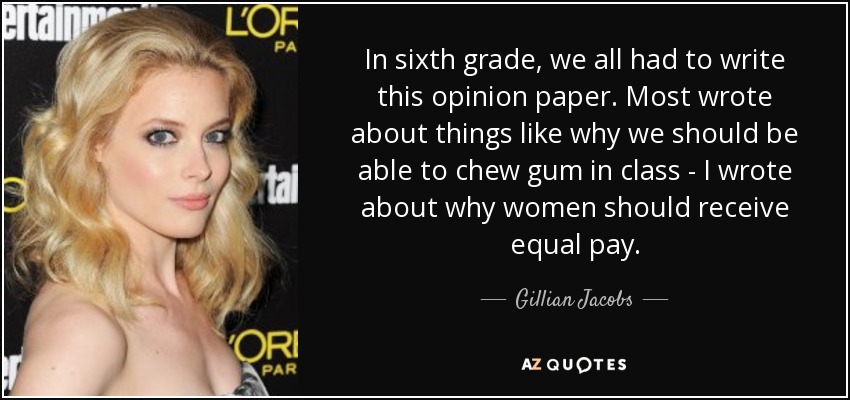
In sixth grade, we all had to write this opinion paper. Most wrote about things like why we should be able to chew gum in class - I wrote about why women should receive equal pay.
Experience taught me to listen to your gut, no matter how good something sounds on paper.
I have a tendency, more than most other physicists, to try to figure out everything all at once, before I publish. And even to try to figure out everything in my head, without pencil and paper.
Thought engenders thought. Place one idea on paper, another will follow it, and still another, until you have written a page; you cannot fathom your mind. There is a well of thought which has no bottom; the more you draw from it, the more clear and fruitful it will be.
Sometimes, when I play music, I feel as if I am giving life. ... It isn't just notes on the paper anymore: you are recreating the thought, transmitting it. It becomes shareable, but it can never be kept. You go through and at the same time you let go of the experience. That is part of the wonder of music: it can never be kept; it is ephemeral and at the same time enduring.
To describe women, the pen should be dipped in the humid colors of the rainbow, and the paper dried with the dust gathered from the wings of a butterfly.
Sometimes, the best songs are the ones you write without any pen and paper or audio recording device or guitar in your hands. Because there's nothing between you and the melody; it's just a great lyric.
I think you can perform any poem. But what I believe is that the best examples of spoken word poetry I've ever seen, are spoken word poems that, when you see them, you're aware of the fact they need to be performed. That there's something about that poem that you would not be able to understand if you were just reading it on a piece of paper.
Breakfast is the one meal at which it is permissible to read the paper.
all through my childhood, my father kept from me the knowledge that the daily papers printed daily box scores, allowing me to believe that without my personal renderings of all those games he missed while he was at work, he would be unable to follow our team in the only proper way a team should be followed, day by day, inning by inning. In other words, without me, his love for baseball would be forever incomplete.
Our correspondences have wings - paper birds that fly from my house to yours - flocks of ideas crisscrossing the country. Once opened, a connection is made. We are not alone in the world.
But a piece of paper can be a powerful presence. I have always had enormous respect for the written word and invariably find a letter more revealing than a face-to-face conversation. In a strange way I suspect I will get to know you better at a distance than I would if you had stayed at home.
Of all the art forms, poetry is the most economical. It is the one which is the most secret, which requires the least physical labor, the least material, and the one which can be done between shifts, in the hospital pantry, on the subway, and on scraps of surplus paper. ... poetry has been the major voice of poor, working class, and Colored women. A room of one's own may be a necessity for writing prose, but so are reams of paper, a typewriter, and plenty of time.
A children's writer should, ideally, be a dedicated semi-lunatic, a kind of poet with a marvelous idea, who, preferably, when not committing the marvellous idea to paper, does something else of a quite different kind, so as to acquire new and rich experience.
With a pencil and paper, I could revise the world.
The only reason to buy a paper book any longer is to own it and cherish it and remember it and tell a story about it.
I suppose you know where this country would be, where the world would be, if everyone who got depressed by the papers stopped reading them.
when ... I've thought of madness, it seems most easily explained to me as poetry in action. A life of symbol rather than reality. On paper one can understand Gulliver, or Kafka, or Dante. But let a man go about behaving as if he were a giant or a midget, or caught in a cosmic plot directed at himself, or in heaven or hell, and we feel horror - we want to disavow him to proclaim him as far removed as possible from ourselves.
Letterwriting is the natural outlet of the "odds." The busy-bodies, the idle, the perverted, the cranks, the feel-it-my-duties ... Also the plain depraved. They all write letters. It's their safe outlet, you see. They can be as interfering, as long-winded, as obscene, as pompous, as one-idea'd, as they like on paper, and no one can kick them for it. So they write. My God, how they write!
Two, let's all stop smoking blunts; let's smoke out of papers. Ladies, you all should just love me. Let's all have a beautiful year, let's get this money.
And I think about my cell at the Pawiak prison. During the first week I felt I would not be able to endure a day without a book, without the circle of light under the parafin lamp in the evening, without a sheet of paper, without you. . . .
The temptation is not here, where you are reading about it or praying about it. It is down in your shop, among bales and boxes, ten-penny nails, and sand-paper.
So the only environment the artist needs is whatever peace, whatever solitude, and whatever pleasure he can get at not too high a cost. All the wrong environment will do is run his blood pressure up; he will spend more time being frustrated or outraged. My own experience has been that the tools I need for my trade are paper, tobacco, food, and a little whiskey.
Money, after all, is an abstract artifact, like language - merely symbolized by the paper or coin or whatever. If you can fully grasp its abstractedness, especially in the computer age, it becomes quite clear that no group can monopolize this abstraction, except through a series of swindle. If the usurers had been bolder, they might have monopolized language as well as currency, and people would be saying we can't write more books because we don't have enough words, the way they now say we can't build starships, because we don't have enough money.
My father urged Alan [Lomax] not to repeat the mistakes of the European folklorists who, a century ago, had collected these peasant songs and then arranged them for part choir and accompanied them on piano, and then told the young people of their country, "Don't change a note, this is our sacred heritage." Father said, whether it's a fiddle tune or a gospel song, learn it right off the record from the people who grew up with it. Don't just learn it from a piece of paper.
Follow AzQuotes on Facebook, Twitter and Google+. Every day we present the best quotes! Improve yourself, find your inspiration, share with friends
or simply: