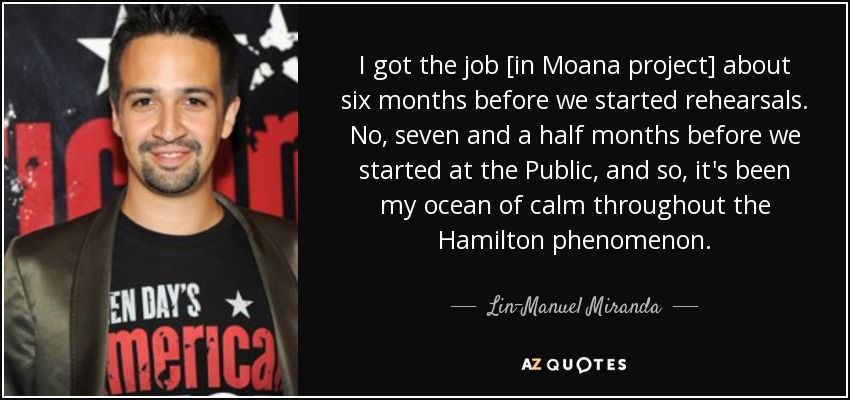
I got the job [in Moana project] about six months before we started rehearsals. No, seven and a half months before we started at the Public, and so, it's been my ocean of calm throughout the Hamilton phenomenon.
I noticed you could monitor the recording that you're making, but you could also monitor the playback head. There's a little distance between them and so you get an echo, right? If you change the amplitude of, say, the playback and play with that, you get different qualities and different sounds. So I was very interested in that phenomenon.
The phenomenon of HIV criminalization is so much more massive than people understand.
We have to accept that some very toxic stuff was marbled into the Trump phenomenon.
I mean, in 1979 I was seven. I do remember punk, though, as a playground phenomenon, and remember that it was exciting to us. It really was, to a five- or six-year-old, quite a thrilling enticement to revolt. The anarchy sign scratched in desk tops, and so on.
The frightening aspect is that it's part of a larger effort from the Pentagon to tear down the wall between public affairs and propaganda, and essentially say there is no difference between information operations, public affairs and psychological operations. They have a new name for that too, it's called Information Engagement. What I hope people take away from this is that it's a window into a larger phenomenon. After a decade of Iraq war you have this Pentagon-military apparatus run amok using resources that they shouldn't be to try to manipulate U.S. public opinion.
Since the industrial revolution, cities, and especially the inner cities, were the places for the newly arrived. Voluntary immigrants seeking economic betterment, refugees, the bohemians, the artists - all of those people were crammed into densely populated neighborhoods and tenements. And as people climbed up the economic ladder they moved out, which really accelerated with the "white flight" phenomenon in the '60s and '70s.
First and foremost, I'm a journalist. My business is the truth. Now, I happen to be other things, too - a pop-culture phenomenon, the most in-demand speaker on the campus lecture circuit, whatever.
As for organs, traits, etc., being "for" something, the notion may be a useful shorthand, but shouldn't be taken too seriously, if only because of the ubiquitous phenomenon of exaptation.
I wrote an op-ed piece in The New York Times about the amazing effect of shared wonder - how I have an audience filled with people who you'd think would hate each other, people from every religious category, all at the same show at the same time. And it's an amazing phenomenon to watch this shared sense of wonder, where these people who really don't like each other - for good and bad reasons, reasons that make sense and that don't make sense - are in the same room, experiencing this unification.
In a way, everybody is wounded from the wound of the real. This phenomenon is similar to madness. The mad person is wounded by his or her distorted relationship to the real.
Reductionist ideology not only hinders biologists from thinking adequately about the phenomena we wish to understand: it has two important social consequences: it serves to relocate social problems to the individual rather than exploring the societal roots and determinants of a phenomenon; and second, it diverts attention and funding from the social to the molecular.
In real life, there are right-wingers, there are anti-immigrant activists who want to overturn this constitutional right that we have to become Americans when we're born in this country. There's lots of people who believe that this has led to the phenomenon of the anchor babies. I am an anchor baby. My parents were able to receive their residency and citizenship because, I, a U.S. citizen child of theirs, was born in Los Angeles.
I am a child of the Enlightenment. I think irrational belief is a dangerous phenomenon, and I try to consciously avoid irrational belief. On the other hand, I certainly recognize that it's a major phenomenon for people in general, and you can understand why it would be. It does, apparently, provide personal sustenance, but also bonds of association and solidarity and a means for expressing elements of one's personality that are often very valuable elements. To many people it does that. In my view, there's nothing wrong with that.
I feel like Americans have always studied nationalism as a foreign phenomenon. And now, we`ve got a nationalist movement in our country that has a very articulate spokesman in the senior counselor to the president [Donald Trump].
No vegetarian has been able to achieve a single Nobel prize. It is a clear-cut condemnation of vegetarianism. Why do all the Nobel prizes go to non-vegetarians? - because vegetarian food does not contain those proteins which create intelligence. And unless we provide those proteins, intelligence cannot grow. The body is a very delicate phenomenon and it needs a very well balanced diet.
I think art is the development of this interface between mind and matter, between mind and phenomenon, between what's inside of us and what's happening outside of us. It developed over the course of the last 35,000 years. We made a lot of improvements because it not only gave us the tools to understand the world better, but it also gave us better and better tools to do it. It's that continuous relationship: technology and discernment.
Writers in the nineteenth century - people like George Eliot and Flaubert - were accustomed to addressing particular communities with which they shared not only linguistic meanings but also an experience and history. Those communities have progressively split in the twentieth century, and grown more heterogeneous, and writers emerging from minority communities have found themselves addressing audiences closer to their experience and history - a phenomenon derided by conservative white men as identity politics and multiculturalism in the arts.
People now have their own particular religion - a denomination of one. I suppose it's a part of the new age phenomenon, but it's much wider than that. On the whole, I would say that is healthy. But I think it was always there, secretly.
I would have gone right ahead but the only thing, the only phenomenon that's going on now of course, which is different in my experiences, is that you are getting things planted in the Net by people about the Woman in White on the Net. That's not a nice change.
You can't just live in phenomenon and not research it.
There's still massive racism in the United States today that is rooted in sexual fears, but it's at least considered unacceptable. In Israel it's a mainstream phenomenon that's encouraged and supported by the state because it supports Israel's demographic imperative in its ethnocratic political structure.
"Externality" is a different phenomenon from akrasia and doesn't always come with it. The set of desires and actions from which one feels alienated isn't always the same as the set of desires and actions of which one disapproves. It has been pointed out that you can disapprove of something inside yourself but still experience it as yours ("damn it, here I go again!"). In addition, you can approve of something inside yourself but feel like it's not yours ("when the emergency sirens went off, it was as if someone calmer and more reasonable took over and knew just what to do").
We're seeing the sort of liberal phenomenon of activists that are speaking out. And they have every right to do so. I think we need to respect that in this country. It's just part of the democratic process.
Donald Trump is a phenomenon that foreign countries haven't seen.
Follow AzQuotes on Facebook, Twitter and Google+. Every day we present the best quotes! Improve yourself, find your inspiration, share with friends
or simply: